From Kibbutz to the global stage
Saudi Crown Prince MBS in Washington — A US Model for Gaza and the Middle East
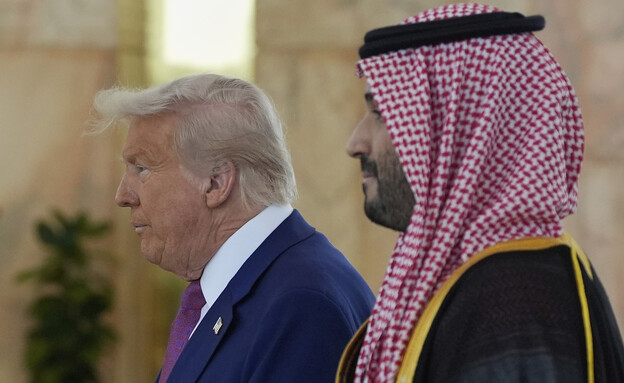
Photo: Saudi Crown Prince Mohammed bin Salman and US President Donald Trump, May 2025 | AP
Saudi Crown Prince MBS in Washington — A New US Model for Gaza and the Middle East.
On Tuesday, November 18, Saudi Crown Prince Mohammed bin Salman will arrive in Washington. This is not a routine diplomatic visit. It may mark the beginning of a reshaped regional architecture.
Over recent weeks, a series of signals from Washington and the Gulf suggest that the United States may be preparing a new framework for Gaza’s reconstruction — one based on a division of influence and responsibilities between two zones:
1. The Northwest (Gaza City and the northern corridor) – under civilian–economic influence of Turkey and Qatar, aligned with the areas where Hamas’s political leadership historically operated.
2. The Southeast (Rafah–Khan Yunis region) – under a Saudi-US reconstruction umbrella, aligned with Israel’s demand for tight security oversight.
This model does not rely on any official declaration. It emerges from a combination of diplomatic hints and a reading of the power dynamics behind the quiet talks between Washington, Riyadh, Jerusalem, Ankara, and Doha.
If adopted, such a framework would allow each actor to secure its strategic goals:
• Saudi Arabia – a new regional foothold;
• Turkey & Qatar – continuity of influence in the north;
• Israel – controlled reconstruction in the south;
• The US – a stable structure ahead of broader political discussions.
This practical division fits into a broader American effort: bringing Saudi Arabia into an expanded “Abraham Framework” — not as formal peace with Israel, but as an economic-strategic partner in a region shaped by US leadership.
What the Americans Want from the Visit
The visit is scheduled for November 18.
President Trump and Vice President JD Vance seek to present a major strategic step in the Middle East. The recent announcement regarding Kazakhstan was the opening act; Saudi Arabia is expected to be the main chapter.
The central American objective: creating an intermediate framework that allows Saudi Arabia to join the regional system without declaring normalization or confronting the Arab consensus on the Palestinian issue.
What Is Expected to Be Announced in Washington?
1. Saudi Arabia joining IMEC (India–Middle East–Europe Corridor)
A strategic corridor that includes:
• A land-bridge through Jordan and Israel
• Rail connections, ports, and energy infrastructure
• Industrial integration between India, the Gulf, and Europe
Israel will likely be defined as a Transit Partner only — not a political party.
2. A Saudi–US Security and Scientific Track
• A new regional innovation hub (Riyadh or Dubai) led by the US
• Israeli technological participation via the American track
• A “soft defense umbrella” for Saudi Arabia
• Possibility: opening the door for F-35 acquisition
3. A Broad Declaration of Principles
Not a peace agreement, but:
Strategic Economic and Security Framework
under the Abraham Initiative
Expected components:
A. Economic cooperation
B. Regional stability
C. A shared vision for the coming decade
No mention of Jerusalem, statehood, or formal normalization.
Regional Implications — Who Gains What?
Saudi Arabia:
• Strategic partnership with the US
• Access to advanced American technologies.
• Acceleration of “Saudi Vision 2030”.
• Stronger position vis-à-vis Iran.
• Lead role in southern Gaza reconstruction.
Israel:
• Controlled rebuilding of southern Gaza.
• Guaranteed land-bridge route.
• Indirect cooperation with Riyadh.
• Entry into a more stable regional economic framework
Turkey & Qatar:
• Continued influence in northern Gaza.
• Ability to participate in reconstruction without political friction with Israel.
• Strengthening their civilian-administrative role in the north.
The United States:
• Re-shaping the Middle East.
• Stability ahead of political negotiations.
• A strategic milestone before the MBS visit.
• A balancing architecture among Saudi Arabia, Qatar, and Turkey.
The Arab World:
• A future political horizon.
• Faster economic reconstruction.
• A mechanism that does not require full regional consensus.
The Larger Logic: An Expanded Abraham Framework:
Washington understands that Saudi Arabia will not sign a formal peace agreement with Israel before progress on the Palestinian issue. Therefore, it now builds a two-level structure:
Level 1 – States with formal peace with Israel:
UAE, Bahrain, Morocco
Level 2 – States in a regional economic framework without diplomatic relations:
Saudi Arabia, Kuwait, Indonesia, Turkey, Qatar, Pakistan, Malaysia, Lebanon, Syria
In other words:
A country can join the system without recognizing Israel.
Turkey as a Natural Candidate for the Northern Gaza Model:
Despite tensions with Israel:
• Turkey now integrates deeply with Gulf economic initiatives.
• Its involvement in Gaza is significant.
• Ankara seeks a role in reconstruction, especially in the north.
This framework allows it to participate without political concessions.
The Weak Points: India and Pakistan
India:
• Strained ties with the US.
• Deep strategic links with Russia.
• Renewed warming with China
• Cooperation with China after easing import restrictions.
• Interest in space and deep-space exploration following the 3I/ATLAS debate.
India is not rushing into US-led trade systems without settling open disputes.
Pakistan:
• New security agreement with Saudi Arabia
• Sensitive positioning vis-à-vis India.
• Renewed US–Pakistan engagement.
Egypt–Qatar–Turkey Dynamic:
• Major Qatar-Egypt tourism project on the northern coast.
• Re-design of reconstruction roles.
• Saudi Arabia does not want a full. “Qatar–Turkey axis” dominating the entire strip.
Conclusion — The US Is Designing “Abraham 2.0”
MBS’s Washington visit is not only an expansion of the Abraham architecture.
It may be the first test of a new model:
• Divided spheres of influence for Gaza reconstruction
• Saudi leadership in the south
• Qatar–Turkey leadership in the north
• A broad regional economic framework without normalization
• An India–Middle East–Europe corridor linking Asia and the West
• Israel as a key transit and supply-chain player
This framework may not be fully declared next week —
but it could become the realistic blueprint shaping the Middle East in the coming years.
Author: Rafi Glick (רפי גליק)
Related Topics
Related Posts