The views expressed herein are solely mine.
Saudi Enrichment Would Trigger a Nuclear Arms Race
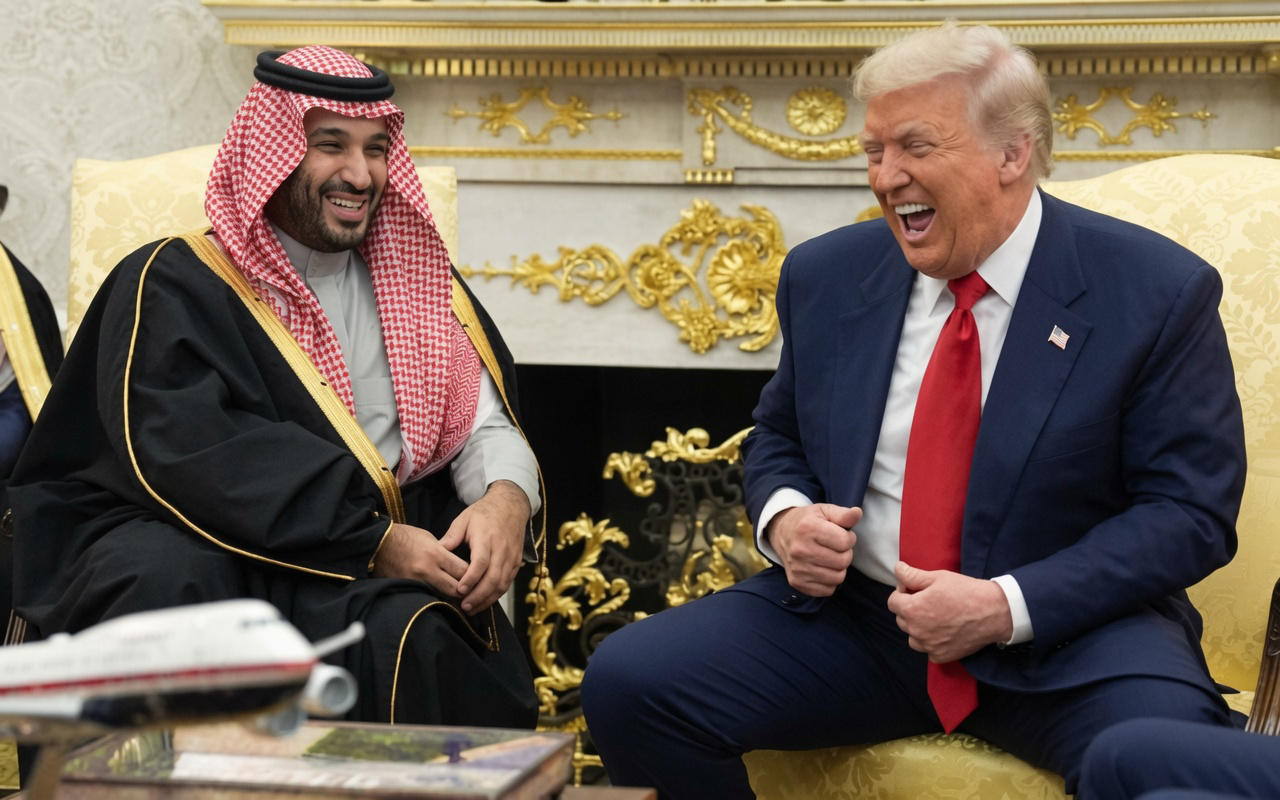
US President Donald Trump (right) meets with Saudi Arabia's Crown Prince Mohammed bin Salman in the Oval Office of the White House in Washington, November 18, 2025. (Evan Vucci/AP).
Former Israeli Defense Minister Avigdor Liberman has condemned the proposed American nuclear agreement with Saudi Arabia. In his view, a deal allowing Riyadh to enrich uranium on its territory represents a red line that will eventually trigger an unsustainable nuclear arms race in the region.
Similarly, former Israeli Prime Minister Ehud Barak pointed out that the draft agreement does not contain any commitment from the Saudis to normalize relations with Israel, indicating the lack of trust between Netanyahu and Trump. This omission signals a clear loss of trust between Jerusalem and Washington, and confirms that the Americans are willing to proceed without factoring Netanyahu’s strategic red lines into the equation.
Saudi Arabia has ample supplies of uranium. According to Chinese and Saudi geological surveys, the Arabian Shield stores more than 90,000 tonnes of uranium. Energy Minister Abdulaziz bin Salman has stated on several occasions that Riyadh wants to establish a complete nuclear fuel cycle, from mining and yellowcake lixiviation to enrichment and fuel production for its reactors. At the same time, the Arabian nation is preparing to export nuclear fuel.
Saudi Crown Prince Mohammed bin Salman has also said that if Iran were to develop a nuclear weapon, Saudi Arabia would do the same “as soon as possible.” The Saudis’ timing is even easier to explain given that the 2009 United States-United Arab Emirates 123 agreement includes the “gold standard,” meaning a total ban on enrichment and reprocessing. Egypt has already begun constructing four Russian-assisted reactors, matching the four Turkey will operate at Akkuyu. Indeed, the moment the US Congress gives the go-ahead to Saudi Arabia, all of these countries will demand the same rights. The slide will begin the day the first centrifuges start spinning on the Arabian Shield.
Today, Iran is capable of enriching uranium to 60 percent. The Saudi nuclear option, secured by only loose bilateral guarantees, will indirectly legitimize Iran’s malicious nuclear program and weaken the cutting-edge qualitative advantage that Israel enjoyed for decades. Tehran will now have every reason to shorten its breakout time, while its regional proxies continue to take a toll on the energy infrastructure of the State of Israel and the Gulf states.
With these Vance-style impulsive policies, Washington undermines the credibility of the Abraham Accords, as normalization with Jerusalem was the price Riyadh was “supposed to pay” for securing nuclear technologies. By failing to deliver on this, the Trump administration cuts its own geopolitical throat, removing a critical bargaining chip in its talks with Saudi Arabia. Also, the United States thus reduces its own bargaining power and signals to every regional capital that proliferation thresholds are negotiable. Handing Riyadh nuclear expertise and infrastructure without requiring normalization—or even a gesture of goodwill—with Israel (until recently Washington’s closest regional ally), would turbocharge Mohammed Bin Salman’s ambiguous bid for Sunni leadership while gutting US deterrence credibility across the Middle East.
As a result, a US congressional coalition should impose—before this agreement’s approval— two effective and cutting-edge conditions. First, all enrichment-related equipment and technical know-how at any future Saudi nuclear plant should be continuously monitored remotely for vibration, electricity consumption, and gas flow. These data streams must feed a joint American-Israeli monitoring node located at Dimona that will yield an independent algorithm aiming to flag anomalies and trigger automatic suspension of US nuclear fuel supply.
Second, before any Saudi nuclear project begins, every identified uranium deposit on its soil must be placed under permanent joint American-Israeli-Saudi custody at a neutral US security site. Continuous monitoring of that material would protect both Jerusalem and Riyadh from proliferation risks while giving them lasting leverage in future negotiations. Nothing less can lock in Israel’s future qualitative military edge, enable a genuine US nuclear partnership with Riyadh, and deliver the strategic Israeli-Saudi normalization that would form the cornerstone of a prospective “Abrahamic NATO”—extending credible deterrence to every Abraham Accords signatory and making the initiative far more attractive to states still sitting on the sidelines.
These recommendations convert abstract safeguards into hard, enforceable barriers. Anything less will lead the Middle East to the arms race that Liberman is now warning about.
Related Topics
Related Posts