
Seeking honest leadership, and new narratives.
Seattle’s World Cup ‘Pride Match’: A Collision of Activism, Culture, and Sport
Credit: Shutterstock
When the City of Seattle decided to brand one of its 2026 FIFA World Cup matches as a “Pride Match,” city organizers likely believed they were sending a message about inclusion, diversity, and the values the city wants to project to the world. The match, scheduled during Seattle Pride weekend, was designated long before the teams themselves were chosen. But fate, or perhaps irony, intervened.
The match now set to carry that designation is: Egypt vs. Iran.
Suddenly what may have once looked like a straightforward civic celebration has evolved into an international cultural and political flashpoint.
Both Egypt and Iran have formally objected to the branding. In Iran homosexuality can carry the death penalty, and Egypt uses morality laws to suppress LGBTQ+ rights. Officials from both countries argued that associating the match with LGBTQ+ Pride celebrations clashes with their religious, cultural, and social values. FIFA, the worldwide governing body for football, stated that its code dictates political neutrality, and the Pride Match branding is strictly an initiative of the local organizing committee, not endorsed by FIFA itself.
Despite objections the Seattle committee has continued with its community programming, emphasizing that football should act to unite people across cultures.
At first glance, many Americans will instinctively side with Seattle. After all, this is a progressive American city hosting a global sporting event on American soil. Pride celebrations are deeply woven into Seattle’s civic identity, and the city has every right to express its values publicly.
But the deeper question is whether global sporting events are meant to unite radically different cultures or become platforms for ideological confrontation. That is where this story becomes complicated.
The World Cup is one of the few remaining events on Earth where nations with profoundly different political systems, religions, values, and cultures still come together under a common language: Sport. The beauty of the tournament has always been that for ninety minutes countries that despise each other politically can still share a field peacefully.
Yet modern international sport increasingly seems unable to resist transforming itself into a battleground for cultural messaging. Seattle’s organizers insist the designation was planned well in advance and not targeted specifically at Egypt or Iran. That may be true. But intent does not erase consequence.
What makes this controversial is not merely the Pride branding itself. It is the perception, especially across the Middle East and much of the non-Western world, that Western cities increasingly expect international guests not only to tolerate Western progressive values, but publicly participate in them. To many in the West, Pride represents human dignity and equality. However, to many in Egypt, Iran, and elsewhere, it represents a direct challenge to religious and cultural norms.
Whether one agrees with those objections or not is beside the point. The issue is whether the World Cup should intentionally place nations into symbolic cultural conflicts that overshadow the sport itself. The uncomfortable reality is that much of the world does not share the social worldview now dominant in American and Western European urban centers.
That does not excuse repression, discrimination, or persecution. Iran’s horrific treatment of LGBTQ+ individuals deserves condemnation. But diplomacy, international engagement, and global sporting culture require understanding that billions of people outside the West view questions of sexuality, religion, and public morality very differently.
Instead of building bridges, events like this risk deepening the sense across much of the world that international institutions increasingly serve as vehicles for exporting Western ideological priorities.
Ironically, FIFA itself spent years trying to avoid exactly these kinds of political and cultural confrontations. During the 2022 World Cup in Qatar, debates over LGBTQ+ symbolism, armbands, and public messaging dominated headlines almost as much as football itself. Seven European nations (including England, Wales, Germany, and the Netherlands) abandoned their “OneLove” armband campaign after FIFA threatened strict sporting sanctions, forcing captains to either not wear it or risk an on-field booking.
Additionally, while FIFA guidelines stated that rainbow flags and attire were welcome, fans at several matches reported having rainbow hats, shirts, and flags confiscated by local stadium security. FIFA later clarified that venues should allow these items, but the enforcement remained inconsistent throughout the tournament.
Many hoped the 2026 tournament in North America would return the focus to sport. Instead, Seattle may have guaranteed another international culture war. Politically, the symbolism could have broader consequences.
Across the Middle East, this controversy is already being framed not as a celebration of inclusion, but as evidence of Western cultural arrogance. The belief that Western progressive norms must be inserted into every international platform regardless of the sensitivities of participating nations.
That narrative may strengthen anti-Western voices in countries already suspicious of American cultural influence. At the same time, progressive activists in the United States argue that backing down would represent surrender to governments that criminalize LGBTQ+ identity and suppress basic freedoms. From their perspective, visibility itself is the point.
This leaves FIFA trapped in an impossible position: if it allows the branding to continue unchanged, it risks alienating large parts of the Muslim world. If it intervenes, it will be accused of capitulating to authoritarian intolerance.
Perhaps the deeper problem is that global sporting events were never designed to carry the weight of modern ideological warfare. The World Cup was supposed to bring the world together.
Instead, Seattle’s “Pride Match” is becoming a symbol of how divided the world actually is.
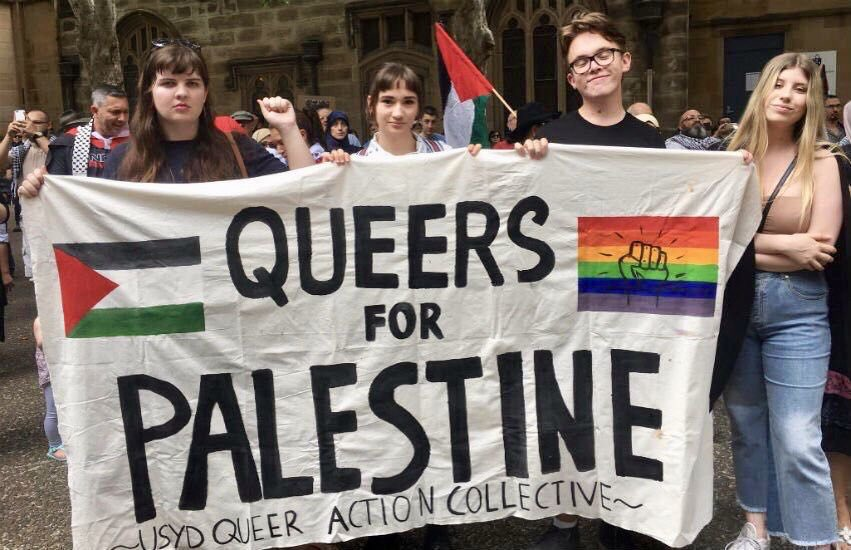
And for us in Israel the irony (“Queers For Palestine” anyone?) is not lost.
Related Topics