The views expressed herein are solely mine.
Seducing Damascus: America’s New Gamble in Syria
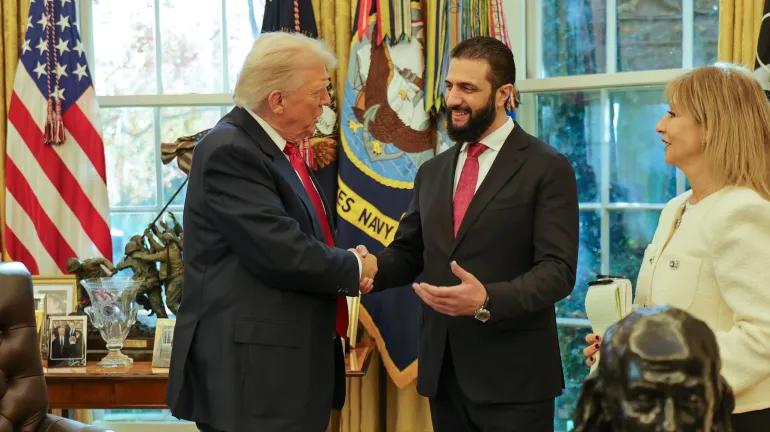
Former President Donald Trump and Syrian leader Ahmad al-Sharaa shake hands as al-Sharaa gestures during their meeting [Syrian Presidency/Handout via Anadolu].
Forget the think-tank jargon and diplomatic euphemisms.
What is unfolding in Damascus is not “reconciliation” — it is seduction.
Washington has finally found a way to flirt with a former enemy, and his name is Ahmed al-Sharaa, Syria’s new strongman — a man who once wore the cloak of jihad and now dons a Western-cut suit while playing basketball with U.S. generals.
Today, the U.S. does not need another war in the Middle East. It needs leverage.
And al-Sharaa, for all his contradictions, offers exactly that: a potential Syrian pivot away from Tehran and Moscow, and back toward the West’s orbit.
What makes this courtship even more astonishing is al-Sharaa’s past.
Not long ago, the U.S. had placed a $10 million bounty on his head, branding him a high-value target for his ties to extremist networks (like Al-Qaeda and ISIS) during the Syrian Civil War.
Today, the man once hunted by drones is being courted by diplomats — proof that in geopolitics, yesterday’s terrorist can become tomorrow’s “strategic partner.”
And here comes the offer: reopen the Syrian embassy in Washington, lift sanctions for 180 days, and let’s talk about ISIS.
Certainly, this is the oldest game in foreign policy — moral compromise dressed as strategic realism.
Thus, if Syria joins the anti-ISIS coalition, the White House can claim a diplomatic resurrection. Doubtlessly, the perfect photo op — America “restoring stability” without firing a shot.
But beneath the smiles, everyone knows the truth: this is about pushing Iran out of the Levant and reclaiming the chessboard Russia and Tehran hijacked during the Obama years.
A Western-leaning Syria would be a geopolitical earthquake. It would rip apart the Iranian supply corridor that feeds Hezbollah, isolate Tehran, and redraw the regional map.
On the other hand, Israel would quietly applaud such a shift; a contained Syria means no rockets from the Golan Heights and a disrupted Hezbollah pipeline.
For Jerusalem, al-Sharaa’s tilt toward Washington would mark a long-awaited vindication of its doctrine of regional deterrence — victory without invasion.
Meanwhile, the Kurds — America’s perennial pawns and occasional partners — watch uneasily.
Any Washington-Damascus rapprochement could leave them stranded, forced to negotiate their autonomy with a regime that once leveled their towns.
Ankara, for its part, would see an opportunity to suppress Kurdish advances under the pretext of border security, further complicating Washington’s balancing act between allies who despise each other.
Yet the risks are just as immense.
Al-Sharaa’s past is drenched in jihadist blood — the same blood spilled in the Druze, Alawite, and Christian massacres his HTS militants unleashed after he seized power — and his rule today clings to life through shaky pacts with militias, warlords, and tribal strongmen.
Nevertheless, Washington pretends not to notice. It calls him a “pragmatist,” a “reformer,” even a “potential partner.”
But beneath the tailored suit and diplomatic smiles lies the same man who once ordered executions in the name of God — now selling himself as the West’s new bulwark against ISIS.
The irony is obscene: America, desperate for a foothold in Syria, is flirting with a butcher who learned to trade the black flag for a handshake.
Hence, betting on him could turn into another American miscalculation — Afghanistan 2.0 in Levantine disguise.
Still, Washington’s logic is cold and clear: if you cannot destroy the enemy, buy its loyalty.
By granting al-Sharaa a diplomatic lifeline and economic oxygen, the U.S. is gambling that he will trade ideology for influence.
This is not about democracy -as Syria’s most recent elections confirmed- it is about control.
The embassy key and the sanction waiver are not gifts — they are handcuffs, designed to bind Damascus to the Western order.
If this gambit works, Iran’s shadow in the Levant shrinks, ISIS collapses for good, and a Western-backed Syria becomes the buffer state Washington always wanted.
But if it fails, the U.S. will have armed a former jihadist with legitimacy — and invited a serpent into the tent.
Either way, the Middle East is watching.
Undeniably, in a region where alliances are as thin as ceasefires, one thing is certain: when America seduces dictators, the honeymoon always ends in chaos.
Fingers crossed.
Related Topics
- Abraham Accords
- Afghanistan
- Barack Obama
- Ceasefires
- Christianity
- Donald Trump
- Druze
- Golan Heights
- Hamas
- Hezbollah
- Iran
- IS Islamic State
- Islam
- Israel At War
- Israel-Iran Conflict
- Israel-Saudi Normalization
- Jerusalem
- Lebanon
- Middle East
- Russia
- Saudi Arabia
- Syria
- Terrorism
- The Arab World
- The Kurds
- Trump Peace Plan
- Turkey
Related Posts