
Middle East Analyst
Senator Cory Booker’s Iran Deal Dilemma
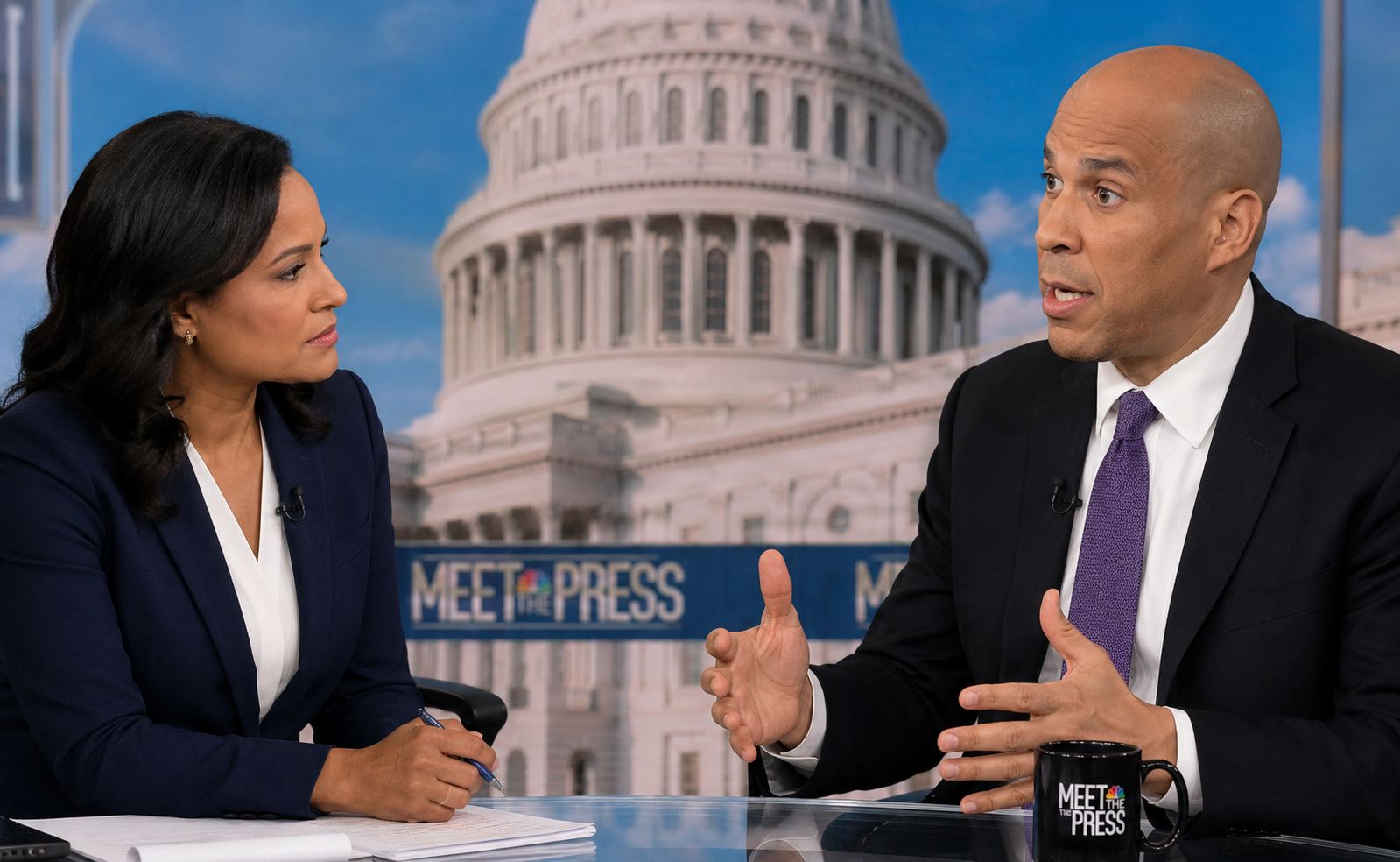
By author (AI)
A Senator Exposes a Democratic Messaging Problem
In his June 23rd interview on NBC’s Meet the Press with Kristen Welker, Senator Cory Booker placed himself squarely in the center of a growing Democratic dilemma. Booker announced that he opposes the Trump administration’s emerging peace framework with Iran, including the reported economic concessions that form the backbone of the interim agreement. At the same time, he reiterated his long‑standing position that the war should end. The tension between these two positions was visible throughout the interview, and it revealed a deeper problem within Democratic messaging as the United States moves toward a possible diplomatic resolution.
Booker’s critique was not incoherent in a policy sense. He argued that the administration’s concessions risk weakening American leverage and that the president should not receive credit for “reversing a crisis he created.” These are arguments that resonate within foreign‑policy circles. Yet they also highlight a contradiction that Booker never addressed directly: if he believes the United States should have held out for a better deal, then he must also believe the administration should have been willing to escalate the conflict or prolong the standoff. Either path would have imposed additional economic pain on American voters who have already felt the consequences of the war through energy price volatility and broader market instability.
This is the political problem Booker walked into. He is trying to have it both ways—supporting an end to the war while rejecting the only available mechanism to end it—and in doing so, he inadvertently exposes Democrats to a narrative vulnerability at a moment when message discipline is essential.
The Credit Question and the Limits of Political Framing
Booker’s most forceful point in the interview was his insistence that President Trump should not be given credit for ending a war that he himself initiated—an expensive war that did little, if anything, to contain Iran’s longer term nuclear, ballistic and proxy threats. This is an understandable political concern. No party wants to hand its opponent a narrative victory, especially in an election year. Booker’s argument reflects a broader Democratic anxiety: if the war ends in a deal, Trump will likely try to present himself as a pragmatic leader who degraded the Iran regime and nuclear program as much as possible without causing irreparable harm to the global economy.
Yet the credit question, while politically charged, is not the central strategic issue. Whether Trump “deserves credit” is a matter of political optics, not foreign‑policy analysis. The more important question—the one Booker did not answer—is how the United States could have secured a meaningfully better agreement without escalating the conflict. The administration was negotiating under a fragile ceasefire, volatile oil markets, and a public exhausted by economic shocks. Under those conditions, the idea that a tougher line would have produced a superior outcome is difficult to defend.
Booker’s refusal to engage this question leaves his critique incomplete. It also risks reinforcing the perception that Democrats are more focused on denying Trump a political win than on articulating a coherent strategy for ending the conflict in a way that minimizes economic harm to American households.
Carville’s Intervention and the Problem of Mixed Signals
Booker’s interview did not occur in a vacuum. Earlier in the week, Democratic strategist James Carville publicly argued that Trump should indeed receive credit for ending the war, comparing the move to what Lyndon Johnson failed to do in Vietnam and what the Bush and Obama administrations failed to do in Afghanistan. Carville’s comments were not merely a disagreement; they were a sign of deeper fragmentation within Democratic messaging.
This fragmentation matters for two reasons. First, it undermines the party’s ability to maintain a consistent narrative heading into the midterms. Democrats want to run on the economy, yet internal divisions keep pulling them back into foreign‑policy debates that voters do not prioritize. Second, if the administration ultimately submits the agreement to the Senate as a treaty—a possibility, though not a certainty—the president will need sixty‑six votes. Some Republicans have already voiced opposition. Many Democrats may be tempted to oppose the treaty as payback for Trump’s withdrawal from the 2015 JCPOA. But that move carries political risk. If Democrats block a peace agreement, Trump could position himself as the pragmatist willing to make necessary foreign‑policy concessions for the economic well‑being of voters, while Democrats appear to be obstructing peace for partisan reasons.
Carville’s comments suggest that some Democratic elites understand this risk. Booker’s comments suggest that others do not.
The Economic Question at the Center of the Debate
The most important question raised by Booker’s interview—the one that may shape the midterms—was never asked directly and never answered indirectly. How could the administration have secured a better deal without escalating the war and increasing the economic pain already felt by American voters? This is the heart of the matter. Oil markets have been volatile. Consumers have felt the impact. The war has already imposed economic costs that will linger even if prices stabilize.
If Booker believes the administration should have held out for more concessions, then he is implicitly arguing for more pressure, more time, and more uncertainty. All of these would have translated into more economic pain. That is a politically perilous position in an election year defined by economic anxiety. Booker did not acknowledge this implication, but it is unavoidable. His critique only makes sense if he is willing to accept the economic consequences of a prolonged standoff. That is the elephant in the room.
The Uncertain Path Ahead
It is important to note that the final details of the agreement have not been negotiated. There is no guarantee that a deal will be reached at all, although as of today it appears more likely than not. This uncertainty gives both parties political room to maneuver. It also means that Booker’s critique may age poorly if the final agreement ends up being modestly better than the 2015 JCPOA that Trump abandoned.
Conclusion: A Preview of the Coming Narrative Battles
If President Trump’s Iran deal is finalized, these the related political narratives will become central to both the US midterms and the Israeli elections. Democrats risk appearing divided, reactive, and distracted from their strongest message: the economy. Republicans, meanwhile, may benefit from the contrast between a president who will claim to have ended a war—albeit one he started—and a Democratic Party that cannot decide whether the war ended to soon.
The coming months will determine whether Booker’s intervention was a momentary misstep or an early sign of a broader Democratic messaging problem.
Related Topics