PoliSci Student | Op-Ed Writer and Columnist | Opinion Journalist
Sephardic Jews in Guatemala
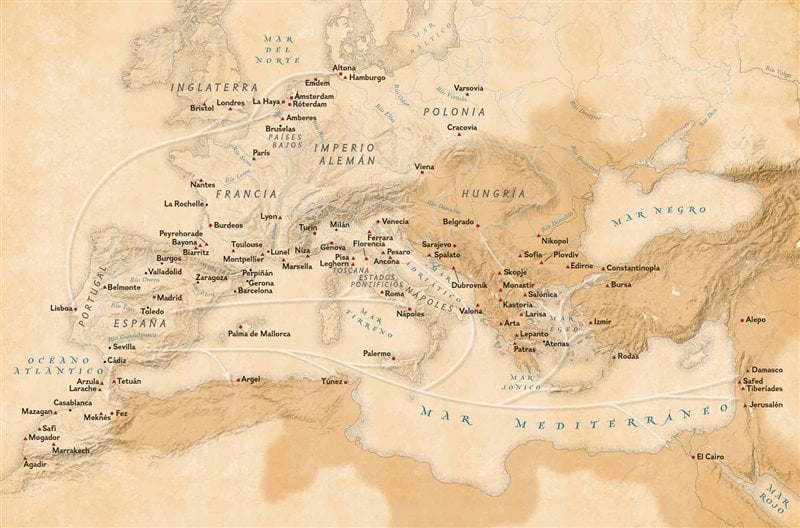
La gran diáspora sefardí by National Geographic (PD)
As I told in an early entry:
Neither am I a descendant of a Polish or Lebanese Jewish family, but of marranos, or as they used to call derogatorily all those judeoconverts who practiced their Judaism in secret due to the fear of being executed during the spanish inquisition
It is something that has followed me for years, one that sounds more like a whisper inherited through centuries than a declaration. To speak of marranos is to open the pages of a forbidden genealogy, to confront the silence that history imposed on those who prayed behind closed doors, that buried the menorah beneath the crucifix to survive.
The first Sephardic Jews arrived in Guatemala after their expulsion from the Iberian Peninsula in 1492. Some came indirectly—from the Canary Islands, from Portugal, from the ports of Veracruz and Cartagena—seeking refuge far from the reach of inquisitorial zeal. The Spanish Crown prohibited the entry of “new Christians” to the Indies, yet many slipped through the cracks, protected by false certificates of purity or by the anonymity of vast oceans. They arrived as merchants, physicians, artisans, translators; some became devout Catholics, others, secret observers of the Sabbath. Their names were often erased from official documents, but their presence left traces—subtle, persistent, like a genetic echo.
Unfortunately, Guatemala preserves little documentation of that hidden chapter. The archives of the Holy Office of Mexico mention “marranos in the provinces of Guatemala,” but the details are scarce, dispersed among centuries of dust and oblivion. That absence, paradoxically, has fueled my own search. Over the years I have devoted myself to tracking whatever remains—wills, marriage records, fragments of stories that escaped the censors’ fire. In my family tree, the surnames de Coronado, Colindres Puerta, Paiz or de Paz, de Molina and Alemán emerge like faint fingerprints of a lost identity. Perhaps they mean nothing; perhaps they are the last syllables of a hidden prayer.
Following that genealogical thread, I arrived at the figure of Ana María Rubio de Cáceres y Sanabria—her paternal name Rubio de Cáceres, her maternal Sanabria—who married an Irish surgeon, Theodore Dominick O’Kelly Plunkett, a Catholic who settled in Guatemala until his death in 1701. The union of an Irish Catholic and a woman possibly descended from conversos encapsulates the complexity of colonial identities. Europe’s wars and exiles condensed in a single marriage certificate written in ink now almost invisible. Behind that faded document, however, lies an entire civilization displaced, adapting, blending, and, at times, vanishing.
Another branch of this uncertain lineage leads me back to the figure of Samuel Abravanel, born around 1370 in Lisbon. Forced to convert, he became Juan Sánchez de Sevilla and married Juana Rodríguez de Monroy. His descendants dispersed after the Portuguese persecutions of the late 15th century, and the name Abravanel—once illustrious in Jewish philosophy and finance—was swallowed by the tide of assimilation. Fernán Rodríguez de Sevilla, Lord of Río Lobos and Villar de Leche, son of Abravanel, married Isabel Ordóñez de Villaquirán. They were the grandparents of Gonzalo de Ovalle y Ordóñez de Villaquirán, a conquistador and encomendero in the lands of Guatemala, who later served as alcalde mayor of Ciudad Real de Chiapas and his ancestors still are alive around us.
To write about these things and about this is to wander through a labyrinth of absences. The Sephardic presence in Central America is scarcely mentioned in school textbooks, and yet it exists, invisible and stubborn, in countless family traditions. It exists in the Friday candle that a grandmother lights without knowing why, in the reluctance to eat pork, in the whispered saying about “our ancestors from Spain.” It exists in the architectural echoes of certain altarpieces—where menorahs and Stars of David appear subtly carved among angels and grapes, as if the stone itself remembered what the people forgot.
In that sense, my genealogical exploration is not only an act of curiosity but also one of recognition. To search for the hidden Jews of Guatemala is to confront the country’s multiple identities, the ones that colonial violence tried to homogenize. We are all, to some degree, descendants of an exile—whether from faith, from homeland, or from memory. The marranos embodied the tension between survival and truth, between assimilation and fidelity. They prayed in secret not because they had ceased to believe, but because belief had become dangerous.
When I look at the names that make up my lineage—Rubio de Cáceres, Sanabria, de Coronado, de Paz, Alemán—I do not see mere genealogical curiosities but the silent testimony of centuries of fear and endurance. I see, perhaps, the same stubbornness that moved my ancestors to keep a light hidden behind the door. Even without documents, without certainty, I sense their presence in that small persistence: the refusal to forget.
History, after all, is not built only from what can be proven but also from what can be remembered. To reconstruct the story of the marranos in Guatemala is to restore to them a voice denied for five centuries. And maybe, just maybe, by tracing their path, I am also tracing my own—the invisible thread that ties Lisbon to Seville, Seville to Antigua, and the past to this act of writing. Because telling this story is not a simple exercise in nostalgia; it is a quiet gesture of justice toward those who lived and died under false names, carrying in silence the faith of their fathers.
Related Topics