
Connecting Continents
Sharing Cargo X-Ray Images among IMEC Customs Authorities
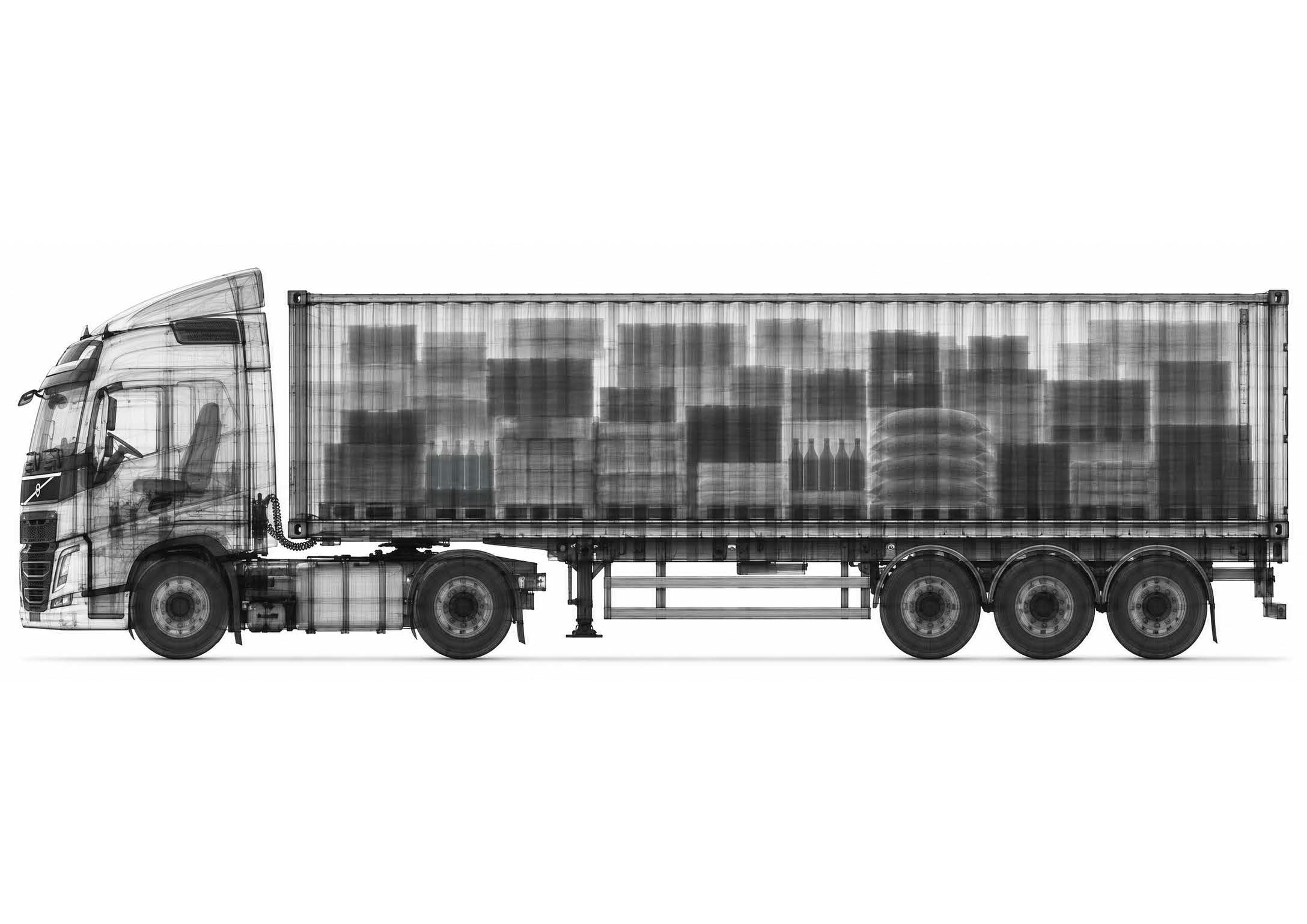
X-Ray scan of truck and shipping container
The purpose of this essay is to suggest modest practical steps by which the India–Middle East–Europe Economic Corridor (IMEC) might be brought more rapidly into commercial life. The measures proposed here are not monumental, and address mostly the security of containerized cargo moving by ship and then truck. They require neither vast capital nor decades of construction. They demand, rather, a certain clarity of thought about the relationship between security, mistrust, and the transit of goods across countries.
War as Episode
To understand the future of the Middle Eastern land corridor linking India and Europe, one should situate the current conflict within a longer historical rhythm in which trade routes have persisted and re-emerged. The present war between the Islamic Republic of Iran and the US, Israel, and the Gulf Arab countries understandably dominates our moment. Yet the long patterns of Indian Ocean–Mediterranean Sea trade tend to function despite the disturbances of any given war.
How can one reasonably adopt such an outlook with confidence? Very recent history offers reassurance. The large-scale regional warfare initiated by Hamas in October 2023 postponed work on the corridor, but it did not derail the fundamental enthusiasm for it in European capitals or in India. Policies that align with durable national interests retain their appeal. They outlast diplomatic quarrels and even some wars. For each IMEC participating state, the corridor’s underlying logic places it in this category.
IMEC’s Road-Based Potential
The “IMEC vision” foresees containerized goods traveling from Indian ports to Europe via the United Arab Emirates, Saudi Arabia, Jordan, and Israel. In time, Syria and Lebanon should also join the network. Although governments contemplate new rail infrastructure, the corridor could begin functioning immediately as a road-based transport route. A prerequisite for all cross-border transport, whether by train or truck, will be inspection of each container’s contents. Properly designed inspection of road-borne cargo today will facilitate rail transport later.
Viewing IMEC in the Broader Landscape
From the perspectives of India, the UAE, Greece, Italy, and Israel, IMEC is seen as an addition to existing transport networks rather than a replacement for China’s Belt & Road (BRI) or the Iran–Russia International North–South Transport Corridor (INSTC). American strategic thinking leans toward stark binaries, with IMEC treated as an explicit alternative to BRI and INSTC. The reality, however, is that American commercial interests thrive over time on the same functional redundancy that benefits every other trading society. The long-standing, albeit fraying, American commitment to freedom of maritime navigation for every nation’s vessels illustrates the point. Moreover, the likely containment of Iran’s disruptive power and logistical capacity will bring secondary effects that reinforce IMEC’s appeal. As Iranian capacity withers, Turkey’s influence on regional transport systems will increase. Ankara is positioned to take advantage of these emerging conditions through its new truck ferry route linking the Emirati ports to Iraq and Eurasia. Still, Gulf Arab leaders’ enthusiasm for this Turkish prospect will invariably be tempered by its neo-Ottoman flavor, especially when they already control their own nascent India-to-Europe route.
Optimism Grounded in History
IMEC, as an idea, represents an optimistic outlook. The business case for a new land route from Asia to the Mediterranean presumes continued, durable growth in global trade, specifically the expansion of India–EU commerce. That optimism enjoys historical precedent. Trade connections between the Indian Ocean and the Mediterranean are ancient. Strategic thinking in New Delhi interprets the present era as a restoration rather than an invention of pathways that existed before the imperial systems that dominated Anatolia and South Asia. One encounters a similar sensibility in Washington, D.C. Legislative initiatives in the United States Congress, as reflected in the Eastern Mediterranean Gateway Act, suggest that the corridor is part of a deeper Western historical geography. A curious convergence of historical consciousness is shaping the political imagination in both capitals.
Existing Trucking Foundations
The practical realization of IMEC may be closer than either its advocates or its skeptics suppose. Even today, cargo moves from Asia to the United Arab Emirates and onward to Israel by truck, relying on what might be called “administrative acrobatics.” Likewise, modest flows of goods pass from Turkey through Israel toward Jordan and the Palestinian territories. These movements are small, compared to the flows envisioned under a mature IMEC, but they demonstrate that a fledgling trucking corridor already exists.
Beyond Infrastructure: Verification
To transform this patchwork into a high-volume transit system is nevertheless an undertaking. Some infrastructure should be expanded, though maybe not much needs expansion right away. Reducing political barriers would help, though it is not immediately necessary on a grand scale. Above all, the participating states must build confidence in the integrity of cargo moving across their borders, and they can do so without fanfare.
The Core Inspection Challenge
Here we encounter the problem of inspection.
Security authorities face an obvious concern: every container, vehicle, and driver that crosses a border must be mistrusted and therefore verified to ensure it does not conceal hazardous materials. Political support for the corridor will depend on this assurance. Governments cannot permit a new trade artery to become a conduit for weapons, explosives, or contraband.
Standardized Cargo X-ray Equipment
The answer lies not in more arduous human inspections at any particular border facility—which often involve unloading each truck for examination—but in improving processes by building on harmonized X-ray imaging hardware and inspection protocols, and then sharing the resulting data. The objective is to expeditiously and confidently clear cargo for forward movement; a container scanned in the UAE, and again in Saudi Arabia, should not require physical re-inspection in Jordan if the digital twins of its contents have been verified as identical and deemed safe by the central system. A practical first step in realizing this goal would be to deploy standardized cargo X-ray equipment at all ports and border crossings along the corridor, beginning in India. Even more crucial would be creating a shared imaging system that allows Customs authorities along the route to analyze the same data.
Operational Model Explained
The operational model functions as follows: upon arrival at any IMEC port or border crossing, cargo is scanned by standardized X-ray equipment. The resulting imagery is encrypted and transmitted instantly to an information-sharing center. At the same time, local officials who created the scan use it to decide whether the cargo can be green-lighted or requires secondary inspection. AI-driven systems at a centralized center analyze images against a database of contraband signatures, double-checking local officials’ judgment. When either the automated system or human analysts identify a potential threat, an alert is immediately sent to the local border authority, triggering additional inspection. Automated systems and human analysts from each Customs authority examine the same images, so that when anomalies appear anywhere along the route, alerts are transmitted instantly, flagging the cargo, vehicle, and its driver for elevated inspection at subsequent checkpoints.
Shortcomings of Current Fragmentation
The current practice of multiple independent scans using different standards at each country’s border crossing causes delays without significantly enhancing security. It effectively embodies a “scan constantly, inspect repeatedly, trust nowhere” approach that prioritizes security over legitimate trade without generating confidence among other Customs authorities along the corridor. Each participating country operates according to its own technological standards and regulatory rules. A container thoroughly scanned at the Emirati ports of Jebel Ali, Fujairah, or Khorfakkan may encounter different equipment and inspection thresholds at the Saudi border crossing at Al Batha. Such discrepancies erode trust between neighboring authorities, generate repeated inspections, costly delays, and familiar temptations of corruption.
Sharing X-Ray Images
Uniform imaging standards would alleviate these problems. A container should be examined according to the same technological criteria, whether it is scanned in India, the Gulf, the Levant, or the Mediterranean. Yet imaging alone is insufficient if the information it produces remains confined within national borders. The essential innovation must therefore be the sharing of imaging data across the entire route, from the Indian port of departure to the European port of entry. Without such sharing, cargo adulteration en route—for instance, along long stretches of isolated roadways in the Saudi interior—might never be visible to inspectors in Jordan, Israel, or the European Union. A “multilateral centralization”— Customs officials from all participating countries working in the same facility — with this narrow focus would also enable AI systems to detect anomalies across large datasets.
Case for Centralized European Hub
For this reason, a centralized information-sharing center would be desirable. A secure facility located in Europe—Greece, Italy, or France as a geographic terminus — or Romania leveraging its SECI Transborder Crime Center precedent from the 1990s—could aggregate X-ray images from the entire corridor.
Bucharest provides a model for this type of information-sharing. After the Balkan wars, a facility was established in Bucharest that coordinated regional intelligence to support commercial cargo movement and interdict the movement of hazardous matériel. Customs officials from Balkan countries that had recently fought each other were stationed in the same facility, alongside Americans, working under American encouragement. Such a location for a central IMEC facility staffed by Indians, Europeans, and Americans would offer neutral ground for cooperation among Customs officials from Middle Eastern countries whose political relations are often delicate.
Sovereignty Concerns Addressable
Concerns about national sovereignty inevitably arise. Security officials are understandably reluctant to relinquish discretionary authority. Yet a fragmented landscape of competing inspections would likely render the corridor commercially unattractive. A multilateral exchange of letters governing IMEC’s security protocol could establish clear rules for data governance. Imaging data would be used exclusively for security purposes. Proprietary commercial information would be shielded from misuse by chauvinistic national trade authorities. These issues can be successfully addressed through coordinated Indian, American, and European diplomatic leadership.
High-Quality Rest Stops for Drivers as Added Safeguard
We should assume that a single scanning system can be tricked or corrupted. To mitigate this risk, inland X-ray stations at secure truck rest facilities would allow additional verification using equipment from a second X-ray manufacturer and employing distinct imaging protocols. These rest stations could also provide secure parking, comfortable lodging, medical, dental, and optical services for drivers, and vehicle maintenance. Caring for drivers and keeping their vehicles safe from tampering while parked adds another layer of security. While no system is infallible, employing multiple imaging sites along the corridor, combined with image sharing, AI analysis, and human risk assessment, will reduce dangers. Private businesses working under government supervision can develop and manage such service facilities along the corridor.
Layered Security Reduces Overall Risk
No system eliminates risk. But combining uniform X-ray scanning, centralized image analysis, and multi-country oversight would greatly reduce the likelihood of dangerous cargo entering the corridor. The success of IMEC will ultimately depend on trust verified by knowledge. I hope this article outlines practical steps that make such verification feasible.
Related Posts