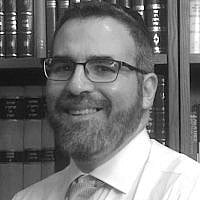
Sharp Edged Simcha
One of the quirkiest things about the Torah is the uneven flow of time from chapter to chapter. Some parshiyot are chock-full of action, and some feel like in the live-action movie of the Torah those scenes wouldn’t make the theatrical-release version. Parshat Vayeitzei is one of those action-packed parshiyot. When we meet Yaakov at the beginning of the parsha, he is on the run with just the shirt on his back and a walking stick. At the end of the parsha, on the cusp of his return to the Land of Israel, he is a whole tribe. In fact, so much happens in this week’s Torah reading that in the course of one aliyah, the majority of the Tribes of Israel are born.
In some ways, the last few months for the Soskil family have felt like a jam-packed parsha. Three months ago, quite unexpectedly, my dad passed away. One month ago my son got married. And one week ago, we had a grandson born. It’s been a lot.
I was thinking that it’s perhaps ironic that during shiva, after Dad died, I felt I had a lot of people around me. It was very easy to make minyanim. And even though the life-cycle event was about missing someone, I felt a lot of people’s presence. But then, when we were all together during the wedding, the sheva brachos, and the bris — all events about adding someone to the family — I’m so aware of how Dad isn’t with us.
Which is just a way of pointing out that everything has layers to it. Some layers happen in the open, and some happen in our hearts. The true reality of something isn’t necessarily obvious. And that idea, I think, connects to one of the big insights from Parshas Vayeitzei.
One of the great Rabbinic traditions is that the Avot kept the whole Torah, even the parts of ritual law that would only be given hundreds of years later at Sinai. And one of the great questions on that tradition comes from this week’s Torah reading. For all the reasons you know, Yaakov ends up married to Leah and then afterward to Rachel. He does this despite the fact that there is an explicit mitzvah in the Torah that—even at a time when a man could have more than one wife—he couldn’t be married to sisters. So did Yaakov keep the Torah or not?
The Ohr HaChayim HaKadosh has an insight here that gives us a look at life, the universe, and everything. He explains that each mitzvah we do has an impact on the world around us and on ourselves. Each sin does as well. It’s an inescapable law of spiritual physics, as fundamental as E = mc² or a = 9.8 m/s². Because of their great awareness of the will of the Creator, the Avot understood how each mitzvah affects the world. They were empowered to make decisions: did the spiritual impact override the practical considerations?
Yaakov understood that violating a future mitzvah could have a detrimental effect on the world. Because of his knowledge of “Torah,” he knew that marrying two sisters would be a violation of a (future) mitzvah and would damage the world in some way. And yet he also knew that Rachel was his destined soulmate. He was empowered to make the call: which was more critical — marrying Rachel or keeping the future command?
So did the Avot keep the Torah? Our tradition says yes. If that’s true, then why are there times it seems they did not? Some explain that they were empowered to decide whether keeping a particular mitzvah was “worth it” when weighed against other factors.
It’s worth stating as clearly as possible: nowadays, post-Revelation at Sinai, our job is to follow the Torah as it is embodied in practical halacha. It is not our responsibility, nor within our capacity, to weigh whether violating a mitzvah is better than keeping it. A key component of Adam’s sin was trying to “outthink” Hashem — believing he could serve God better by breaking His word than by following it. He was wrong, and so are we if we think that way. We live in a world where we are commanded to keep the mitzvot; we don’t intuit them.
Though we are not empowered to use intuition in place of halacha, it is common practice to consult people we believe have deep spiritual sensitivity for things that are not strictly halachic. And in our own lives, we are empowered to use our own spiritual awareness to interpret the frustrations and happenings of daily living.
And that brings us back to this year of simchas and shiva and the sense that everything is more than what it seems. Life is complicated. Simchas can carry a sharp edge of absence; sorrow can hold a whisper of joy. That’s the world we live in — where the surface is never the whole story. May Hashem bless us with the spiritual sensitivity to notice the deeper reality in every moment, and the wisdom to appreciate it.