She-asani Yisrael: A Reform Jew’s Case for Particularism
I used to think liturgy, at least within the Reform movement, was pretty much set. Perhaps, over time, a word or phrase here or there might change according to our modern sensibilities, but the overall meanings and messages of our prayers were generally consistent. I was aware that the Reform prayer book today is quite different from the accepted liturgy of early Reform Judaism close to a century and a half ago, but at least within my lifetime, a prayer was what it was.
Well, I was wrong. I first realized how wrong I was when I started to be able to translate the Hebrew text myself. I subsequently discovered that many of the English translations of even the most familiar prayers were more interpretations of the Hebrew than direct translations. And with an interpretation comes a particular ideology, one that might differ significantly from the original Hebrew text.
Take, for example, the blessing we say before reading from the Torah: Asher bachar banu mikol ha-amim v’natan lanu et torato. The prayer book I used on Rosh HaShanah, Mishkan HaNefesh, translates that as: “(the One) who embraced us and gave us this Teaching, having chosen us to embody Torah among the peoples of the earth.”
Beautifully said. Also, quite inaccurate, as far as translations go. Because the literal meaning of the Hebrew is: “who chose us from all the nations and gave us [God’s] Torah.” More concise, less flowery, but also a different ideology. A truly particularistic ideology. The literal translation felt…uncomfortable for the editors of Mishkan HaNefesh. And why wouldn’t it? Being the “chosen people” seems to imply superiority over the other peoples, other nations, of the world. And that’s certainly not what we believe. The interpretive version of that blessing in this prayer book is explicitly less particularistic. And isn’t that a safer, more moral approach? Don’t we want to work towards a more universalist ideology in Judaism?
In November of 1885, the leaders of the Reform movement in America convened a conference in Pittsburgh where they debated over a series of guiding principles for the movement as a whole. They ultimately crafted a document called the Pittsburgh Platform which defined the basic tenets of Reform Judaism for nearly half a century until it was revised in 1937 in Columbus, Ohio. The Pittsburgh Platform of 1885 states the following: “We recognize, in the modern era of universal culture of heart and intellect, the approaching of the realization of Israel’s great Messianic hope for the establishment of the kingdom of truth, justice, and peace among all men.”
An elegant and perfectly inoffensive sentiment of universalism, defining our greatest hope and aspiration to be a world of “truth, justice, and peace” for everyone. What Reform Jew, whether in the nineteenth century or the twenty-first, would oppose that statement?
Naturally, the Platform continues: “We consider ourselves no longer a nation, but a religious community…”
And herein lies the danger of a turn towards pure universalism. With those words, the early Reform Jews of America erased the concept of Jewish peoplehood, and with it went the desire for and the right to a homeland, a sovereign state of our own.
We see this ever-growing push towards a universalistic ideology in progressive Jewish circles today as well. Even the word “particularism” has been cast in a negative light by many. It is seen as nothing more than regressive tribalism, forcing unnecessary and even harmful divisions between people of different faiths—presumably the opposite of our goal of “repairing the world”. However, in the wise words of Rabbi Ammiel Hirsch: “We cannot succumb to those who preach a false philosophy of Jewish universalism that camouflages disdain for Jewish particularism under the guise of a…misunderstanding of tikkun olam—social repair…A universalism unmoored from particularism is not Jewish universalism. It is just universalism, of the non-Jewish kind.”
Without particularism, there is no Jewish people, and without a defined people, Jews are defenseless in the face of mounting antisemitism and the deceptively attractive pull of assimilation. We become separate congregational communities—or worse, mere Jewish individuals—with no real connection to other Jews beyond the connection we claim to all of humankind.
Jews make up just two percent of the population of the United States. But last year, according to data recently released by the FBI, 63 percent of religion-based hate crimes in the U.S. were committed against Jews. And, according to the Anti-Defamation League, “2025 was the deadliest year for antisemitic attacks in the Jewish diaspora in more than three decades”. Without a sense of particularism and an understanding of Jewish peoplehood, a purely universalist approach relieves individual Jews of any special responsibility for other Jews. So, who is going to speak up for us? Who will defend us against the “ambient antisemitism” we can no longer afford to ignore?
Elie Wiesel’s response to such a question would probably be unapologetically particularistic. In his 1986 acceptance speech upon receiving the Nobel Peace Prize (ironically a prize for universal human rights advocacy), he said the following: “[Since] I am a Jew profoundly rooted in my peoples’ memory and tradition, my first response is to Jewish fears, Jewish needs, Jewish crises…It would be unnatural for me not to make Jewish priorities my own…” According to Elie Wiesel, then, the answer to the very real threat of antisemitism lies in our hands. In our acceptance of the responsibility we must take for our people’s wellbeing and future.
And while yes, antisemitism is a very serious concern, there is another threat we should be even more worried about. As Rabbi Hirsch writes: “The growing inclination among liberal Jews to deemphasize Jewish distinctiveness is the gravest threat to the future of liberal Judaism. For what are the prospects of the continuity of the people if the people is not committed to its own continuity, and does not even agree philosophically that it is a legitimate objective and a social good? Is it possible to sustain the Jewish people without being committed to the Jewish people?”
But what does it mean to be committed to our people? Rabbi Hirsch continues: “Audacious honesty requires that we press Reform Jews: Are you committed to the Jewish nation—and what does that mean to you? Do you believe that the Jewish people, like all other nations, [has] the right to self-determination, or are Jews somehow different?” The right of our people to a sovereign state is not a concept that should be debatable, and it certainly should not be the controversial subject that it has become among Reform Jews. To quote the State of Israel’s “Declaration of Independence”, or Megillat HaAtzmaut, “This right is the natural right of the Jewish people to be masters of their own fate, like all other nations, in their own sovereign State.”
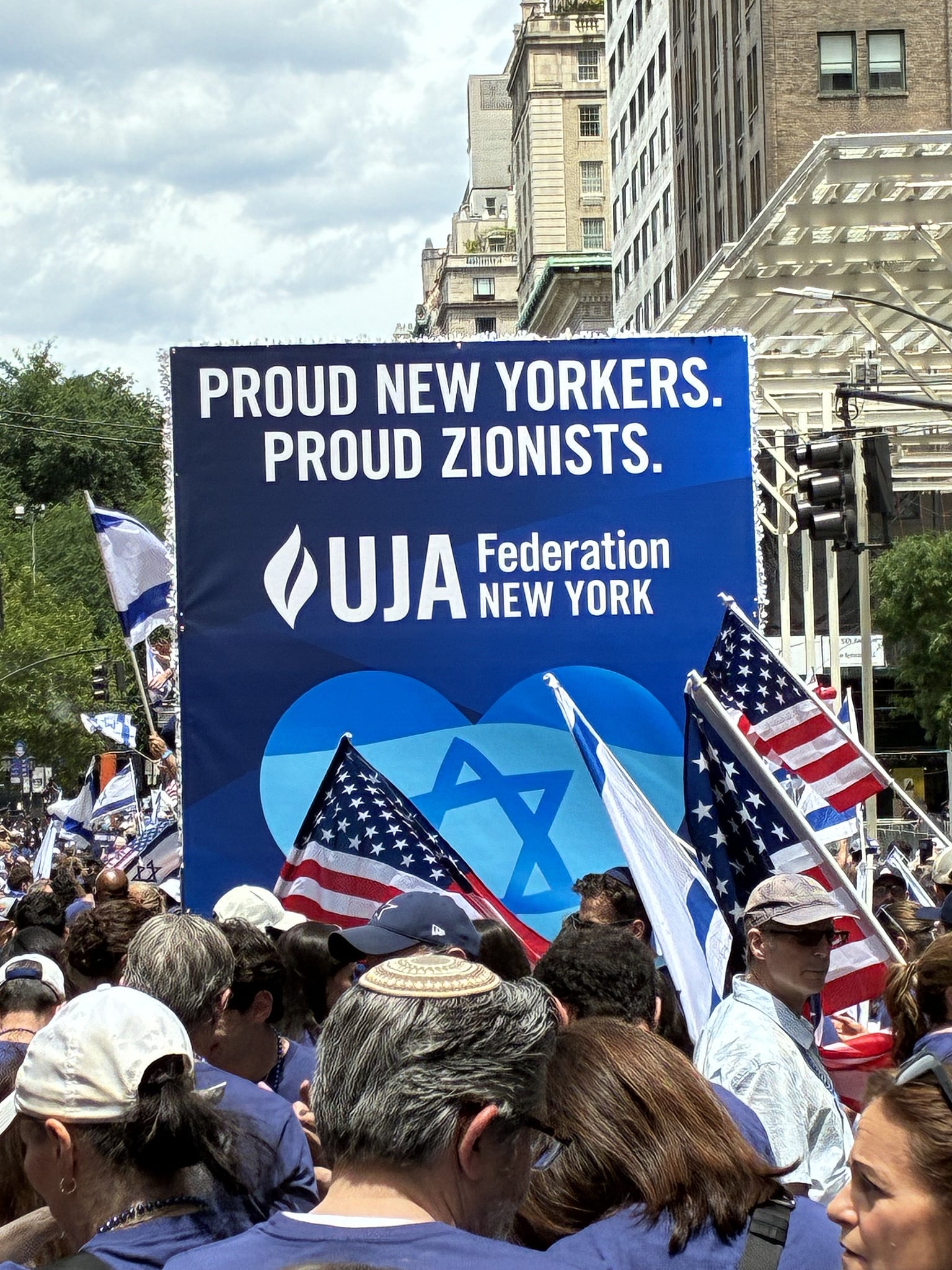
Zionism and Zionist are not “bad” words or words to be avoided. I do not accept the antisemitic redefining of those words to mean something that they don’t. I can very matter-of-factly say that I am a Zionist, because I believe in the concept of Jewish peoplehood, I support my people’s right to a state, and I am committed to the survival, the flourishing, of my people. And I will not qualify those statements out of some misplaced desire to appear aligned with current so-called “progressive” ideologies.
My mother raised me to be proud of being Jewish. She told me that, while she did not have a religious Jewish upbringing, she was always proud of being a Jew. Of being part of the Jewish people. I inherited that pride in being Jewish, and the education I received in my supplementary religious school reinforced it. Now it is my responsibility to share that pride with the next generations. Our people cannot survive without it, and to quote Rabbi Hirsch one more time: “In the modern world, those who are not committed to Jewish survival will not survive as Jews.”
One of our concluding prayers, Aleinu, is often mistranslated, because its meaning for us is misunderstood. The prayer states that it is upon us to praise God, our Creator, and proceeds to say why. Mishkan HaNefesh translates the more particularistic lines of that prayer as: “(the One) who made us unique in the human family, with a destiny all our own.”
A lovely idea and indeed a true statement. However, it’s not really the same as what the Hebrew actually says—that we must praise: “(the One) who did not make us like the nations of the lands, and did not appoint us like the families of the earth, who did not make our portion like theirs, and our fate like all the masses.”
Like the blessing before reading from the Torah, this prayer also came across as problematic and thus was uncomfortable for the editors. But Aleinu is not about superiority. It’s about being proud of being different. The People of Israel has a special responsibility and a different relationship with God. Not better. Just different. And I’m proud of that.
The late Rabbi Lord Jonathan Sacks, former Chief Rabbi of the British Commonwealth, spoke in 2010 about what it means to be a Jew. These were his remarks:
“I have a little dream, it goes like this. You are wandering through an enormous library. [Like the] Library of Congress, yeah? …And you’re wandering through, and you’re looking at all the titles of the books and then suddenly you stop dead. There’s a book and on the title, it’s got your name…What is this book that has your name written on it? And you open it up and you see that there are several hundred pages of that book written by many different hands in different languages. And you try to work out what this book is. And with a shock, you realise that this book has been written by your ancestors. Every single one of them has written a chapter in this book telling their story and handing it on to their children. And as you get to the end of the book, with a shock you see that that empty page has your name on it. And you realise that is the chapter that you have to write.
“Now, you’re in the middle of this library. Can you just put that book on the shelf and walk away and forget it? I don’t think you can really, because if you did all those 200 generations of your ancestors would have kept that book going in vain because it would have stopped with you. I kind of think I couldn’t do that. If they put their faith in their children to keep the book going, then they have all put their faith in me. And I have to write my chapter in that book and when the time comes, give that book on to my children and grandchildren.
“That is what it is to be a Jew. To be a Jew is to be part of the most remarkable story ever lived, by any people, covering more countries, more adverse circumstances, more triumphs and tragedies than any other story. And then the sudden realisation that every one of us has a chapter to write in that story and hand the book on. That is what it is to be a Jew.”
And so, my charge this Rosh HaShanah is more of a hope: that we choose to be part of the Jewish people, not just a faith community consisting of individual Jews. That we feel a responsibility for other Jews and for the continuity of this people. That we feel a sense of pride in being Jewish and intentionally nurture that pride in the next generation. That we remember what it is to be a Jew.
My hope is that we all come to understand one of the Nisim B’chol Yom, daily miracles, which we recall every morning: Baruch Atah, Adonai Eloheinu, Melech ha-olam, she-asani Yisrael. Blessed are You, Adonai our God, Sovereign of the universe, who made me a Jew.