Sheba, Nvidia and the code of life
Israel’s Sheba Medical Center has been one of my quiet obsessions for years. Whenever I read about Sheba, I feel I’m not just reading about a hospital; I’m reading Israel’s own story in miniature – creative, innovative, resilient, self-renewing, and relentlessly committed to excellence even when the world is on fire.
So when I saw that Newsweek has now ranked Sheba as the eighth-best hospital on the planet, I was not remotely surprised. If anything, I thought: “About time.” This is the same institution that built Project K, the world’s first AI-powered emergency department, in a country where missiles and mass-casualty events are not hypothetical scenarios but lived reality. In many ways, Sheba has become a living lab for resilience and renewal in medicine.
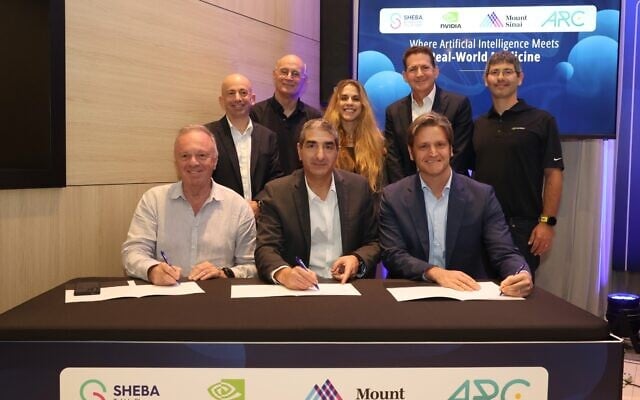
And now, Sheba is doing something even bolder: teaming up with Nvidia – the multi-trillion-dollar AI titan – and New York’s Mount Sinai to build what is essentially a ChatGPT for the human genome.
As an Israel-lover and tech-watcher, I’ll admit: I had to sit back and breathe that in.
Think about what this partnership is trying to do. For decades, we have known how to read the human genome. We sequenced it; we celebrated; we declared a new era. But here is the twist: we really understand only about 2% of that code – the bits that directly make proteins. The other 98% was long dismissed as “junk DNA,” like the scribbles in the margins of a great book.
Now Sheba, Nvidia, and Mount Sinai are telling us: those scribbles might be the real story.
Using large language models – the same class of AI that powers tools like ChatGPT – they want to train an engine on the “language” of DNA itself. Feed it whole-genome sequences, clinical records, and mountains of research data. Let it learn the patterns, the grammar, the punctuation of life. Then, ask questions no human brain alone could answer: What hidden variations in this patient’s genome are quietly raising their risk of cancer or heart disease? Which antidepressant is most likely to work for this specific person, based on their biology, not a population average? How might we design a drug that fits their genetic profile like a key in a lock?
In other words, they are not just building a clever algorithm; they are creating an AI-powered guidebook to what it means to be human.
As Avner Halperin at Sheba’s ARC Center put it, this is about decoding the 98% of the genome we still barely understand – and then turning that knowledge into actionable, personalized medicine. This is the real heart of innovating the future of Israel: taking Israeli strengths in data, AI, and chutzpah and aiming them at the deepest mysteries of life itself.
This is personalized medicine, the Israeli way. For years, “personalized medicine” has been a buzzword. But AI makes it tangible. In the classic model, doctors treat disease rather than anticipate it. You get sick; you show up; they do their best. Personalized medicine flips the script: screen earlier, detect faster, tailor treatment to you rather than the “average patient.”
To do that well, we need to integrate everything: your genome, your medical history, your lab tests and imaging, your lifestyle, and, increasingly, real-time data from wearables and digital tools.
Your doctor’s co-pilot
Imagine arriving at a future Sheba clinic. Your genome has already been sequenced. With your consent, an AI model – trained on millions of DNA sequences and clinical outcomes from Israel, the United States, and beyond – quietly analyzes your risk profile.
Your doctor does not lose their job to the machine; instead, they gain a co-pilot. The AI flags an early pattern in your DNA linked to a certain cancer pathway. It suggests a tailored screening regime and a short list of preventative strategies backed by data. Your physician, with wisdom and experience, weighs these recommendations and discusses them with you.
That is not science fiction. That is exactly the kind of ecosystem this Nvidia–Sheba–Mount Sinai project is building towards.
And it feels profoundly Israeli to me: a shift from crisis response to proactive care, from treating emergencies to preventing them – yet still deeply rooted in compassion and human judgment. It is resilience and renewal expressed in code and clinic.
There is also something beautiful about the shape of this partnership. On one side you have Sheba in Tel Hashomer – the largest medical center in the Middle East, a frequent target for global delegations who come to learn how you keep running a top-tier hospital under rockets, pandemics, and war. Sheba’s ARC Innovation Center has already turned hospital corridors into a testbed for AI, digital health, and field-hospital simulations.
On another side you have Mount Sinai in New York – a leader in genomics and AI-driven medicine, stewarding enormous datasets through its Million Health Discoveries program.
And then there is Nvidia – the AI powerhouse whose chips and software quietly underpin much of today’s generative AI revolution. Their engineers, like Drs. Nati Daniel and Yoli Shavit, are essentially building the “engines” that let these genomic models run at a scale no research institute could manage alone.
Put those three together and you get something uniquely powerful: clinical excellence and operational toughness from Israel, research depth and scale from the United States, and AI infrastructure from one of the world’s most important technology companies.
In a world that loves to lecture Israel, I find it refreshing – and frankly thrilling – to see Israel at the centre of a collaboration that could benefit billions of people, no matter their nationality, tribe, or politics. This is what medicine without borders really looks like.
Sheba’s global reputation has not come from PR. It has been earned in bomb shelters, field hospitals, and humanitarian missions from Ukraine to Africa. Governments and health leaders visit Tel Hashomer to learn how to keep a hospital running under fire, how to deploy underground wards, how to design digital systems that do not collapse when the sirens sound.
Now, those same instincts are being applied to the most delicate infrastructure of all: the human genome.
It is worth noting that this AI project is not only about glory or rankings; it is also about economic and strategic resilience for Israel. If Sheba and Mount Sinai can crack the hidden language of the genome – and keep the intellectual property associated with new diagnostics and therapies – Israel strengthens its place as a global powerhouse in life sciences, in addition to cybersecurity and chips.
In a time when Israel’s enemies try to paint it as a source of instability, Sheba’s work tells another story: a tiny nation that insists on turning its trauma into tools that can heal others. That, to me, is the deepest meaning of innovating the future of Israel.
Of course, as joyous as I am about this collaboration, I do not want to romanticize it. AI in genomics raises serious ethical, privacy, and equity questions: How do we protect deeply personal genetic data in an age of cyberattacks and data breaches? How do we prevent bias in AI models trained on populations that may not represent every community equally? How do we ensure that personalized medicine does not become a luxury product for the wealthy, but a public good – accessible in Sderot and Tzfat as much as in Tel Aviv?
These are not footnotes. They are central to whether this revolution truly serves people.
Israel is, encouragingly, uniquely positioned to grapple with these challenges. It is small enough to run bold experiments at national scale, tech-savvy enough to build robust digital safeguards, and battle-tested enough to know that when systems fail, real lives are on the line. If Israel gets this right, it won’t merely help decode the genome; it will show how a democracy under pressure can deploy AI responsibly, for the good of its own citizens and the wider world.
‘We are not done’
When I zoom out, this project feels like a near-perfect snapshot of where Israel stands today. On one hand, the country is bruised – still absorbing the shock of wars, investigations, and political storms. On the other, it is somehow generating ventures bold enough to rewrite the rules of human health.
Sheba’s AI emergency room, its humanitarian missions, its rise up the Newsweek rankings, and now this genomic alliance with Nvidia and Mount Sinai – together they whisper a simple message: “We are not done. We are not done pushing the limits of what a hospital can be. We are not done turning hardship into innovation. We are not done offering our best ideas to a world that often misunderstands us, but still desperately needs what we can build.”
So yes, I welcome this collaboration with a full heart. I’m excited not only for the new drugs and diagnostic tools it may yield, but for the story it tells about Israel itself: a nation that refuses to stagnate, that insists on turning silicon and code into instruments of healing, that keeps betting on life even when surrounded by death cults.
Somewhere in that vast, mysterious 98% of our genome, there are secrets waiting to be revealed – secrets about disease, about resilience, perhaps even about why some bodies bounce back while others break. How fitting that a hospital in Tel Hashomer, working with partners in New York and engineers in the world of AI, is leading the charge to find them.
If that is not resilience and renewal written in the language of DNA, I don’t know what is.