‘Shiluv’: The forgotten story of Indian Jews in Israeli politics
As Israel is getting ready for an upcoming election cycle in October 2026 with complex coalition dynamics at play and communities being divided more than ever, I would like to share the story of a group of Indian Jews who contested in an Israeli election.
In July 1984, as Israelis lined up to cast their ballots in the 11th Knesset elections, most of the country was consumed by the fierce battle between Shimon Peres’s Labor Alignment and Yitzhak Shamir’s Likud. But tucked away on the ballot, below the names of Israel’s political titans, appeared something few Israelis had ever heard of, Shiluv.
For the average Israeli voter, Shiluv was just a Hebrew word meaning “integration.” For Israel’s small community of Indian Jews, however, it was far more. It embodied a dream that had been quietly nurtured for decades, a dream of sending one of their own to the Knesset, of claiming a voice for a community that too often felt invisible in Israel’s national story.
The dream, bold as it was, fell short. Shiluv won just 5,499 votes, far below the 15,400 needed to secure a single Knesset seat. The party dissolved almost as quickly as it appeared. Yet for the Bene Israel, Shiluv remains less a story of failure than of courage. It was the moment a small immigrant group declared that they, too, belonged in the national conversation.
Fighting for recognition, the Gandhian way
To understand why Shiluv mattered, one must return to the early 1960s, when the Bene Israel (Maharashtrian Jews) faced one of their darkest moments in Israel. In 1961, the Chief Rabbinate questioned their Jewishness, ruling that members of the community could not marry Jews from other groups. For a people who had preserved Jewish practices on India’s Konkan coast for centuries through circumcision, Sabbath observance, and Jewish dietary laws, this ruling was not only insulting but existential. It marked them as outsiders in their new homeland.
The Bene Israel response was extraordinary. Inspired by Gandhi’s philosophy of Satyagraha (nonviolent resistance) men and women marched through the streets of Jerusalem, staged sit-ins outside the Knesset and the Jewish Agency office and demanded equality. “We had no weapons except our unity,” one elder from the community recalled.
Their activism was unprecedented in Israel at the time, and it worked. By 1964, under sustained public pressure, the Knesset overturned the Rabbinate’s decision, recognizing the Bene Israel as fully Jewish. That episode left the community with a powerful lesson: organized protest, rooted in principle, could change the course of policy. Two decades later, that lesson would be carried into politics.
From Dimona’s city hall to the national ballot
If Shiluv was born anywhere, it was in Dimona. This desert development town became home to thousands of Indian Jews resettled in the 1950s and 1960s. While many worked in the textile factories or in the Dead Sea industries, Dimona also became the heart of Indian Jewish cultural and political life.
In 1980, Bene Israel activists launched Kiddum Dimona, a municipal party that stunned the political establishment by winning a city council seat. Leaders such as Samson Shmuel, and later David Samson Bhonker, took up community causes, fair housing, synagogue allocations, and access to municipal resources. But the challenges extended beyond city limits. Discrimination in jobs, lack of recognition in public religious life, and cultural invisibility weighed heavily.
When Bhonker raised these issues with a senior member of the Labor Alignment, he was warned against forming an ethnic-based party. “It’s not proper,” he was told. “We are building a kibbutz galuyot, an ingathering of exiles. Your party will divide the people.” His response was cutting,
“Look at the synagogues you have built. There are Ashkenazi synagogues, Moroccan synagogues, Yemenite synagogues, Russian synagogues. But never one for Bene Israel. Who created these divisions, if not you?”
By 1984, the community was determined to try its luck on the national stage. Under the banner of Shiluv, headed by Tzafania Sariker, the party refused to be co-opted by larger blocs. “We didn’t want to be contractors for other parties,” Samson recalled. “We wanted our brothers and sisters to vote freely and independently.”
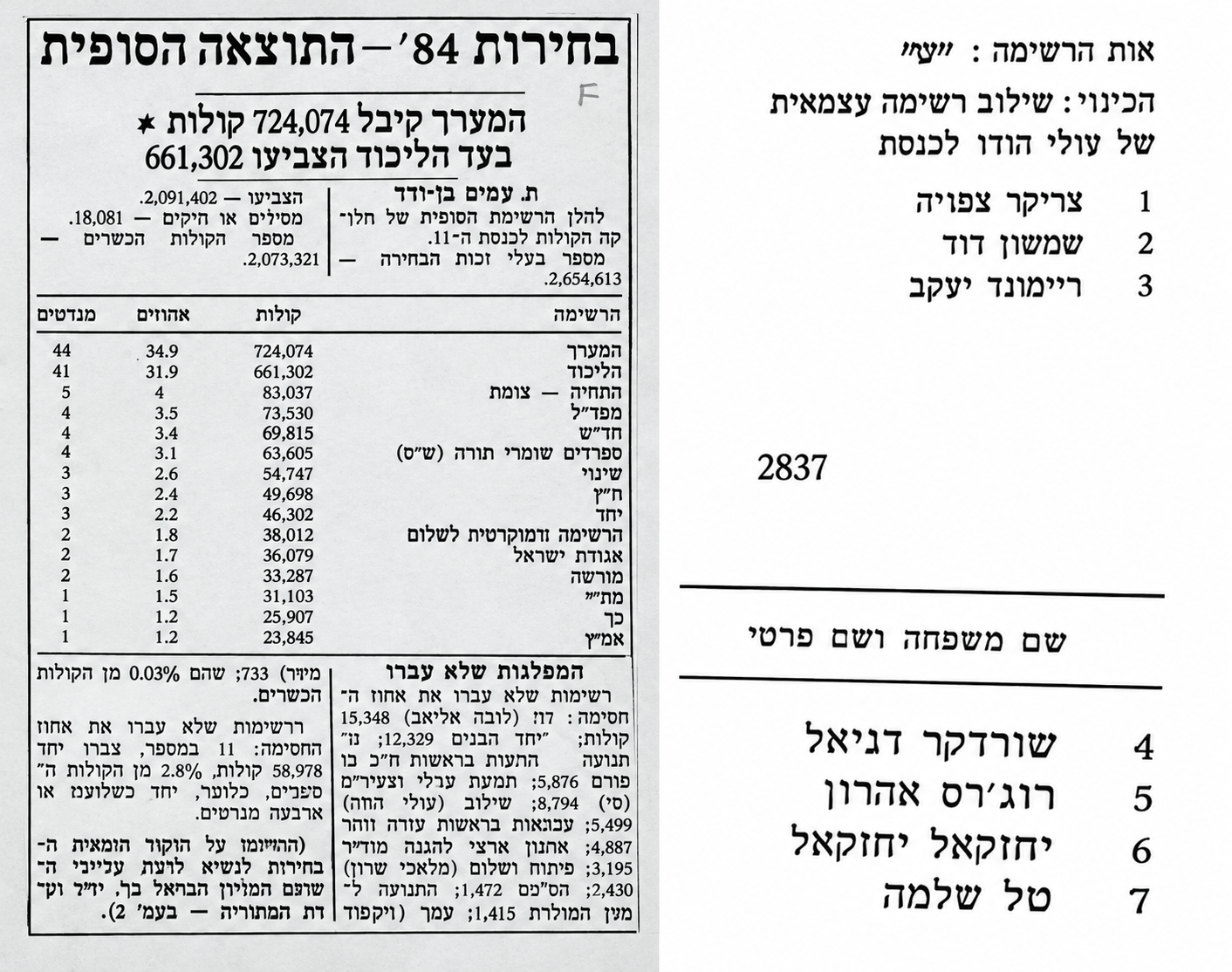 11th Knesset Election Summary & Candidates list (credit: Personal archives of Mr. Samson Bhonker)
The dream and the disappointment
The math did not look impossible. In 1984, just 15,400 votes were needed for a Knesset seat. With around 30,000 Bene Israel in Israel, victory seemed within reach, if the community mobilized. But the national spotlight was elsewhere. The 1984 elections were dominated by the Labor–Likud deadlock, which ultimately produced a unity government. Shiluv’s campaign, carried out on a shoestring budget, barely registered in the national media.
On election day, the results reflected both promise and limitation. Shiluv polled strongest in towns with significant Indian Jewish populations: Dimona, Be’er Sheva, Lod, Ashdod, and Ramle. In Be’er Sheva’s district alone, the party secured nearly 2,000 votes. But nationwide, the total reached only 5,499 – a fraction of what was needed.
The party dissolved soon after. The dream of independent Bene Israel representation in the Knesset evaporated.
Immigrant politics in Israel: A recurring story
Shiluv’s fate was not unique. Immigrant groups throughout Israel’s history have experimented with politics as a way of amplifying their voices. Ethiopian Jews briefly attempted parties in the 1980s and 1990s, fuelled by anger at systemic discrimination. In the 2000s, groups like Lev LaOlim sought to advocate for new arrivals facing bureaucracy.
Some communities, however, had the numbers to succeed. Russian-speaking immigrants, who arrived in the hundreds of thousands in the 1990s, built formidable political structures, culminating in Avigdor Lieberman’s Yisrael Beiteinu, which remains a force in Israeli politics to this day.
But for smaller groups like the Bene Israel, the structural obstacles were immense. Israel’s electoral threshold has risen steadily over the decades, from 1% in the 1980s to 3.25% today. For a community numbering in the tens of thousands, independent representation has become virtually impossible.
What made Shiluv distinctive, however, was its ethos. Unlike parties rooted solely in ethnic pride or economic protest, Shiluv’s very name, “integration,” reflected a vision of inclusion. The Bene Israel did not seek to separate themselves from Israeli society. They wanted to be woven into its fabric, but with their voice audible.
Why Shiluv still matters
Forty years later, Shiluv is remembered not for its vote tally but for its symbolism. For the Bene Israel, it represented dignity, a refusal to remain silent. As Samson Bhonker later reflected:
“Forming a party was our way of saying: we are here, we belong, and we will not be ignored.”
In a democracy, the winners shape policy. But the act of running, of daring to put one’s community on the ballot also shapes the nation’s story. Shiluv is a reminder that democracy is not only about those who win seats, but also about those who demand to be counted, even against impossible odds.
The paradox of Israel’s identity as a kibbutz galuyot is that while the state has succeeded in bringing Jews home, it has often struggled to give each group equal space at the table. Shiluv’s story makes that paradox visible.
For the Bene Israel, the struggle for recognition has taken many forms: Gandhian protests in the 1960s, municipal politics in Dimona in the 1980s, and, for one brief moment, a national political party that dreamed of representation.
The dream did not last. But its legacy endures as a quiet reminder: even the smallest voices matter in a democracy and sometimes, history is written not only by those who govern, but by those who refuse to accept silence.
The questions raised by Shiluv remain relevant. Who gets to speak for Israel’s many immigrant and minority communities? How do groups that arrive as “exiles” transform into citizens with equal voice? These questions echo today in the activism of Ethiopian Israelis, in the continuing debates over Mizrahi representation, and even in the cultural assertion of newer immigrant groups.
Shiluv’s story is a reminder that Israel’s democracy is strongest when it finds room for all voices, not only those who command numbers, but also those who bring unique histories and identities to the table. The Bene Israel may never have placed a representative in the Knesset, but in daring to try, they offered Israel something else: a challenge to build a democracy that truly reflects the mosaic of its people.