
Urban sociologist and geopolitical commentator
Shivaji in Israel and the Return of Civilizational Time
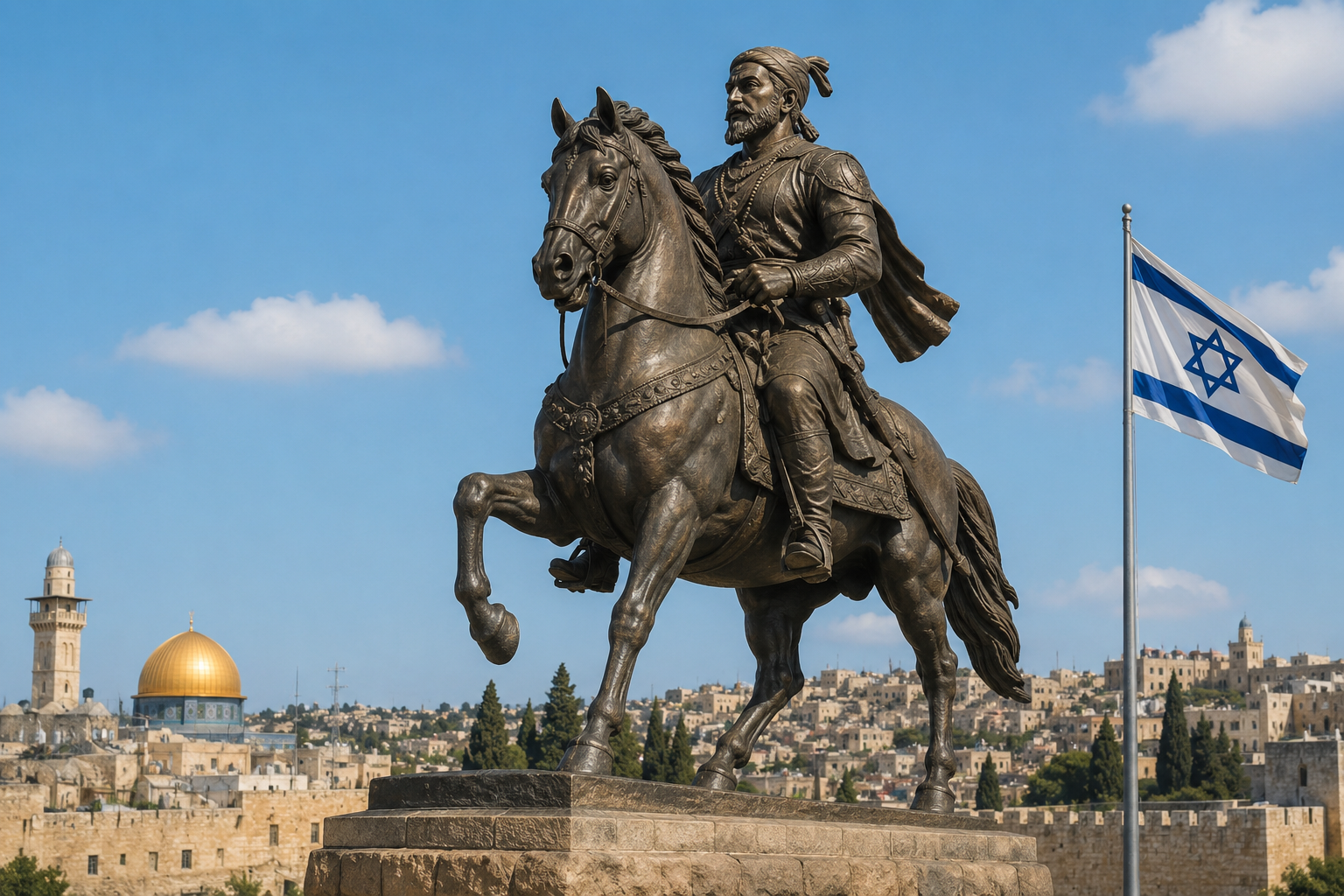
Chhatrapati Shivaji Maharaj (1630–1680) in Israel. AI Illustration. (Credit: ChatGPT)
A statue isn’t merely a decoration or a tribute, it’s a claim about what history means. When Rome erected statues of conquered kings, it was saying: your memory belongs to us now. When revolutionaries pull down statues, they are not merely destroying stone. They are contesting the ownership of the past. When a new nation chooses which figures to honor in bronze, it is making its most fundamental argument: this is what we came from, this is what we are, this is what gives us the right to exist.
Israel’s Consul General Yaniv Revach, standing in Mumbai on the occasion of Shivrajyabhishek Din (on June 06), the coronation anniversary of Chhatrapati Shivaji Maharaj, announcing plans to install a grand statue of the Maratha king in a major Israeli city, was therefore doing something far larger than diplomacy. He was making a claim about time. About the kind of time that matters. About which memories are real.
But buried in this diplomatic moment is a deeper philosophical puzzle, one that no one seems to be asking: what happens when two civilizations, whose entire structures of time are fundamentally different, begin to speak to each other in the language of shared memory?
The Actual History and Its Honest Limits
Most commentary on this event begins at the present. That is its fatal error.
The Bene Israel, the ancient Jewish community of the Konkan coast, are among the oldest continuous Jewish settlements outside West Asia. Their oral tradition holds they arrived after a shipwreck near Navgaon, close to Alibag, with some accounts dating the event to around 175 BCE, which, if accepted, makes them contemporaries of the Maccabean revolt, the very resistance narrative that stands at the heart of the Israeli founding mythos.
For roughly two thousand years, this community lived embedded in the fabric of Konkani life: pressing oil, observing the Sabbath, speaking Marathi, absorbing Hindu customs while preserving Jewish ones. They were called Shanivar Teli, Saturday oilmen, because they would not work on the Sabbath, a fact that speaks to a remarkable social accommodation: their Hindu neighbors simply absorbed it as a community characteristic.
However, there is another characteristic of such civilizational readings of the past: they tend to generate new alignments of memory and meaning in the present, often stretching the historical record into areas where certainty becomes difficult to sustain. After the announcement of the plan of Shivaji’s statue in Israel, some interesting articles have appeared claiming Bene Israel served in Shivaji’s army.
Did the Bene Israel really serve in Shivaji’s forces? The honest answer is: probably, but not certainly. The scholarly record is careful here. Benjamin J. Israel, in his authoritative The Bene Israel of India: Some Studies (Orient Longman, 1984), acknowledges that Bene Israel, apparently, served in the army and navy of the Marathas, before they started enlisting in the East India Company’s army. There is one named individual: Aaron Churrikar, described as a commander of a Maratha naval fleet, whose family reportedly held the position until 1793, sourced from Rev. J. Henry Lord’s The Jews in India and the East, a 19th-century missionary account rather than primary Maratha historiography. Mostly records draw on community tradition rather than archival Maratha records.
What is unambiguous is that the Bene Israel were present in the Konkan during the rise of the Maratha state, deeply embedded in the social fabric of the region in which Shivaji built his kingdom. Whether or not individual Bene Israel fought under his banner in any documented sense, the community shared the geography, the language, and the lived world of the civilization Shivaji was reconstructing. That is a real historical fact, even if the military claim requires the qualifier “possibly.”
Two Sovereignties, One Grammar
To understand why Shivaji resonates so profoundly with Israeli identity, we must understand what he actually did, not as a military hero, but as a theorist and practitioner of sovereignty.
The 17th-century was the age of the great universalist empires. The Mughals, at their height under Aurangzeb, claimed not just territory but ontological legitimacy: the right to define what proper political order looked like for the entire subcontinent. The Safavids held Persia. The Ottomans held much of the Islamic world. In Europe, the Habsburgs made similar claims. Shivaji did not simply resist one of these empires militarily. He did something far more radical. He constructed an alternative theory of sovereignty from scratch.
His coronation in 1674 was not merely a ceremony. It was a philosophical statement. Shivaji had to import Brahmin scholars from Varanasi because the existing establishment refused to perform a Kshatriya coronation for someone they classified as a Shudra. He had to argue his way into legitimacy against the gatekeepers of his own tradition. The resulting coronation was a reconstruction of Vedic kingship, a deliberate reaching back past centuries of disruption to re-establish an older grammar of sovereignty.
Zionism, in its deepest intellectual register, made exactly these moves. The argument was not merely “we need a safe haven”; it was: Jewish civilizational continuity, expressed across two thousand years of diaspora, gave the Jewish people the right to reconstitute sovereignty in their ancestral land. The establishment of the State of Israel required the same reaching-back past disruption, the same construction of institutions from near-nothing, the same confrontation with those who denied the legitimacy of the claim.
The parallel is structural: a parallel of the grammar of sovereignty, of the logic of civilizational reconstitution. And that is why, when an Israeli diplomat encounters the story of Shivaji, there is a flash of recognition that is not fabricated. It is genuine.
The Problem of Time
Here is where the analysis must go somewhere it rarely does.
The Jewish civilizational tradition is, in a profound sense, the inventor of linear time in Western culture. The same linear time that Newton would later formalize in physics. This is not a casual observation. When the Hebrew Bible introduced the idea of a God who acts in history, who moves from Creation toward Redemption through singular, unrepeatable events – the Exodus, the Covenant, the Prophets – it established a temporal grammar that was genuinely new. The Greeks had cyclical time: the eternal return, the wheel of the seasons, history as eternal recurrence. The Biblical tradition broke that wheel. Time became an arrow, not a circle. History became a narrative with a beginning, a middle, and an end toward which it is straining.
This linear temporal structure is the deep skeleton beneath Zionism. The Return to Israel is comprehensible only within a linear frame: a people exiled at a specific moment in history, maintaining memory across two millennia, and returning: not cycling back as part of an eternal natural rhythm, but completing a sentence begun at a specific historical moment. The very phrase “next year in Jerusalem,” repeated annually at Passover for two thousand years, is an act of radical linear faith: the belief that history has a direction, that exile is a parenthesis, and that the parenthesis will close.
India’s civilizational relationship with time is categorically different, and this is where the encounter between Shivaji and Israeli recognition becomes philosophically vertiginous.
Indian civilization has never been comfortable with the linear arrow. The great cycles of Hindu cosmology – the yugas, the kalpas, the endless breath of Brahma – are not merely mythological decoration. They encode a genuinely different ontological claim: that time is not an arrow but a pulse, that what appears as historical progress is a local fluctuation within a vastly longer rhythm, that civilization rises and falls not toward an end but through phases of a pattern. Even the concept of avatar, the divine descending into history to restore dharma, is structurally cyclical: Vishnu intervenes again and again, in different forms, across different ages, not to bring history to a conclusion but to re-establish its proper rhythm.
This creates a fascinating paradox at the heart of the current diplomatic moment. Israel and India are recognizing each other through the language of civilizational memory, but the structure of that memory is fundamentally different. When Israel remembers exile and return, it remembers a singular event within a linear narrative. When India remembers the Maratha restoration of sovereignty, it is drawing on a civilizational grammar in which sovereignty is periodically lost and periodically restored as part of a natural rhythm: Shivaji is not completing history, he is embodying dharma within an ongoing cycle.
What does it mean for these two temporal structures to encounter each other, as they are doing now, in stone and in strategy?
One possibility is that they simply talk past each other: each civilization recognizing in the other a mirror of its own deepest commitments, while remaining structurally blind to the differences. Israel sees in Shivaji a Zionist hero avant la lettre; India sees in Israel a civilization that successfully enacted what India is now re-enacting. Both recognitions are real. Neither is complete.
But a more interesting possibility is that the encounter itself produces something new. The linear structure needs the cyclical to survive within history: a purely linear civilization, straining toward an end that never arrives, tends toward messianic exhaustion or secular disillusionment. The cyclical structure needs the linear to act within history: a civilization embedded only in cycles risks becoming fatalistic, unable to recognize the singular moment that demands singular response. Shivaji himself, interestingly, embodied something of this synthesis: he acted as though this moment was unique and decisive (a linear impulse), while drawing legitimacy from an ancient and cyclical civilizational grammar.
The India-Israel encounter may, at its deepest, be a meeting of these two temporal philosophies, each offering what the other lacks.
The Geopolitics of Memory in a Fracturing World
The timing of all this is not accidental.
India-Israel relations have undergone their most significant structural transformation in recent history. What began as a cautious, almost covert strategic partnership, as full diplomatic relations were established only in 1992, has now been elevated to a Special Strategic Partnership. Prime Minister Modi’s 2017 visit was the first ever by an Indian head of government. His 2026 visit to Jerusalem resulted in the formal elevation of ties. Defense cooperation has moved from procurement to co-development: the Barak-8 missile system is a joint project, not a purchase. A Free Trade Agreement is being negotiated. UPI payment systems are being linked.
But the more important transformation is narrative. For decades, India’s relationship with Israel was constrained by what might be called the Palestine veto: the sense that any deepening of ties had to be offset by, or apologized to, India’s traditional solidarity with the Palestinian cause. That constraint has not disappeared. India still supports a two-state solution and voted with the 142-nation majority on UN resolutions regarding Palestinian statehood. What has changed is that the Palestine veto no longer functions as a ceiling on the relationship. India has “de-hyphenated” its relationships; it refuses to make its Israel relationship contingent on its Palestine position.
The Shivaji statue initiative lands in exactly this transformed moment. It is a cultural act reflecting a strategic transformation. It says: we now have the kind of relationship in which we can speak to each other in the language of civilizational respect, not merely strategic transaction.
The Collapse of the Western Mediating Framework
We must now make the deepest structural argument.
For roughly two centuries, global prestige and legitimacy flowed through a Western mediating framework. It defined which histories mattered, in essence, those legible to the Western imagination. It defined which figures deserved international recognition: Indian figures who achieved global recognition did so in Western-legible categories: Gandhi as the saint of non-violence, Tagore as the mystical poet. None of them represented Indian political or military power. And it defined the terms of international legitimacy: new states achieved recognition by signing onto Western-designed institutions.
This framework is not collapsing, but it is no longer the only one. What we are witnessing is the emergence of civilizational multi-polarity: major civilizational entities beginning to construct frameworks of mutual recognition independently of Western mediation.
The India-Israel relationship is one of the clearest early expressions of this. Israel is not saying: “We recognize India because America told us to.” Israel is saying: “We recognize your civilizational history. We see in it something that resonates with our own. We want to honor that recognition in stone.” That is qualitatively different from transactional diplomacy. It is civilizational acknowledgment, and crucially, it does not require Western approval or Western mediation.
The Long Arc
Let us attempt, finally, the longest view.
We are living in one of those rare historical moments when the architecture of world order is genuinely in flux. The post-1945 order – American hegemony, multilateral institutions, a liberal international framework – is not ending, but it is no longer the only architecture. New structures are being built through the gradual accumulation of bilateral relationships, cultural recognitions, and strategic understandings between major civilizational entities.
In this emerging world, the decision to honor a foreign civilizational icon carries weight it did not carry thirty years ago. Thirty years ago, the significant diplomatic gestures were institutional: joining the WTO, signing the NPT. Today, the significant gestures are increasingly symbolic-civilizational: which leaders visit which holy sites, which historical figures are honored, which memories are invoked.
And so we return to the question of time. The Bene Israel community, whether or not individual members fought under Shivaji’s banner, a question history may never fully resolve, lived for two millennia in the Konkan, pressing oil and observing the Sabbath, absorbing a cyclical civilizational grammar (including the Maharashtrian surnames ending with kar) while never abandoning their linear one. Their descendants now live in Israel, having enacted the great linear return. And a diplomat from that returned civilization stands in the city that grew from the world the Bene Israel once inhabited, proposing to honor the king of the civilization within which they once lived.
Both temporal grammars have, it turns out, been working on the same problem from different directions: how does a people survive rupture and reconstitute itself across time? The linear answer is: by remembering a singular origin and straining toward its completion. The cyclical answer is: by recognizing that what was lost will, in the fullness of the right yuga, return.
Perhaps what Shivaji in Israel ultimately represents is this: that history can complete its sentences in grammar that takes centuries to become legible, and that sometimes, the completion arrives as something neither grammar could have predicted alone.
Memory, once set in bronze, becomes very hard to undo. That, ultimately, is the point.
Related Topics
Related Posts