
Should Israel Allow All-Muslim Cockpits on Israel-Bound Flights?
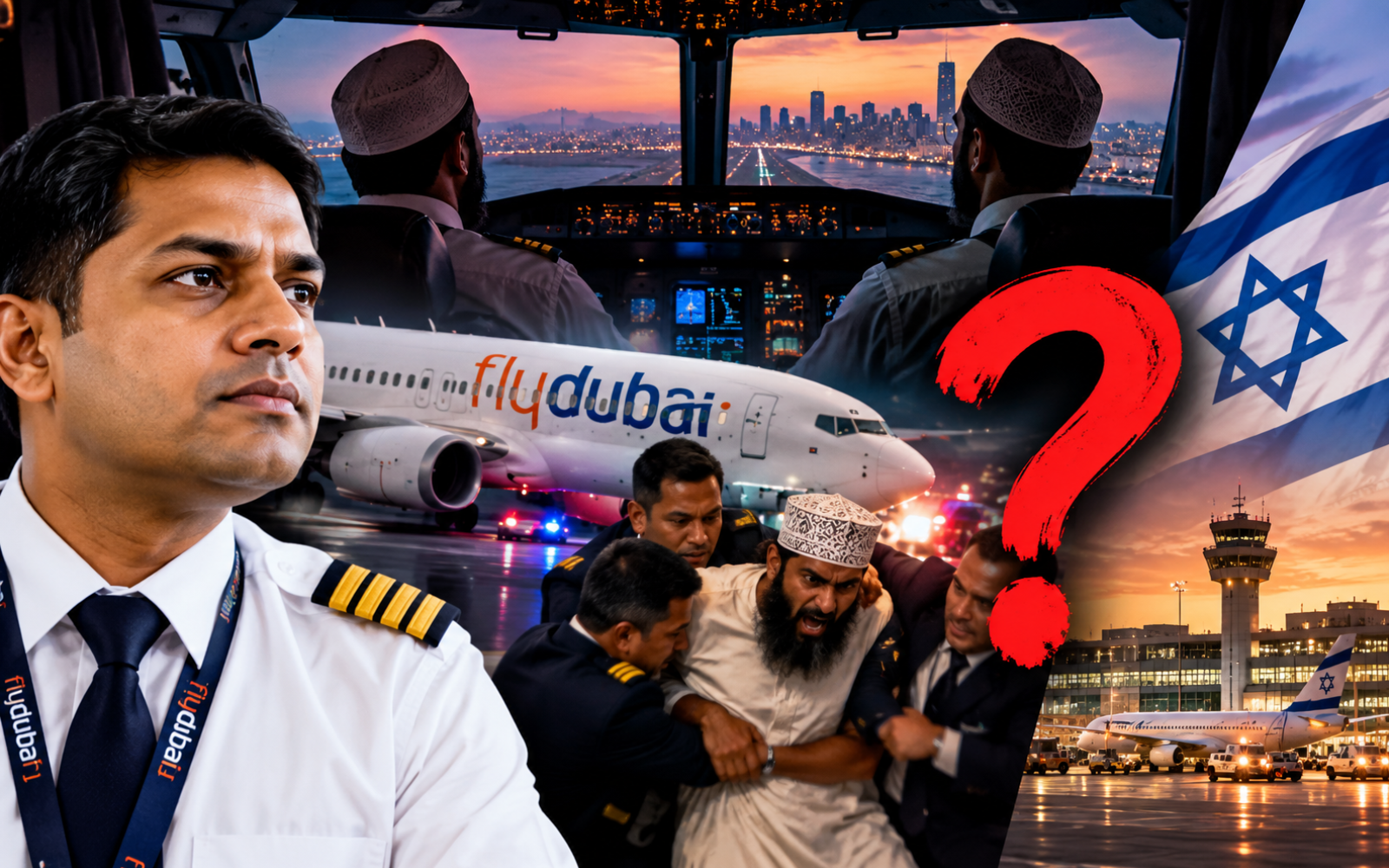
The plane eventually landed safely in Saudi Arabia, which makes it easy to look back at FZ1073 as an extraordinary aviation emergency with a fortunate ending. But remove just one element from what happened next — the wounded captain opening the cockpit door, the passengers rushing forward, or the extraordinary presence of two off-duty Flydubai pilots aboard — and the story could have ended very differently.
Prime Minister Benjamin Netanyahu has already given that possibility a name. Speaking after the incident, he said those who intervened “managed to prevent a 9/11 disaster.” He later called Machchhar a “true hero,” saying that despite being seriously wounded, the Indian captain fought back, opened the cockpit door and enabled passengers and crew to overpower the attacker.
Those words matter because this was not simply a case of an unruly passenger trying to enter a cockpit. According to Israeli accounts of the incident, the danger was already inside it. The co-pilot had allegedly attacked the captain, and the aircraft then entered a terrifying descent. One passenger later recalled believing that September 11 was happening again.
Machchhar somehow remained conscious long enough to release the cockpit door. Israeli passengers and crew were then able to enter and overpower the attacker. Yet even that did not solve the entire problem, because the captain was badly wounded and somebody still had to fly a Boeing 737 carrying more than 170 people.
Then came another extraordinary piece of luck. Two off-duty Flydubai pilots happened to be traveling aboard the aircraft. They were not supposed to be flying FZ1073. They simply happened to be there. Once the attacker had been subdued, qualified pilots were available to take control and eventually bring the aircraft down safely at Tabuk in Saudi Arabia.
That raises perhaps the most unsettling question left by FZ1073: what if those two pilots had not been aboard? Suppose Machchhar had lost consciousness seconds earlier and never opened the cockpit door. Suppose passengers had succeeded in overpowering the attacker but discovered that nobody else aboard was qualified to fly the aircraft. Or suppose control of the plane had never been recovered at all.
Would September 30, 2026, now be remembered as the date of a frightening aviation incident, or would Netanyahu’s reference to a “9/11 disaster” have become horribly literal?
September 11 taught the world something that can never be unlearned: a commercial airliner can itself become a weapon. No bomb has to be smuggled into the cabin and no missile has to be launched from the ground. If someone determined to cause mass casualties gains control of a large passenger aircraft, the aircraft itself can provide the destructive force.
That is why FZ1073 raises questions far beyond Flydubai. It raises questions for Israel, and one of them will make many people deeply uncomfortable. After FZ1073, should Israel allow a Tel Aviv-bound aircraft to enter its airspace when every pilot capable of controlling that aircraft is Muslim and there is no non-Muslim pilot aboard? Put even more directly: should Israel permit an all-Muslim cockpit on an aircraft approaching Tel Aviv without additional Israeli security scrutiny?
For many readers, even asking that question will sound discriminatory. That objection cannot simply be ignored. A person’s religion does not prove that he is a terrorist, and Muslim pilots safely operate commercial aircraft across the world every day. There is no reasonable basis for treating every Muslim pilot as dangerous merely because he is Muslim.
But that does not mean the security question disappears. Aviation security exists precisely because governments are expected to imagine low-probability but catastrophic scenarios before they happen, rather than explain afterward why nobody considered them.
Israel is also not an ordinary aviation destination. Israeli citizens, airlines, airports and diplomatic facilities have faced terrorist threats for decades. FZ1073 exposed a particularly difficult vulnerability because the alleged threat was not someone attempting to breach a secure cockpit from the passenger cabin. He was already sitting behind the controls.
Passengers can be screened. Luggage can be searched. Travelers can be questioned and identities checked. But what happens when the person who may pose the danger has already passed every ordinary barrier and has been entrusted with the aircraft itself?
A fellow pilot has described the Omani co-pilot involved in FZ1073 as a religious extremist, saying that he prayed excessively and refused to shake hands with women. That account does not establish why he allegedly attacked Machchhar, nor does it establish a connection with any terrorist organization. His precise motive and background remain matters for investigators.
Netanyahu nevertheless said the man “obviously hated Israelis,” while describing what was prevented as a “9/11 disaster.” Those statements make it difficult to argue that Israel should simply treat the episode as an unusual workplace assault and move on.
The harder question is how Israel distinguishes between religion and security risk. Should religion itself determine whether somebody is allowed to fly toward Israel? That would create obvious problems. But should Israeli security officials examine ideology, signs of radicalization, extremist affiliations, unexplained behavioral changes and intelligence information more aggressively when vetting foreign cockpit crews? After FZ1073, that question is considerably harder to dismiss.
There is also the problem of time. A pilot may pass background checks when joining an airline and become a very different person years later. Beliefs can change. Political events can change people. Radicalization can happen gradually or quickly. Connections with extremist individuals or organizations can develop after someone has already been given access to an aircraft.
So what does Israel actually know about a foreign pilot before that person approaches Ben Gurion Airport? Was the individual checked only when hired by the airline? How frequently is that background reassessed? Does Israel receive enough information to conduct its own risk assessment? And if every qualified pilot aboard belongs to the same potentially relevant risk category, should Israel require another layer of security or redundancy?
Israel has already begun moving in that direction. After the FZ1073 incident, the Prime Minister’s Office said security checks on pilots flying into the country would be expanded, including pilots working for foreign carriers. Israeli officials have said they want to know exactly who is flying incoming aircraft and conduct security checks accordingly.
That is a logical first response, but FZ1073 suggests that the larger problem cannot be solved by paperwork alone. Israel may also need to reconsider how much redundancy it expects aboard foreign aircraft, what information it requires about cockpit crews and what happens when the only people capable of controlling an Israel-bound aircraft share a security characteristic that intelligence officials believe deserves additional scrutiny.
This is where the debate becomes uncomfortable. Where does legitimate security profiling end and religious discrimination begin? How much additional scrutiny is reasonable when the potential consequence of getting the answer wrong is not simply a delayed flight or an offended traveler, but a passenger aircraft potentially becoming a weapon?
There may be no simple answer, and FZ1073 should not become an excuse to assume that every Muslim pilot is dangerous. But refusing even to ask difficult questions would also misunderstand what aviation security is supposed to accomplish.
The aircraft reached the ground safely because an extraordinary chain of events went right. Captain Smit Machchhar remained conscious long enough to open the cockpit door. Passengers had the courage to intervene. And two qualified pilots happened to be sitting elsewhere on the aircraft.
Remove any one of those circumstances and the ending might have been very different.
Netanyahu called what they prevented a “9/11 disaster.” The next time, Israel cannot assume that the right people will simply happen to be sitting on the plane.
This time, the cockpit door opened.
May the people of Israel always remain safe, and may evil fail every time.
October 1, 2026
Tokyo, Japan