Economist
Should Prayer be a Substitute for Action?
An old Jewish man is standing at the Kotel and begins to pray. “Oh God, I try very hard to observe all the 613 commandments, sometimes at great sacrifice to myself and my family. I pray 3 times a day and I never work on Shabbat. All I ask of you is that I win the lottery just once.” The man breaks down in tears and continues, “I promise to give half of the winnings to Tzedaka. All I ask is that you allow me to win the lottery this week.” At this point he hears a voice that bellows, “Buy a ticket.”
Although funny, this joke raises some very deep philosophical questions: Is it appropriate to pray for things that we ourselves have the power to achieve without divine intervention? Should prayer be limited to outcomes that require divine intervention? Is it enough just to pray for something or should our prayers be combined with personal action? And if people have the capacity to achieve an outcome, but they refuse to take the necessary actions, is their prayer for that outcome a bracha l’vatala (a prayer in vain)?
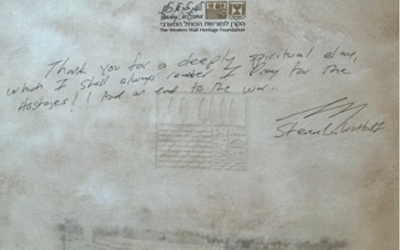
I was reminded of this joke and those questions when I heard that Steve Witkoff, President Trump’s Special Envoy to the Middle East, visited the Kotel during his recent visit. He put a handwritten note between the stones on which it was written, “I pray for the hostages!! And for an end to the war.”
Based on his words and actions, I think many would agree that Mr. Witkoff has demonstrated his deep personal sincerity in wishing (and praying) for all the hostages taken on October 7th to be released and that he is prepared to do whatever he can to make that happen.
By contrast, over the last 22 months, there have been reports that some Israeli politicians have not made seeking the release of all the hostages a high priority; in fact, some have stated publicly that they don’t care if the hostages get released, and others may have taken steps to actually undermine the safe release of the hostages. Do these politicians pray for the release of the hostages? And if they do, might they be guilty of performing a bracha l’vatala?
According to Midrash, Nachshon ben Aminadav was the first to enter the water when the Israelites found themselves before the Sea of Reeds after leaving Egypt. The midrash goes on to state that the Sea did not begin splitting until the water reached Nachshon’s nostrils. Many Rabbis bring this midrash to teach us that according to our covenant, we are actually partners with God – and that God expects us to “put some skin in the game” before he acts his wonders on our behalf.
 So what does all this mean for praying for the release of all the hostages? Is it “enough” to just pray to God for their safe return? Or must our prayers be combined with some kind of action in order to make our prayers effective? Should our prayers on behalf of the hostages be directed to God or toward those whose decisions will ultimately turn our prayers into a reality? If so, should we pray for God to give the leaders of Israel and Hamas the wisdom and strength of character to do what is necessary for the hostages to be safely released?
Related Topics
Related Posts