Sigd: Why Ethiopians build rivers, not bridges
This year, the Sigd holiday arrives after two especially difficult years — years of pain and loss, but also moments of profound hope and triumph. Only recently, we witnessed one of the most moving and uplifting events imaginable: the return of the hostages home. Their return awakened a powerful feeling, almost like a resurrection — something beyond comprehension.
It was a moment of deep gratitude, a measure of comfort within sorrow — a mixture of confusion, joy, and grief intertwined.
Sadly, it seems as though the public atmosphere that existed in Israel before October 7 is rising again — the language of “us and them,” tribal polarization, and a growing inability to truly listen to one another. It is reminiscent of the well-known Yiddish saying: “Er iz fun undzere, oder nisht fun undzere” — “He is one of ours, or not one of ours.”
Today, the issue is not only whether someone is “one of ours,” but also, a dangerous assumption that everyone “with us” is automatically good, and everyone not with us is bad and dangerous. It feels as if we have learned nothing, and our shared social fabric continues to unravel.
Precisely in such days, the ancient holiday of Sigd — dating back to the days of Ezra and Nehemiah — takes on renewed meaning. It calls us to stop, to reflect, to unite. The holiday’s roots are found in the early Second Temple period. It was preserved within Ethiopian Jewish tradition for generations, even as it faded from memory elsewhere.
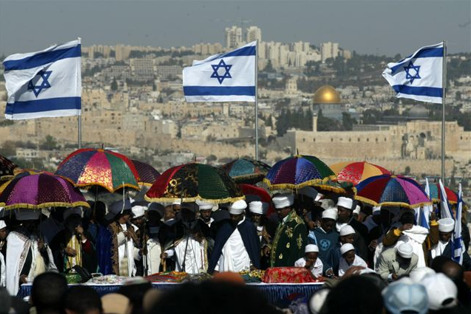
Sigd is observed on the 29th of Cheshvan (November 20 this year), 50 days after Yom Kippur, as a day of fasting and prayer to renew the covenant between the people and God — parallel to Shavuot, which is celebrated 50 days after Passover. Like the Sinai revelation, Sigd is celebrated on a mountain — a place of elevation and soul-searching. At dawn, members of the community immerse in the river, dress in white, and gather “as one person with one heart.”
The priests carry the Orit (Torah) on their heads, accompanied by joyous women’s singing. Some climb the mountain with a stone on their head — a symbol of humility and self-nullification. There, at the mountaintop, the prayers of Sigd rise upward with outstretched hands and deep intention.
The message is simple yet profound: To place a stone upon one’s shoulder — not as a burden, but as an invitation to lower ourselves, listen, and truly see the other. To understand that even what seems irrational or outside the norm can be held, understood, and treated with compassion.
Sigd calls us to renew our sense of shared destiny and to rebuild the bonds between individuals and communities. I once heard a wise Ethiopian man say:
“In Ethiopian culture, we do not build bridges — we build rivers.”
Immediately, I understood the depth of it. In Ethiopian villages I visited, I never saw bridges — only rivers. This difference is essential: A bridge is inert, a temporary crossing; a river is a living, flowing presence that nourishes everything around it. The Western world learned how to build bridges — and that is important — but did not always succeed in creating rivers.
Bridges symbolize multiculturalism; rivers embody solidarity, belonging, and genuine connection between hearts. And the difference becomes clear especially in crisis:
When a bridge collapses, each person runs to save themselves. But when a river floods, people rush to reach out and help one another.
This is the message of Sigd: Do not settle for cold “bridges” of polite coexistence; build living rivers of understanding, listening, and care. The Ethiopian community in Israel can serve as a flowing river — connecting all the groups that make up Israeli society.
It is not a burden — it is a vital asset, reminding us that a healthy society is not built on bridges alone, but on rivers of humanity and hope.
Sigd invites us to renew trust between groups, communities, and identities — Jews, Muslims, Christians, Sephardim, Ashkenazim, new immigrants and veteran Israelis, secular and religious — all of us one human tapestry, between Israelis and Jews around the world.
But beyond fasting and prayer, Sigd is a holiday of hope — a hope that gives strength to rise from pain, continue on, heal, and believe that things can be different. It reminds us not to become captive to cycles of hatred, revenge, and blame — but to hold up a mirror to ourselves, and move: From blame to responsibility, from entrenchment to partnership, from political discourse to civic discourse.
Political talk divides and exhausts; civic talk brings people closer and renews hope. Sigd calls us to choose that hope. It is a holiday of awakening — a call to take the Orit (Torah) out of the ark and bring light into our hearts, so we can heal, unite, and begin again.