
Middle East Forum Fellow/North Africa Risk Consultant
Sisi and Erdogan: Two Autocrats Carving Up the Mediterranean for Survival
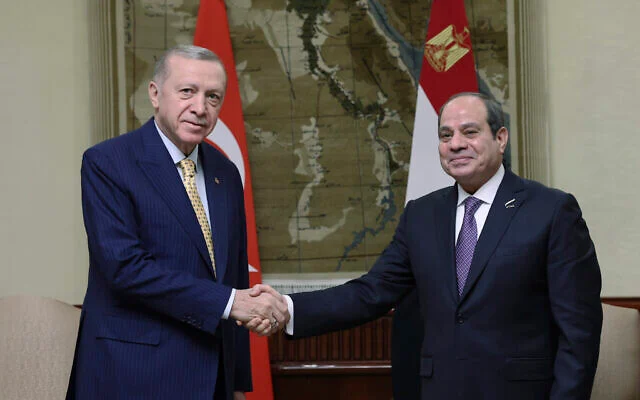
In this handout photo released by Turkish Presidency, Turkey's President Recep Tayyip Erdogan, left, shakes hands with Egyptian President Abdel Fattah Al-Sissi during their meeting at Al-Ittihadiya palace in Cairo, Egypt, Feb. 14, 2024. (Turkish Presidency via AP)
The military framework agreement signed this week in Cairo between Egypt and Türkiye is not the grand diplomatic masterpiece their state-controlled media suggests. Instead, it is a desperate, cynical consolidation of power by two aging autocrats—Abdel Fattah el-Sisi and Recep Tayyip Erdoğan—who have realized that their own regime survival depends on ending a decade of public hostility. By committing to joint military production and coordinated naval strategies, Cairo and Ankara are not just redrawing the map; they are building a “security ceiling” designed to entrench their own rule and bypass international accountability.
For years, the Eastern Mediterranean relied on the Sisi-Erdoğan rivalry as a stabilizer. Greece, Cyprus, and Israel operated under the assumption that Egypt would remain a secular bulwark against Erdoğan’s neo-Ottoman expansionism. This week’s summit shattered that illusion. By intertwining their military-industrial complexes, these two leaders have signaled that the era of ideological proxy wars is over, replaced by a “military-industrial condominium” that prioritizes the continuity of their own regimes over regional democratic aspirations.
The shift reflects a hard-eyed, transactional pragmatism. Erdoğan, once the self-appointed champion of political Islam, has quietly shelved his “Muslim Brotherhood” rhetoric in exchange for access to Egyptian markets and strategic maritime depth. Sisi, whose domestic legitimacy is crumbling under the weight of a catastrophic debt crisis and soaring inflation, has traded his “anti-terrorist” posture for the hope that Turkish investment and drone technology can stabilize his failing economy. They are not friends; they are business partners in a region where might makes right.
This realignment carries immediate and grim consequences for Libya. For years, the international community attempted to mediate between the two sides. Now, Cairo and Ankara are positioning themselves as a duopoly that can dictate terms to Tripoli and Benghazi behind closed doors. If a political settlement emerges from this coordination, the rest of the world will be presented with a fait accompli. This isn’t peacebuilding; it is a partition of influence by the two largest ground forces in the region, effectively telling the United Nations and European mediators that their roadmaps are now irrelevant.
There is a growing belief that the West has lost its leverage, a perception fueled by what many see as an “American vacuum.” Sisi and Erdoğan are betting that a transactional Washington, more concerned with containment than with democratic norms, will accept this new order as a form of “stability.” By managing migration, energy corridors, and jihadist containment on their own terms, they are making themselves indispensable to the West, even as they undermine Western interests.
While some argue the West could still isolate Erdoğan through economic sanctions or defense restrictions, this new axis makes such isolation exponentially more difficult. You cannot easily isolate a NATO member when he is building warships and sharing intelligence with the Arab world’s largest military. This partnership provides both leaders with a “buffer” against Western pressure, allowing them to play the US and Europe against the emerging realities they have created on the ground.
The economic dimension of this deal is perhaps its most cynical aspect. By focusing on joint defense industrial projects, Sisi and Erdoğan are looking to bolster their respective military complexes—sectors of their economies that they directly control. While the average Egyptian or Turk struggles with a cost-of-living crisis, their leaders are planning “Mediterranean defense industrial complexes” to build drones and warships. This is not an investment in the people; it is an investment in the tools of state power.
Ultimately, the Eastern Mediterranean is moving away from a system of ideological checks and toward a model of transactional autocracy. This is a system where predictability is bought, influence is consolidated, and former enemies become partners because the cost of confrontation has become too high for their fragile domestic foundations. The Cairo-Ankara axis is a warning: the rules of engagement in the region are no longer being written in Brussels or Washington, but in the palaces of two men who have decided that the only thing more valuable than a rivalry is a shared monopoly on power.
Related Topics
Related Posts