Sleeping with a Stone Under Your Head
Parashat Vayetzei opens with a man completely exposed. Jacob has just fled Beersheba with nothing on his back, leaving behind the warmth of his parents’ tent, the familiarity of home, and every physical anchor he ever knew. Night falls while he is out in the open wilderness near Luz. There is no inn, no bedroll, no established camp. He gathers some stones from the dirt, sets one under his head as a pillow, and lies down on the hard ground to sleep.
It is one of the bleakest, loneliest moments in the Torah. Yet right there, stretched out on bare dirt with a rock beneath his skull, Jacob dreams of a ladder rooted in the earth and reaching straight into the heavens, with angels ascending and descending. He wakes up startled, shakes the dust off his clothes, and declares: “Surely the Lord is in this place, and I did not know it… This is none other than the house of God, and this is the gate of heaven” (Genesis 28:16–17).
Look at where that revelation happened. God did not meet Jacob inside a grand sanctuary, a famous academy, or a bustling city center. The gate of heaven cracked open in the middle of nowhere, on a rocky patch of ground where a solitary traveler had nothing left to lean on except a cold stone and his own stubborn faith.
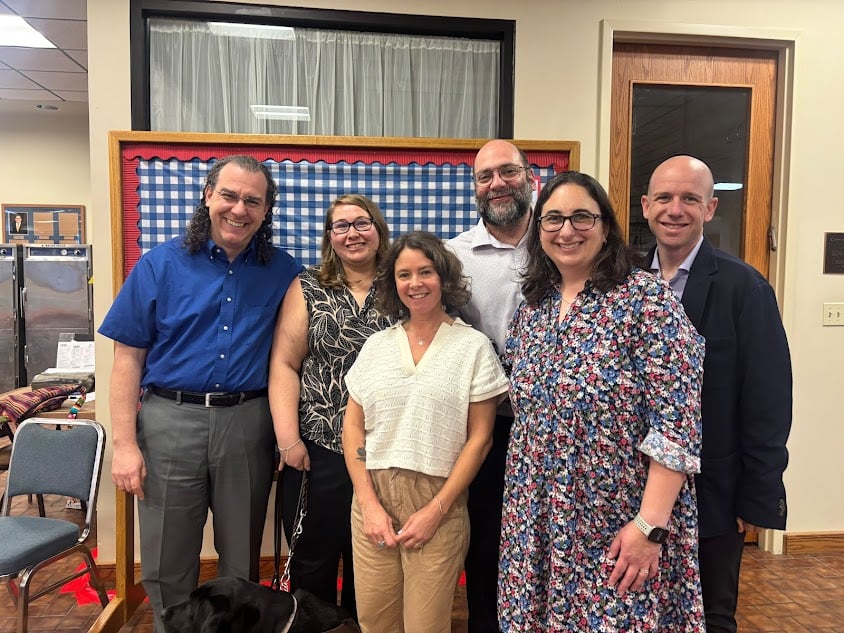
I felt that exact electricity last week down in Corpus Christi, gathering with my fellow alumni from the MAKOM fellowship, alongside the phenomenal leadership of the Center for Small Town Jewish Life.
If you have never spent time with people who lead Jewish life in small towns and remote outposts, you are missing one of the fiercest, most authentic expressions of Judaism in North America. Sitting around those tables in Corpus Christi—swapping stories from the trenches, trading hard-won wisdom, and praying together—you realize immediately that there is zero room for coasting out on the perimeter.
In big metropolitan hubs, Jewish life can easily run on autopilot. You walk into a massive landmark building, sit in a padded pew, and let the surrounding infrastructure carry you. Nobody notices if you stay on the sidelines because a dozen committees are handling the logistics.
Out in the places where MAKOM fellows and the Center for Small Town Jewish Life operate—from coastal Maine to South Texas, and across the military installations where I serve—there are no sidelines. Sometimes your sanctuary is a cramped classroom on a military base, a borrowed community hall, or a historic small-town synagogue where twelve people are fighting tooth and nail to scrape together a Friday night minyan. When you are out on the edges, it is easy to look around at the rocks on the ground and buy into the lie that “real” Jewish vitality only happens back in the major hubs where the crowds are huge and the budgets are endless.
Watching the MAKOM alumni in Corpus Christi proved how dead wrong that assumption is.
The Midrash (Bereishit Rabbah 68:11) asks a gritty, practical question: why did Jacob put stones around his head in the first place? To protect himself from wild beasts prowling in the dark. He was vulnerable, outnumbered, and miles from backup. Yet the Sfat Emet points out that those very stones—the harsh, unforgiving realities of isolation—became the literal foundation of the altar he built the next morning. The rough obstacles he used to guard his head in the dark turned into the cornerstone of his sanctuary at dawn.
That is what the Center for Small Town Jewish Life is doing every single day. They refuse to treat small communities like relics of the past or quiet outposts waiting to fade away. Instead, they invest in passionate, relentless leaders who take whatever rough stones are lying in front of them—small numbers, geographic distance, scarce resources—stand them upright, pour their hearts into them, and build living altars right where they stand.
Jacob didn’t wait for someone else to build a city around him before he took ownership. He took what was unpolished in his immediate environment, consecrated it, and kept marching forward.
Leaving Corpus Christi, my battery was completely recharged. Whether you are holding down a historic congregation in a small town, navigating a new duty station thousands of miles from home, or staring down a stretch of life that feels cold and exposed, never mistake a lack of institutional comfort for an absence of purpose. You do not need a palace to build an altar. Take the stones right in front of you, stand them up with conviction, and remember that the gate of heaven opens wherever we choose to stand our ground.