


Geopolitical Advisor | Foreign Policy | Defense & Security
Smart People, Useful Idiots?
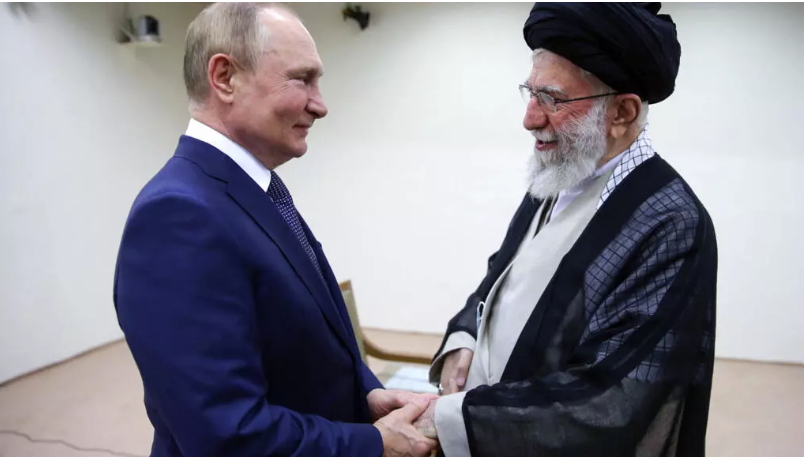
Iranian Supreme Leader Ayatollah Ali Khamenei received Russia’s President Vladimir Putin in Tehran in July 2022 © – / KHAMENEI.IR/AFP/File
In the modern information battlefield, intelligence is no immunity against manipulation. In fact, it can sometimes make one more susceptible to it. Highly educated commentators, respected scholars, and seasoned journalists can—without realizing it—end up reinforcing narratives carefully cultivated by authoritarian regimes. In the age of hybrid warfare, this phenomenon has become one of the most effective strategic tools deployed by the Kremlin.
I was reminded of this recently while listening to a conference featuring historian and commentator Anne Applebaum, one of the West’s most prominent analysts of authoritarian systems. In her remarks, she correctly described the extensive ways in which Vladimir Putin’s Russia attempts to influence Western societies. These methods include online propaganda networks, manipulation of traditional media, exploitation of academic institutions, and the amplification of polarizing voices through social platforms. Russia’s doctrine of hybrid warfare is built precisely around these techniques.
Yet, within the same conversation, a contradiction appeared.
Applebaum also argued that the ongoing military confrontation with the Iranian regime was “a war of choice” and noted that the United States had used more Patriot missile interceptors in roughly twelve days of fighting in the Iran theater than Western countries had provided to Ukraine over extended periods during its defense against Russia. The implication was clear: resources were being diverted toward a conflict that might have been avoidable, rather than toward one that was clearly defensive.
This argument may sound reasonable at first glance. But it ignores a critical strategic reality.
The confrontation with the regime in Iran was not a discretionary adventure undertaken on a whim. It was the culmination of years of escalating threats, weapons development, and openly declared hostility toward the state of Israel. Iranian leaders and their proxies have repeatedly stated their intention to destroy Israel. Over the past decade, Tehran has invested heavily in ballistic missile programs, proxy militias across the Middle East, and nuclear enrichment capabilities that many intelligence services believe were moving steadily toward weapons-grade thresholds.
At the same time, Iran’s regional strategy involved surrounding Israel with heavily armed proxy forces—from Hezbollah in Lebanon to various militias in Syria and Iraq. These groups have accumulated vast arsenals of rockets and missiles capable of striking Israeli population centers.
The strategic fear was not hypothetical. Israeli defense planners increasingly warned that Iran was approaching the ability to coordinate massive, simultaneous missile barrages that could overwhelm Israel’s layered air defense systems. Even advanced systems like Iron Dome, David’s Sling, and Arrow have limits. Saturation attacks—hundreds or thousands of projectiles launched at once—are designed precisely to exceed those limits.
In that context, the claim that confronting Iran represented a “war of choice” becomes difficult to sustain.
A better historical analogy may be one that many analysts prefer not to invoke: the question of whether a preemptive strike against Japan before the Attack on Pearl Harbor would have been labeled a “war of choice.” In hindsight, we know that Japan’s strategic trajectory made conflict with the United States almost inevitable. But at the time, any preemptive move by Washington would almost certainly have been described by critics as unnecessary aggression.
History often punishes those who wait too long to recognize an approaching threat.
The deeper issue raised by Applebaum’s comments is not simply about military resource allocation. It is about perception—and how public perception in democratic societies is shaped.
Russia’s hybrid warfare doctrine is built precisely on creating confusion about the legitimacy of Western actions. Through networks of media influence, social media amplification, and sympathetic ideological actors, Moscow seeks to frame defensive or preventive actions by Western democracies as reckless aggression. The goal is not necessarily to convince everyone, but to generate enough doubt and division that democratic governments struggle to act decisively.
In this sense, Iran occupies a special place in Russia’s broader geopolitical strategy. Tehran has become one of Moscow’s most important strategic partners. Iran supplies drones and military technology used in Russia’s war against Ukraine. Russia, in turn, provides diplomatic cover and technological assistance to Iran’s military and nuclear ambitions. Weakening the Iranian regime—or even significantly degrading its military capabilities—would directly undermine one of Russia’s key partners in the anti-Western axis that has been gradually consolidating over the past decade.
Seen from Moscow, therefore, shaping Western opinion against confronting Iran is a strategic objective.
This is where the concept of the “useful idiot,” famously attributed to discussions about Soviet propaganda tactics, becomes relevant. The term does not describe malicious actors or secret agents. It refers to well-intentioned individuals who, while acting in good faith, unintentionally reinforce narratives that serve authoritarian interests.
Hybrid warfare thrives on precisely this dynamic.
A respected intellectual raising doubts about the necessity of confronting Iran may believe they are promoting restraint and prudence. Yet the effect of that argument—especially when amplified across media ecosystems—is to weaken political support for actions that could constrain a regime closely aligned with Moscow.
The irony is striking. In the same breath that one warns about Russia’s information warfare, one may unknowingly echo a narrative that aligns almost perfectly with Russian strategic interests.
This is not an accusation of bad faith. It is a reminder of how complex the modern information environment has become. Even experts deeply familiar with authoritarian tactics can find themselves navigating narratives shaped by those very tactics.
Democratic societies face a difficult challenge. They must remain open to debate, criticism, and dissent—these are the very qualities that distinguish them from authoritarian systems. At the same time, they must also recognize that adversaries actively exploit this openness.
The line between healthy skepticism and strategic self-deception can sometimes be thinner than we think.
Understanding that line requires more than intelligence or expertise. It requires a constant awareness that the information battlefield is real, and that the narratives shaping public opinion are often part of deliberate geopolitical strategies.
When smart people fail to recognize this dynamic, they can become—despite their best intentions—participants in someone else’s information war.
And in the era of hybrid conflict, that may be one of the most powerful weapons authoritarian regimes possess.
The Free World must recognize a simple truth: Ukraine, Israel, Taiwan, and other frontline democracies form a single chain of bulwarks against dictatorship. If one link is allowed to break, the entire chain is weakened and will ultimately fail. Let’s be smart!
About the Author
Dr. Andrei Schwartz is an independent geopolitical commentator specializing in international affairs, foreign policy, and security dynamics. Based in Europe, he brings a global perspective to the analysis of great-power competition, regional stability, and the evolving balance between East and West.
Through his public commentary, Dr. Schwartz examines underreported developments, challenges prevailing narratives, and explores the strategic implications of political and security decisions impacting democratic societies. His work places particular emphasis on national sovereignty, institutional resilience, and long-term geopolitical risk.
He is especially focused on the preservation of the values and civilizational foundations of the Judeo-Christian world, as well as the strength and continuity of the Transatlantic partnership as a cornerstone of international stability.
Related Topics
Related Posts


Andrei Schwartz