The views expressed herein are solely mine.
Riyadh Chose the Brotherhood Security Camp
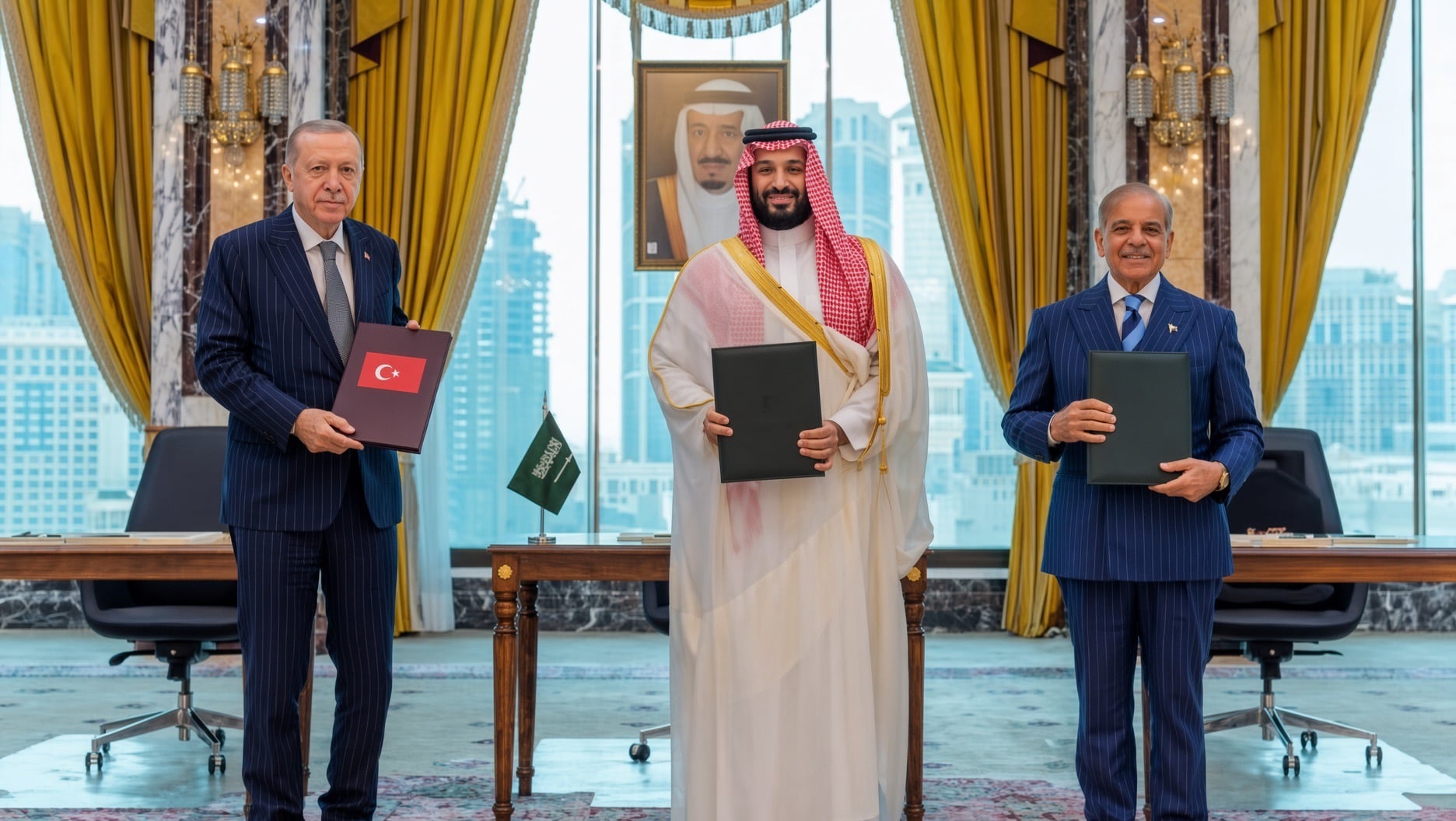
From left, Turkish President Recep Tayyip Erdogan, Saudi Crown Prince Mohammed bin Salman and Pakistani Prime Minister Shehbaz Sharif pose after signing a trilateral defence agreement in Mecca, Saudi Arabia, Friday, Aug. 7, 2026. (AP PHOTO).
On August 7, 2026, Saudi Arabia ended years of geostrategic ambiguity. Saudi Crown Prince Mohammed bin Salman (MBS) joined Turkey’s neo-Ottoman despot, Recep Tayyip Erdoğan, and Pakistani Prime Minister Shehbaz Sharif in Mecca to sign a mutual-defense agreement that treats an attack against any member as an attack against all three.
The conflict with Iran did not create Saudi Arabia’s strategic realignment; it merely forced the kingdom to reveal its true loyalties. As Tehran and its proxies bombarded Saudi territory with missiles and drones and disrupted vital energy shipments through the Strait of Hormuz and the Red Sea, the barrage accelerated a choice MBS had postponed for years. His random, erratic, and impulsive reversals have earned him the moniker “Trump of the Middle East.” This crisis stripped away the diplomatic theater and exposed the revisionist order he actually prefers.
Before the war, Saudi Arabia stood one political decision away from joining an emerging Abrahamic security network. Such an “Abrahamic NATO” never required a Brussels bureaucracy, a permanent headquarters, or an Article 5 guarantee. Israel, the United Arab Emirates, Bahrain, and Morocco already produced alliance effects through intelligence cooperation, missile-defense coordination, defense technology, maritime security, and strategic access across the arc from Gibraltar to Hormuz.
The Al-Saud regime had even already laid the geopolitical groundwork. Saudi authorities opened their airspace to Israeli aviation, joined the 2023 India-Middle East-Europe Economic Corridor (IMEC), and negotiated a tripartite pact that linked American security guarantees and a civilian nuclear program to normalization with Jerusalem. IMEC, for example, promised to translate the Abraham Accords from diplomatic symbolism into hard strategic reality. By September 2023, MBS openly declared that normalization drew “closer every day.” Yet closer never became close enough.
Any illusion of gradual convergence was shattered in September 2025, when Saudi Arabia signed a bilateral mutual-defense pact with Pakistan to counter rising Iranian aggression. Once the war with Tehran erupted, Islamabad immediately dispatched roughly 8,000 troops, sixteen JF-17 fighters, two drone squadrons, and a Chinese-made HQ-9 air-defense system to the kingdom. This public deployment alone marked a significant escalation, but the confidential arrangement behind it reportedly permits Pakistan to deploy as many as 80,000 troops. With Ankara eager to project power across the Islamic world, Turkey’s accession now transforms that bilateral arrangement into a powerful trilateral military bloc.
While Qatar abstained from signing this new Mecca Pact, Doha remains a core constituent of this expanding, yet toxic alignment. Saudi Arabia’s desperation to blunt Iran has inadvertently integrated the kingdom into a pre-existing Islamist network. The Turkish military base in Qatar, capable of hosting thousands of troops, serves not as a stabilizing force but as the axis’s hard-power spine. For decades, Qatari and Turkish authorities have coordinated defense production and played a double game, hosting Hamas’s political bureau while laundering the Muslim Brotherhood’s extremism through state-sanctioned media platforms. Simultaneously, Pakistan supercharges this alignment with military manpower, Chinese hardware, and the blackmail leverage of a nontransparent arsenal containing an estimated 170 nuclear warheads.
Accordingly, the division of labor within this unnatural coalition is now unmistakable. Turkey supplies the military-industrial center. Qatar provides capital, media reach, sanctuary, and diplomatic access. Pakistan contributes troops and nuclear prestige. By joining them, Saudi Arabia now gives this radical ecosystem strategic depth, geographic reach, and access to the heart of the Arabian Peninsula. To Washington and regional allies, the distinction between Riyadh’s ideological membership and its geopolitical enablement offers little comfort; they must absorb the consequences of a re-energized Islamist axis.
This is a dangerous movie the West has seen before, and Saudi Arabia’s modern strategic blunders reflect a history that MBS seems determined to ignore. During the 1950s and 1960s, the kingdom foolishly opened its borders to Muslim Brotherhood exiles fleeing Egypt and Syria, naively viewing them as a convenient buffer against Gamal Abdel Nasser’s revolutionary Arab nationalism. Rather than remain grateful guests, these radical cadres systematically infiltrated Saudi schools, universities, and religious institutions. From within the state apparatus, they effectively engineered the subversive Sahwa, or ‘Islamic Awakening’—the very internal monster MBS spent the last decade trying to exorcise.
Instead of containing this rot, Riyadh spent the mid-1970s expanding it globally. Saudi state organs quietly bankrolled the Muslim Brotherhood’s international ambitions and leveraged the Muslim World League to build a formal transnational apparatus. This shortsighted Saudi patronage handed the movement vital logistical depth and global networks. Ironically, this is the same infrastructure that migrated toward Qatar and Turkey decades later, after Riyadh belatedly recognized its mistake and turned against the group.
Predictably, the Islamists never repaid Saudi generosity with loyalty, resulting in a blowback that nearly destroyed the monarchy. When King Fahd invited American forces into the kingdom in 1990, Sahwa leaders weaponized the organizational skills they had honed under royal protection and turned them directly against the throne. Their campaign mounted the most severe domestic threat the House of Saud had faced in its history, forcing desperate Saudi authorities to spend the rest of the 1990s trying to dismantle the extremist monster that their own delusional strategy had empowered.
Despite this damning historical record, Riyadh’s current alignment does not mean Saudi Arabia has adopted Muslim Brotherhood doctrine. The kingdom formally outlawed the group in 2014, and MBS famously tarred Iran, Turkey, and the Brotherhood as a “triangle of evil” in 2018. Yet, history proves that ideological membership and strategic enablement are not the same. By binding Saudi security to the Brotherhood’s principal state patrons and protectors in a desperate bid to counter Tehran, MBS has done the unthinkable: he has invited the virus back through the defense terminal, strengthening the very geopolitical ecosystem he once condemned.
Nowhere is this strategic blindness more acute than in Saudi Arabia’s landmark 2023 procurement of Bayraktar Akıncı combat drones. By handing Ankara the largest defense-export contract in Turkish history, the kingdom did not just purchase hardware; it directly financed a hostile, ideologically driven defense complex. The political core of the Ankara-Islamabad axis flatly rejects the stabilizing order built by Israel, the Emirates, India, Greece, and Cyprus. Consequently, Saudi defense dollars now underwrite the very coalition designed to eviscerate the Abrahamic network.
This financial enabling laid the groundwork for formal alignment, and the Mecca pact now creates three immediate dangers. First, collective defense gives Ankara and Islamabad dangerous leverage over Saudi threat perceptions. Turkey maintains disputes with Greece and Cyprus, while Pakistan’s confrontation with India remains nuclearized. Neither theater advances Saudi security. As a result, Riyadh has unilaterally decided to hollow out its own security by inheriting Ankara’s aggressive revisionism and Islamabad’s toxic rivalries.
Second, the agreement places American, Chinese, Turkish, and Pakistani systems inside an increasingly crowded command environment. Saudi forces operate American F-15s, Patriot systems, and Terminal High Altitude Area Defense (THAAD) batteries, while Pakistani personnel have now brought Chinese HQ-9 systems and JF-17 fighters. Deeper integration could expose American operational patterns and electronic signatures unless Washington and the Abraham Accords states enforce strict technical separation. Saudi Arabia cannot simultaneously demand access to America’s most sensitive defense technology and major non-NATO ally status while integrating its command environment with Chinese-equipped Pakistani forces.
Third, the pact attacks the economic logic of the Abrahamic order. Erdoğan opposed IMEC because its planned route bypassed Turkey, just as Pakistan remains India’s main military adversary. Saudi Arabia has therefore allied itself with the two states possessing the clearest interest in weakening the corridor that once promised to place the kingdom at the center of an Indian-Arabian-Israeli-European system. MBS did not merely decline the Abrahamic network; he joined the governments most determined to undermine it.
For these reasons, Washington’s fixation on Saudi normalization has outlived strategic reality. The United States must stop making that elusive prize the axis around which every regional initiative orbits. Instead, Israel, the United Arab Emirates, Bahrain, and Morocco should immediately establish a distributed Abrahamic fusion lattice, with Egyptian and Indian liaison cells. Morocco should host the Atlantic node, the United Arab Emirates the Gulf node, Bahrain the maritime node, and Israel the missile-and-drone correlation node. A common data standard should let every capital exchange radar tracks, shipping anomalies, sanctions data, and cyber warnings without creating a politically vulnerable headquarters or formal mutual-defense treaty.
These nations should also pair that lattice with an Abrahamic defense-production passport. Israel can provide cutting-edge seekers, advanced electronic-warfare systems, and unmatched, battle-tested integration. The United Arab Emirates can supply capital and logistics. Morocco can manufacture airframes, combat vehicles, and wiring assemblies, while Bahrain anchors fleet maintenance. Egypt and India can contribute the industrial scale required to make the network self-sustaining. Cross-certification would allow members to repair or replace preapproved components under an active blockade. Rotating reserves of interceptor motors, drone engines, advanced electro-optics, secure radios, and critical power modules among Morocco, the United Arab Emirates, and India would deny hostile actors the ability to paralyze the network at the Strait of Hormuz or Bab al-Mandab. An alliance that cannot replenish its own hardware under enemy fire remains a diplomatic club, not a serious security framework.
In parallel, Washington and the Abraham Accords states must construct rigorous procurement firewalls around critical defense systems. Any regime integrating Turkish, Pakistani, Qatari-financed, Chinese, and American platforms must segregate mission data, source code, logistics nodes, and electronic-warfare libraries. The United States should condition future transfers of advanced software and munitions to Saudi Arabia upon verifiable network isolation and aggressive end-use monitoring. Regional allies should share only sanitized warning data until the kingdom restores strategic trust.
Finally, the US Congress must act where the executive will not. The Trump administration has dangerously accommodated this newborn Qatar-Pakistan-Turkey-Saudi axis through its recent Strategic Defense Agreement, preferential defense access, and the short-sighted approval of future F-35 deliveries—completely ignoring the existential risks to American technology, Israeli security, and the corridor connecting India to Europe. Thus, Congress must step in to prohibit the sale or transfer of F-35 aircraft and related systems to Saudi Arabia, while blocking any privileged access to American defense articles or co-production agreements. Congress should mandate strict technical segregation between American platforms and Turkish, Pakistani, Chinese, or Qatari-linked systems, conditioning every future release of munitions or software upon continuous end-use monitoring and verified network isolation. Policymakers should also restrict intelligence sharing and suspend nuclear cooperation until Saudi Arabia reverses course.
This return to the Muslim Brotherhood camp proves Riyadh has learned nothing from history. Having previously burned themselves playing with Islamist fire, Saudi leaders are repeating the same strategic blunder. The Abrahamic security network cannot afford to wait for slow learners. Washington and its allies must move forward aggressively and let Saudi Arabia fail once again.
Related Topics
Related Posts