
The views expressed herein are solely mine.
Smash Eagle 44 Before Iran Soars
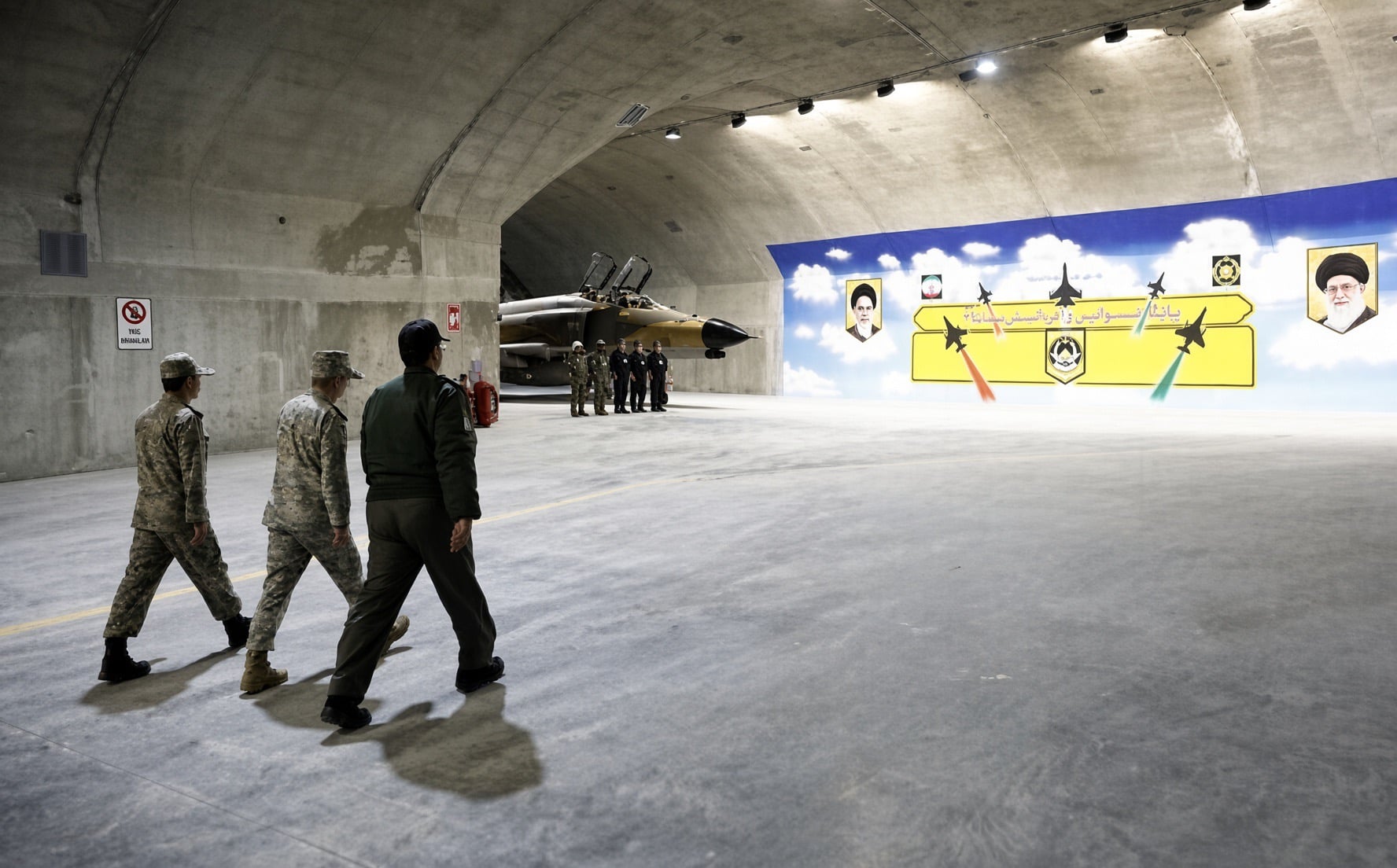
A poster inside a newly unveiled Iranian underground Air Force base. The central silhouette appears to be that of the Sukhoi Su-35 jet, which Iran does not yet have as of February 2023. (Iranian Army via Fars).
Iranian engineers are rapidly reconstructing and expanding the Eagle 44 underground airbase, defying at least three separate U.S. and Israeli air assaults launched between late March and July 15, 2026. Recent imagery from as late as September 29, 2026 shows a finished western taxiway section with its upper concrete layer fully complete. Simultaneously, a second segment is advancing across compacted and stabilized soil, runway obstacles have been cleared, and debris has been entirely stripped from paved surfaces. Although two surface support buildings remain rubble and another stands damaged, unyielding impact craters still pocket the landscape near the western tunnel entrances. Nestled deep within the Zagros foothills of Hormozgan province—160 kilometers northwest of the critical Strait of Hormuz—the facility shields IRIAF F-4 Phantoms, strike drones, and heavy munitions inside a network of tunnels excavated since 2013. Iranian authorities originally unveiled the asset in February 2023, but Tehran’s current rush to pave a second taxiway underscores a deeper strategic resilience. This calculated redundancy guarantees an alternate route from the western hangars to the 4.3-kilometer runway the moment a primary link is cratered.
This precise geographic footprint positions protected aircraft and drones within minutes of a chokepoint carrying roughly 20% of global oil shipments, directly menacing U.S. naval forces in the Gulf and partner facilities along the Arabian shore. By forcing Eagle 44 back into service, Iran preserves its capacity to regenerate air and drone power even after absorbing initial waves of precision strikes. Consequently, the regime retains the leverage to threaten commercial shipping, compel U.S. carrier strike groups to operate farther away, and fundamentally drive up the political and economic costs of any future Western intervention. While earlier strikes under Operation Epic Fury damaged surface access routes and temporarily isolated assets inside the mountain, the subterranean tunnels show no evidence of structural collapse. Tehran’s heavy investment in a redundant taxiway exposes a deliberate blueprint to maintain sortie generation under persistent bombardment. American and Israeli planners, therefore, face a hardened node whose ultimate military value depends less on the current number of flyable airframes than on its structural capacity to project power adjacent to the chokepoint.
Allied planners confronted this exact geometric dilemma in early 1945 at the Mittelwerk complex near Nordhausen. By March of that year, the Allies recognized that conventional strategic bombing could not collapse the V-2 production halls carved deep into the Harz mountains. Effective denial instead required sealing the northern and southern tunnel portals while relentlessly interdicting the connecting rail lines, ensuring that ready-to-use missiles could not exit and raw materials could not enter the site. By choking off those narrow access points, forces can render a completely intact interior strategically inert. This same operational principle later led Allied efforts against Germany’s broader subterranean infrastructure: when the mountain protects the machinery, only the mouths and arteries serving it dictate whether the site retains military utility. Eagle 44 presents the exact same problem today. The ridge reliably shields the aircraft and munitions, but the entire asymmetric advantage hinges on the taxiways and tunnel entrances—the sole chokepoints dictating whether these assets can deploy or safely retreat.
Two concrete measures would immediately convert this defensive geometry into a decisive allied advantage. First, U.S. and Israeli planners must designate Eagle 44’s tunnel portals and both taxiway alignments as a permanent, pre-planned “access-denial” target set. The attack sequence should lead with ordnance tailored to crater the taxiways and immobilize aircraft movement, shifting instantly to heavy penetrating weapons aimed directly at the lips of the tunnel mouths. These follow-on strikes would collapse the unstable rock and soil directly above the entrances, engineering a thick rubble plug far more complex and time-consuming to clear than an ordinary surface crater.
Furthermore, the coalition must establish continuous, high-resolution satellite and signals monitoring over these exact coordinates, structurally paired with pre-delegated re-strike authority. Under this protocol, any detected Iranian attempt to clear debris, establish an improvised path, or pave a connection would automatically trigger an immediate, automated follow-on strike—bypassing the delays of a standard campaign planning cycle. Together, these two steps turn the mountain’s geology and Tehran’s reconstruction tempo into liabilities rather than assets.
Ultimately, the permanent denial of Eagle 44’s exits completely removes Iran’s ability to regenerate air and drone power at the edge of the Strait. Leaving those exits intact, by contrast, preserves a hardened sanctuary that previous strikes have already proved cannot be neutralized by superficial surface damage alone.
Related Topics
Related Posts