

Geopolitical Analyst: Bridging Somaliland & Israel to the world
Somaliland and the New Regional Containment Battle
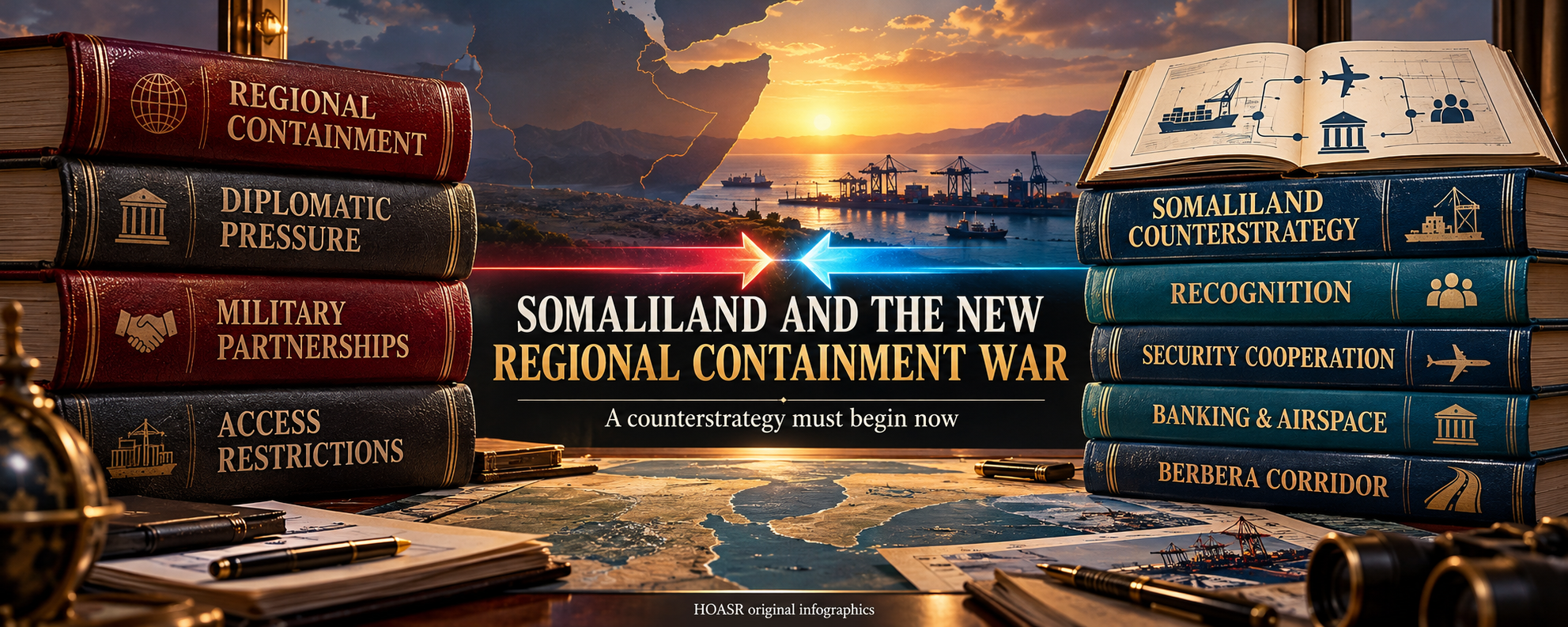
An editorial illustration showing opposing strategy volumes, with regional containment facing Somaliland’s plans for recognition, security cooperation, banking, airspace and the Berbera corridor. Credit: HOASR original infographics.
Somalia: The Second Strategy
For more than three decades, Mogadishu’s main answer to Somaliland was legal and diplomatic. It invoked Somalia’s internationally recognized borders, persuaded governments to avoid formal recognition and relied on the African Union, Arab League, Organization of Islamic Cooperation and United Nations system to preserve the status quo.
Israel changed that status quo when it recognized Somaliland on 26 December 2025. The recognition did not produce an immediate chain reaction, but it destroyed the claim that no UN member state would ever cross the line. Mogadishu now had to isolate it, discourage a second and reduce its practical value.
The El Alamein Joint Declaration of 4 October 2026 shows how the second strategy is taking shape. Egypt, Somalia, Eritrea and Sudan rejected recognition or support for Somaliland.
In the same document, they declared that Red Sea governance belongs exclusively to coastal states and rejected unilateral action affecting the interests of the two downstream Nile countries. They also agreed to establish a follow-up mechanism and hold further consultations.
This is what may be called Somalia’s second strategy: moving from territorial integrity as a legal defense to regional containment as a political system. The objective does not have to be military conquest.
It can be achieved by making recognition costly, limiting Hargeisa’s room to operate and ensuring that Somaliland remains dependent on institutions controlled by or accessed through Mogadishu.
The verified record is already serious enough. Egypt and Somalia signed a security pact in 2024, and Egypt delivered weapons and ammunition to Mogadishu later that month. Egypt subsequently committed personnel to the African Union mission in Somalia.
The African Union’s February 2026 communiqué states that the Egyptian deployment should coincide with the withdrawal of Burundian troops.
It does not say Egypt will replace Ethiopia or establish positions along Ethiopia’s eastern frontier. Indeed, AUSSOM reported on 7 September that Ethiopian personnel in Sector 4 were being replaced by a new Ethiopian rotation.
Villa Somalia could allow Egyptian or Turkish deployments anywhere through bi-lateral agreements in the future. Whether or not that is a part of its ongoing strategy to contain Somaliland remains to be seen.
Israel: Recognition Must Become Power
President Abdirahman Irro’s state visit to Israel on 14 June 2026 and the opening of Somaliland’s embassy in Jerusalem moved the relationship beyond a press release.
Yet no second government has followed Israel, and the regional response has grown more organized. The issue is: can the relationship acquire enough institutional weight to survive pressure?
Israel should therefore resist the temptation to define success through rumors of a base at Berbera. Somaliland’s defense minister has confirmed Israeli training but said there were no talks for an Israeli military base, as Reuters reported in June.
A secretive or heavily militarized relationship would give Somaliland’s opponents their strongest narrative: that recognition was purchased for a military base against Yemen or for importing the Gaza conflict into the Horn.
The better strategy is visible, civilian and difficult to reverse. Israel can help Somaliland train Somalilanders and build maritime awareness, coast-guard professionalism, cybersecurity, water systems, agriculture, health technology and financial compliance.
It can support an internationally safe approach to Somaliland’s airspace problem and connect Hargeisa with insurers, banks, investors and research institutions. These are quieter under the radar tools than a naval base and would create a more lasting power.
As I argued earlier in The Red Sea Opening Israel Cannot Afford to Lose, the geopolitical competition is not over who arrives first. We know Israel arrived first. The race is over who shapes the geography environment after recognition.
Türkiye: The Competitor with Institutional Advantage
Türkiye is not simply another country supporting Somalia’s territorial position. It is the external power most deeply implanted into the Somali state.
Somalia’s official record describes the February 2024 defence and economic cooperation agreement as a ten-year commitment under which Türkiye will build, train and equip the Somali navy.
Ankara has also signed agreements covering offshore energy exploration, trained Somali forces at TURKSOM and deployed naval assets in support of its maritime operations. President Recep Tayyip Erdogan has called Israel’s recognition of Somaliland unacceptable and said preserving Somalia’s unity is a Turkish priority.
This gives Ankara several advantages at once: trained personnel, access to commanders, defense procurement, offshore energy interests, naval operations and a close political relationship with Mogadishu. Türkiye can describe these activities as counterterrorism, state-building and maritime security.
The lesson here is that an embedded power can influence events without dramatic announcements. Israel cannot answer Türkiye’s long-built position with symbolism. It needs civil institutions of its own in Somaliland.
Somalia can present them as protection of recognized sovereign territory. Somaliland and Israel must nevertheless consider how the same capabilities could shape the balance around Berbera and waters claimed by both Hargeisa and Mogadishu.
Egypt: The Nile Meets the Gulf of Aden
Egypt primarily views Somaliland through Ethiopia. Addis Ababa’s search for sea access and the Grand Ethiopian Renaissance Dam place the Gulf of Aden and the Nile inside the same strategic calculation.
The declaration is useful strategy for Cairo. It organizes diplomatic pressure around several of Ethiopia’s vulnerabilities at once. Egypt can improve its bargaining position over the Nile by supporting governments able to restrict Ethiopia’s maritime choices. Somalia gains a powerful external partner against Somaliland. Eritrea gains regional backing at a moment of renewed confrontation with Addis Ababa over Red Sea access.
A northern war would make access through Eritrea more dangerous and a negotiated commercial corridor through Berbera more valuable. But it could also make Addis Ababa more cautious at the very moment Somaliland needs a decisive partner.
Saudi Arabia and the Makkah Pact
The Makkah Joint Defence Agreement adds another layer to the contest. Saudi Arabia, Türkiye and Pakistan signed the agreement on 7 August 2026. They established a permanent secretariat on 31 August, and in early October agreed to move quickly on collective defense measures after attacks on Saudi Arabia. Türkiye has said its role would be defensive and focused on areas such as air defense, electronic warfare and technical support.
Its political significance is still considerable. All three members joined the diplomatic rejection of Israel’s recognition of Somaliland. Saudi Arabia is an influential Red Sea state, while Pakistan provides military capacity and now leads the pact’s secretariat. A security structure does not need a Somaliland clause to alter how Israel, the UAE and Hargeisa calculate risk.
Saudi policy already intersects with Gulf competition. Somaliland should not assume that the Abraham Accords or Gulf solidarity will automatically align Saudi policy with the UAE’s investment in Berbera or Israel’s recognition.
The U.A.E.: The Investor Cannot Stay Only an Investor
The UAE has more commercial exposure in Somaliland than any other Gulf state. DP World says it committed up to $442 million to develop and expand Berbera Port. The port, economic zone and corridor toward Ethiopia form the physical foundation of Somaliland’s claim to be a regional trade partner rather than a diplomatic cause.
Mogadishu’s decision in January 2026 to annul its agreements with the UAE showed how quickly a commercial relationship can become entangled in sovereignty politics. DP World said Berbera operations were unaffected, and Somaliland rejected Mogadishu’s decision. The port kept working. The political risk did not disappear.
The UAE does not need to choose between Somaliland and every other Arab partner.However, it does need to protect the commercial system it created. That means corridor finance, customs integration, shipping guarantees, insurance partnerships, direct banking links and quiet diplomacy in Arab capitals. Berbera deserves to be defended as a lawful, reliable commercial hub, not left as a political orphan.
Taiwan: The Democratic Partner with Practical Tools
Taiwan’s relationship with Somaliland is both moral and strategic. The two sides established representative offices in 2020 around what Taiwan’s foreign ministry calls shared values of freedom, democracy and human rights.
Cooperation now reaches health, agriculture, information technology, education and maritime security. A coast-guard cooperation agreement signed in July 2025 added a direct security dimension.
China has answered with an equally clear alignment. In a January 2026 joint statement, Beijing affirmed that Somaliland is part of Somalia, while Mogadishu reaffirmed the one-China principle. That exchange turns two recognition disputes into one diplomatic bargain.
The two tiny democracies have one value in common. Somaliland’s 2024 election produced a peaceful transfer of power after a difficult delay. The international observation mission documented a competitive process across all six regions and issued recommendations for improvement.
But both have built democratic political systems under external pressure, and that experience gives their relationship a solid foundation that transactional diplomacy cannot reproduce.
Ethiopia: Two Strategic Needs and a Narrowing Route
Prime Minister Abiy Ahmed responded on 5 October by again calling access to the Red Sea essential. Days later, the confrontation with Eritrea sharply increased the cost of any strategy centred on Assab. Djibouti remains vital, but near-total dependence on one corridor leaves Ethiopia vulnerable to pricing, political change and regional pressure.
The 2024 memorandum with Somaliland was bold but incomplete. Its secrecy, naval language and uncertain implementation allowed Somalia to mobilize regional opposition before Ethiopia and Somaliland had built the legal, commercial and diplomatic support needed to sustain it. Addis Ababa should learn from that failure rather than abandon the Berbera option.
Ethiopia can commit cargo volumes, invest in the road and dry-port network, harmonize customs systems and make the Berbera corridor part of a transparent national logistics plan. Security cooperation should protect trade, not create the appearance that Somaliland’s coast is being acquired for military use.
Ethiopia must also stop treating Somaliland as leverage to be raised in one negotiation and lowered in the next. If Addis Ababa wants a dependable route, it must become a dependable partner.
Djibouti: The Absent State at the Centre of the Calculation
Djibouti was absent at El Alamein. The reason: Djibouti’s economic interest requires no conspiracy theory. The World Bank says Djibouti handles 95 percent of Ethiopia’s imports. A 2025 Congressional Research Service brief, citing World Bank material, says more than 90 percent of Ethiopian trade transits Djibouti and estimates roughly $400 million a year in port fees.
The frequently repeated figure of about $120 million for Ethiopian port access is not supported by the strongest available sources; it appears closer to estimates of Djibouti’s total foreign-base rent rather than Ethiopian port payments. Berbera therefore threatens no one by its mere existence.
One of the risks for Washington is concentration. Camp Lemonnier is the only enduring American military installation in Africa. China opened its first overseas military base in Djibouti in 2017, only a few miles away. The Congressional Research Service records American concerns about Chinese attempts to restrict airspace and interfere with US flights near the two facilities. Berbera offers Washington diversification, not a demand to abandon Djibouti.
Washington: Delay Is Also a Decision
President Irro’s September visit to the United States put Somaliland before Congress, executive agencies and policy institutions. His Hudson Institute appearance on 14 September presented Somaliland as a security and economic partner. He met lawmakers including Senator Ted Cruz. He then carried the campaign to New York during the UN General Assembly period.
The visit delivered access, but no public US recognition decision, formal security agreement or major investment package. Washington does not have to move from its current policy to full recognition in one step. It can immediately distinguish Somaliland from Somalia in its travel advisory; legislation introduced on 16 September directs the Secretary of State to consider that change.
It can establish a permanent senior channel with Hargeisa, commission investment and security assessments for Berbera, expand direct counterterrorism and coast-guard cooperation and help Somaliland meet the compliance standards required by international banks.
Airspace deserves its own working group. Somalia’s aviation authority says it administers the entire Mogadishu Flight Information Region, while Somaliland controls its airports, landing permission, immigration and security on the ground.
As I wrote in The Visa That Crosses a Border Mogadishu Does Not Control, Somaliland should seek an ICAO-compatible technical arrangement that separates safe service provision from the unresolved status dispute. Israel, the United States, the UAE and Taiwan can supply expertise and diplomatic support, but aviation safety must remain the first rule.
Finance is another imperative front. The World Bank can operate projects in Somaliland only through difficult arrangements connected to its Somalia country framework. Its own evaluation notes that IDA financing required agreements with the Federal Government of Somalia and special subsidiary arrangements before projects could operate in Somaliland. Full World Bank membership normally requires IMF membership, which in turn depends on broad state recognition.
That legal barrier is real, but it is not an excuse for inaction or paralysis. Washington and its partners can pursue direct project agreements, IFC private-sector programs, political-risk insurance where legally possible, verified public financial data and a compliance pathway for correspondent banking.
This Is Not a Simple Democracy VS. Authoritarianism
There is a democratic dimension to this struggle, but the camps are not clean. Somaliland and Taiwan have competitive elections. Israel and the United States are democracies. The UAE is not. Türkiye holds elections but has a highly centralized political system.
Ethiopia and Somalia have their own serious governance problems. Regional policy is driven by security, trade and regime interests as much as political values.
Yet Western credibility is still at stake. Somaliland has spent 35 years building a separate administration, maintaining relative peace and holding repeated elections. If those achievements never affect policy, while recognized states can use institutions they do not control on the ground to block Hargeisa indefinitely, the democratic message becomes hollow.
China benefits from precisely that gap. It can argue that recognition, access and international status are decided by power and institutional vetoes, not by governance or consent. Israel broke that pattern once. The United States and other democracies must now decide whether the exception becomes a durable policy or an isolated act.
Somaliland: The Counter-strategy Must Begin Now
Somaliland’s leadership should stop treating recognition as a single diplomatic campaign managed mainly by the presidency and foreign ministry. The second strategy against Somaliland crosses defense, finance, aviation, ports, local reconciliation, information and law. Hargeisa needs a permanent national coordination structure able to work across all of them.
The first task is to convert Israel’s recognition into a written partnership programme with deadlines, budgets and public benefits. The second is to organize a five-part partner group involving Israel, the United States, the UAE, Taiwan and Ethiopia. Each partner brings a different asset: diplomatic recognition, global influence, investment, technical capacity and market access.
It should invite qualified foreign aviation authorities and independent experts to design options for a Somaliland sector, third-party service provision and eventual ICAO engagement.
Third, Hargeisa needs a financial-access programme led by the central bank, finance ministry and private sector. The target should be verifiable anti-money-laundering standards, beneficial-ownership rules, payment security, audited public accounts and correspondent banking relationships.
The aim is not to escape international rules. It is to meet them so well that political and financial exclusion becomes harder to justify.
Fourth, the Berbera corridor must become a working regional system. Somaliland, Ethiopia and the UAE should publish targets for cargo, road performance, border processing, storage, insurance and investment. A port is strategic only when goods can move through it predictably.
Fifth, although Hargeisa is now addressing its internal vulnerabilities, it must expedite the process and leave no stone upturned. No foreign partner can compensate for unresolved grievances in its regions. Local reconciliation, fair public appointments, revenue sharing, accountable security forces and credible elections are national-security tools.
Somalia’s objective is to create conditions for sociopolitical instability and that is its strongest containment strategy where Somalilanders would feel excluded from their own region. Somaliland needs a disciplined public international narrative brand. It should not answer every rumor with a larger rumor. It should publish facts, agreements and measurable results.
It should clearly explain that partnership with Israel does not mean importing the Gaza war; cooperation with Taiwan does not mean hostility toward China; and a Berbera corridor does not threaten Djibouti’s existence. Effective strategic communication begins with that credibility.
The Scoop: The Map Will Not Wait
Somalia’s second strategy has begun, even if it has never been published under that name. Its elements are visible: a regional declaration, defense partnerships, African Union deployments, Turkish institutional depth, Chinese diplomatic support, Arab and Islamic opposition to recognition and the continued use of aviation, finance and multilateral systems that recognize Mogadishu’s authority.
This is containment in the modern sense. It seeks to keep Somaliland internationally limited, territorially disputed and economically dependent while avoiding the cost of a conventional war.
Israel’s recognition interrupted that strategy. It did not defeat it. The UAE’s investment gave Somaliland infrastructure. It did not guarantee access. Taiwan supplied partnership and know-how. It cannot open every multilateral door. Ethiopia gave Berbera strategic scale. It has not yet made the corridor irreversible. Washington gave Irro a hearing. It has not yet made a decision.
The warning is therefore not only for Hargeisa. It is for every partner that assumes someone else will protect the opening. Strategic space and time disappears when it is not used wisely.
Somaliland’s leaders must move from diplomatic celebration to institutional construction. Its partners must decide whether they want Berbera to become a durable commercial hub in a free and international Red Sea order or leave the field to states already building the alternative.
The map is moving. The bureaucracy says wait. History rarely waits for it.
Related Topics
Related Posts