Geopolitical Analyst: Bridging Somaliland & Israel to the world
Somaliland Chose Taiwan and Israel: The Case for Trust and a Wider Partnership
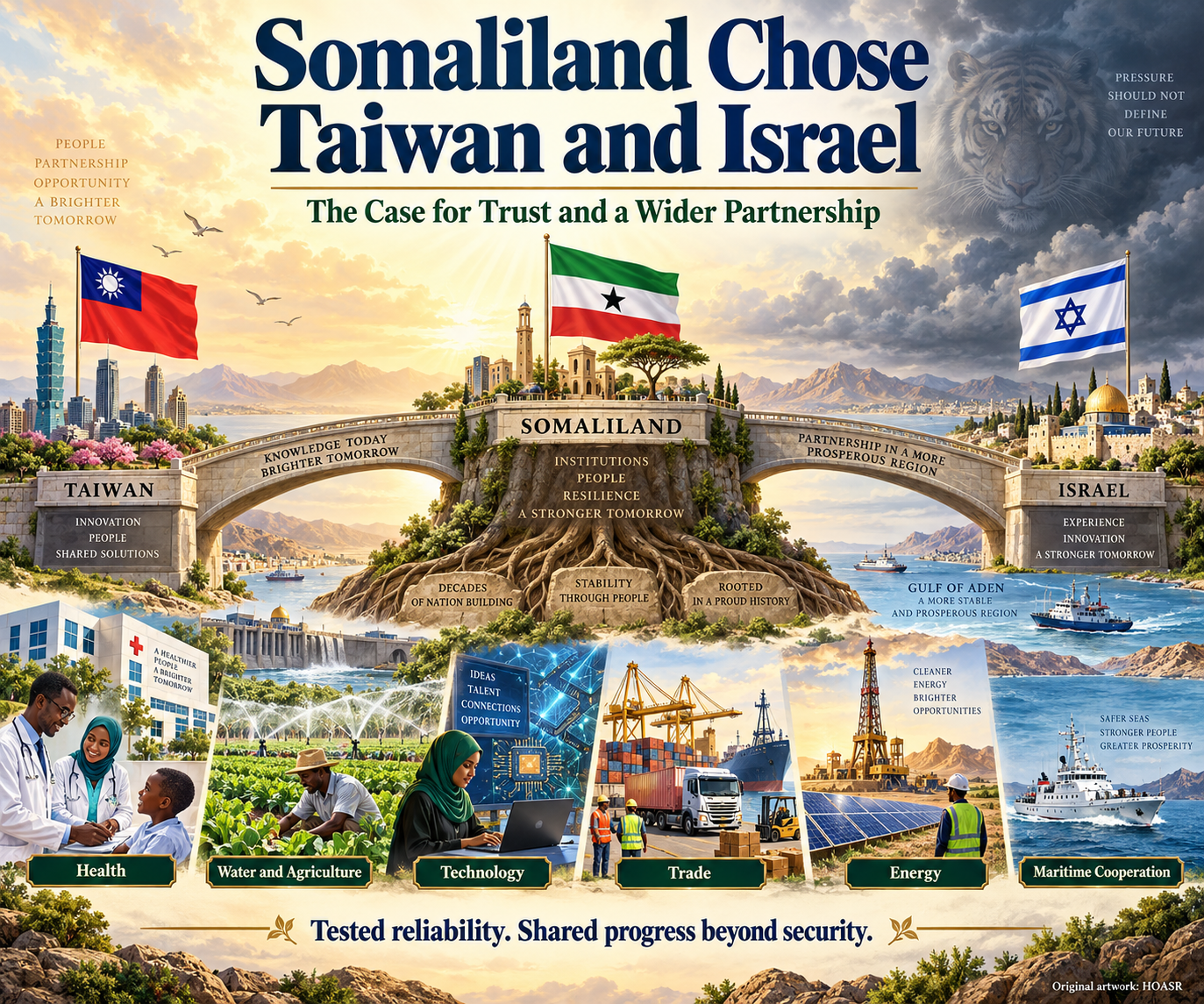
Original HOASR editorial artwork illustrating Somaliland’s resilience and its relationships with Taiwan and Israel. Bridges symbolize sustained cooperation, while scenes of healthcare, irrigation, technology, trade and energy show the potential for a partnership extending beyond maritime security.
Somaliland’s choices under pressure demonstrate reliability and resilience while Taiwan’s practical record and Israeli recognition create the basis for a productive partnership beyond maritime security.
Somaliland chose Taiwan when doing so invited pressure from China. It chose Israel knowing that recognition would provoke opposition from Mogadishu and other governments. Jerusalem should consider those choices together. They reveal a partner willing to stand by a considered national decision when the easier course would be to retreat.
Taiwan’s experience gives Israel something more useful than an assurance of friendship. It provides a record. Since the two sides opened representative offices in 2020, their relationship has survived intimidation and a change of government while developing into cooperation in healthcare, agriculture, technology, commerce and maritime affairs.
Israel’s recognition in December 2025 made a different contribution. It broke a longstanding diplomatic barrier and acknowledged the statehood Somaliland had spent decades exercising. Somaliland accepted that opening and has pursued the relationship through high-level diplomacy and security cooperation.
The next task is to connect recognition to the productive work that makes a partnership last. Israel should match Taiwan’s consistency, exceed its contribution where Israeli capabilities justify doing so and work with Taipei where joint action would serve Somaliland better. Three small democracies can build a partnership whose influence comes from what they accomplish together, extending well beyond Red Sea security.
Somaliland has a record on which trust can be built
Somaliland’s reliability did not begin with its Taiwan relationship. Its 35-year experience since restoring its independence in 1991 has involved rebuilding institutions and maintaining self-government through prolonged diplomatic exclusion. Israeli recognition arrived only near the end of that period.
That history is very important to note because it demonstrates persistence without the normal advantages of international acceptance. Somaliland continued developing a political order while waiting for recognition. Its difficulties are real, but so is the endurance that brought it to this point.
In November 2024, voters elected opposition leader Abdirahman Mohamed Abdullahi Irro to replace the incumbent. The election result showed that national leadership could change through the ballot. The Taiwan relationship continued under the new administration.
For Israel, that continuity is consequential. A friendship that survives a transfer of power has a stronger foundation than an arrangement resting entirely on personal ties between leaders. Hargeisa’s conduct suggests that certain foreign-policy choices have become part of a broader national direction.
Trustworthiness cannot be proved by a single diplomatic decision. It develops through repeated conduct. Somaliland’s persistence with Taiwan, its pursuit of Israeli recognition and its long commitment to self-government together make a serious case for confidence.
I see principle in the insistence that Somaliland should choose its partners for itself. I see resilience in its willingness to bear the consequences. Israel should take that record seriously when deciding how much political effort and productive investment to commit.
Taiwan was a choice Somaliland defended
Beijing opposed the Somaliland–Taiwan relationship from its beginnings. A Foreign Policy Research Institute analysis in 2020 described reported Chinese development offers conditioned on Hargeisa abandoning its emerging partnership with Taipei. Somaliland proceeded with the representative offices.
In a July 2026 commentary, Michael Rubin reported, citing Somaliland and Taiwanese officials, that assistance exceeding a quarter of a billion dollars had been offered and refused. The amount remains an attributed account. The continuing partnership is the clearest public evidence that Chinese pressure failed to secure the outcome Beijing wanted.
For a country with substantial development needs, rejecting assistance tied to surrendering diplomatic choice is meaningful. Somaliland decided that its relationship with Taiwan had value beyond the immediate financial inducement. Jerusalem should recognize the significance of that judgment.
Pressure also reached the movement of people. In April 2025, Somalia’s civil aviation authority notified airlines that Taiwanese passports and travel documents would no longer be accepted for entry, exit or transit from 30 April. The measure affected access to Hargeisa through Mogadishu’s administration of the relevant airspace. Taiwan’s foreign ministry protested, accusing China of instigating the restriction, and noted Beijing’s endorsement.
The partnership survived. On 29 July 2025, Taiwan’s foreign ministry confirmed that ordinary Taiwanese passport holders could again travel to or transit Somaliland and Somalia following diplomatic efforts and assistance from like-minded partners, as CNA recorded. Taiwan’s representative office continued operating.
The eastern disputes add another dimension to the pressure surrounding Somaliland. Rubin has alleged Chinese involvement in an insurgency; Brendon J. Cannon’s April 2026 analysis discussed reports of Chinese arms reaching SSC-Khatumo in Las Anood and the risks created by Beijing’s backing for Mogadishu. These are attributed allegations, not a verified funding chain for destabilization across Sool and Sanaag. Local grievances and contested authority also require attention in their own right.
Somaliland’s strongest response combines diplomatic firmness with reconciliation and development at home. A partner becomes more resilient when citizens have confidence in its institutions and can see opportunities in its future. Israel and Taiwan can help strengthen that foundation.
Beijing’s tiger may roar. Somaliland still has a country to govern, and Taiwan still has a democracy to sustain. Their decision to keep working together is the part of this story Israel should study most closely.
Taiwan has made the relationship productive
Taiwan’s contribution has grown because it remained engaged after the initial diplomatic announcement. Its relationship with Somaliland now reaches into ministries, hospitals, technical programs and commercial ventures.
In remarks marking Somaliland’s national day in May 2026, Deputy Foreign Minister François Wu described cooperation spanning agriculture, healthcare, information technology, education, commerce, energy and infrastructure. He also welcomed Somaliland’s expanding international presence following Israeli recognition. Taipei treated that progress as strengthening a friend’s position.
The June opening of Somaliland’s relocated Taipei office supplied another political signal. Representative Mahmoud Adam Jama Galaal defended Hargeisa’s freedom to choose its relationships despite pressure from Beijing and Mogadishu. The diplomatic presence continued to develop rather than recede.
Healthcare shows what persistence can produce. Somaliland’s health ministry announced an approximately US$22 million Taiwan Medical Center agreement for Hargeisa Group Hospital, and groundbreaking followed in October 2025.
Professional training has already produced tangible results. An August 2026 update reported that, by March, 16 instructors had completed emergency medical services training in Taiwan, 212 participants had completed Advanced Cardiac Life Support training and 118 had received pre-hospital emergency-care training. Ambulance dispatch call centers were also reported at Hargeisa Group Hospital and Gabiley General Hospital.
TaiwanICDF’s project portfolio extends to seed development, fruit and vegetable production, maternal and infant care, health information and electronic government. Its government data-center and information-security project addresses the administrative foundations on which reliable public services depend.
These programs make the democratic connection productive. The partnership helps Somaliland serve its citizens and gives Taiwan a useful institutional presence in the Horn of Africa. Israel should aim for the same depth of engagement, contributing to priorities Somaliland has identified and institutions it can maintain.
Commerce gives the partnership a longer horizon
Taiwan’s commercial involvement strengthens the case that this relationship can endure beyond diplomatic symbolism.
Central Sky International Trading Co.’s January 2026 announcement described a US$20 million livestock quarantine venture near Berbera involving Taiwanese, Saudi Arabian and American private capital. Groundbreaking took place in December 2025. Planned systems included electronic livestock identification, solar power and waste treatment.
Its published schedule envisaged construction through the third quarter of 2026, subsequent testing and operations beginning in early 2027. Those remain project targets. The economic purpose is clear: improve sanitary compliance and traceability in an existing export industry and support access to Gulf markets.
Trade finance is entering the discussion as well. On 18 August, Somaliland’s representative met Taiwan’s Export-Import Bank leadership to discuss commercial mechanisms and stronger financial connections. Separate TaiwanICDF discussions considered investment and lending mechanisms, including water infrastructure. These talks indicate an expanding agenda, although they do not establish approved financing or disbursement.
The lesson for Israel is that serious commerce needs more than delegations. Businesses require equipment finance, workable payments, dependable buyers and enforceable contracts. Export credit and investment insurance should be considered alongside project preparation and commercial outreach.
Israeli veterinary technology, irrigation, water treatment and renewable energy could improve the productivity of Somaliland’s established sectors. Fisheries need resource assessments, sustainable harvesting, processing and cold chains. Cooperation with Taiwanese firms could connect complementary capabilities to markets rather than create competing assistance programs.
Such ventures would also create interests in the partnership’s survival. Workers, producers, institutions and investors have stronger reasons to defend cooperation when it supports their livelihoods. That is a form of diplomatic strength with a much wider reach than naval access alone.
Toosan 1 shows Taiwan accepting commercial risk
Petroleum exploration adds another important dimension. CPC Corporation, Taiwan’s state-owned petroleum company, entered Somaliland’s SL10B/13 block through OPIC Somaliland Corporation under an agreement with Genel Energy providing for a 49 percent working interest. CPC’s announcement records the agreement’s signing in December 2021.
In its August 2026 results announcement, Genel said it continued working with its Taiwanese partner toward the operational and commercial conditions required to deliver the Toosan-1 well. Its planning identified drilling in 2027. Preparations are continuing; drilling and commercially recoverable reserves have not been established by that announcement.
This involvement matters because exploration requires a longer horizon and acceptance of commercial uncertainty. Taiwan’s presence includes a state-owned company pursuing an opportunity with an international energy operator. Somaliland is being treated as a place in which productive activity may warrant sustained commitment.
A successful project could eventually support engineering, transport, procurement and employment, with the scale depending on investment and results. Any future connection to petroleum export infrastructure at Berbera would require a commercially viable discovery and further development.
Israel could contribute geological services, power systems, environmental monitoring or infrastructure technology where project requirements support its involvement. Cooperation in solid-mineral mining would require separate geological mapping, testing and commercial assessment. Oil exploration and mineral occurrences should not be presented as proven wealth awaiting extraction.
Somaliland must ensure that licensing, community consultation and environmental obligations give these ventures a durable public foundation. The purpose of extractive cooperation should be a stronger national economy with transparent benefits.
Israel has changed the diplomatic equation
Israel’s recognition accomplished something Taiwan’s representative-office relationship could not. It formally acknowledged Somaliland as a state and gave Hargeisa a new basis for international engagement. Its significance should be assessed on its own terms.
Somaliland chose to pursue that relationship despite the opposition recognition attracted. Israel should interpret this as another expression of Hargeisa’s insistence on choosing its partners. Taiwan’s experience offers evidence that Somaliland can maintain such a choice through difficult conditions.
President Irro’s June 2026 visit brought meetings with President Isaac Herzog and Prime Minister Benjamin Netanyahu. Somaliland’s defense minister subsequently confirmed Israeli training for police and military personnel while denying talks to establish an Israeli military base in a Reuters interview. An August meeting between the two countries’ envoys in Nairobi continued discussion of regional developments and Red Sea security.
Recognition and these exchanges establish a political foundation. They should now support an organized economic and institutional relationship. Israel’s newer engagement need not duplicate six years of Taiwanese work before contributing at comparable depth.
Jerusalem can begin with sustained programs in water, healthcare, agriculture and digital services, accompanied by commercial financing and professional exchanges. Its diplomatic contribution will carry greater weight when Somalilanders also experience its practical value.
The maritime fusion center belongs within a wider agenda
The Taiwan-funded Red Sea Fusion Centre project, whose launch was reported on 28 August 2026, is an important new opportunity. The event involved Taiwan’s representative Allen C. Lou, senior Somaliland ministers and the coast guard commander. Taiwan’s representative office presented it as supporting freedom of navigation and inviting additional international stakeholders.
The public account did not establish the center’s detailed capabilities or operational readiness. Its potential lies in bringing maritime information together to help responsible agencies understand activity at sea and coordinate responses. Vessel monitoring, search and rescue and fisheries enforcement are possible functions, depending on its eventual design.
The initiative follows the July 2025 coast guard cooperation agreement, which Taiwan’s foreign ministry described as opening a new phase of security cooperation. Israel should explore participation through discussions with Somaliland and Taiwan about staffing, secure communications, analyst training and information-sharing requirements.
This would connect a common interest in maritime commerce to Somaliland’s own coastal responsibilities. Its value will depend on useful information and the capacity to act on it. It should become one part of a broad relationship that also strengthens productive sectors and public institutions.
Three democracies can build influence through delivery
Somaliland, Taiwan and Israel have different histories and very different resources. Their threats are not interchangeable. What they share is an understanding that a small society must invest in its own capacity and preserve room to make national choices under pressure.
Democratic affinity gives that cooperation meaning, but it also demands accountable government, civil liberties and protection of civilians. Somaliland’s political cohesion will depend on its ability to address grievances and extend opportunity beyond Hargeisa and Berbera. Partners should contribute to that work.
Hargeisa should propose a practical Somaliland–Taiwan–Israel coordination mechanism. This is a recommendation for the next stage, not an announcement of an existing three-way agreement. It should begin with a few projects whose financing, responsibilities and schedules are clear.
A health initiative could build on Taiwanese training with Israeli specialist and hospital-management expertise. Water and agricultural programs could combine technical support with equipment finance. Commercial ventures could connect livestock and fisheries services to dependable markets. The fusion-center project offers a separate opportunity for maritime coordination under Somaliland’s authority.
Scholarships, professional exchanges and local training would give these programs continuity. Transparent contracts and public reporting would help Somaliland measure their value. Wider cooperation with Ethiopia, Gulf investors and other partners should remain open; a confident partnership expands Somaliland’s choices.
Israel should match Taiwan in continuity and institutional commitment, and exceed that benchmark where it has the means to deliver more. Partnership with Taipei can help it achieve results sooner. Somaliland’s role is to set priorities and ensure that cooperation serves its citizens.
I believe the Somaliland–Israel relationship will endure because Hargeisa’s record shows that its difficult choices can survive pressure, and because both sides have reason to turn their diplomatic commitment into lasting practical interests. Taiwan’s experience strengthens that judgment.
Somaliland chose Taiwan and defended the relationship. It chose Israel and helped open a new chapter in its international position. Jerusalem now has the opportunity to build with a partner whose reliability has been tested. Working independently and with Taiwan, Israel can help make three small democracies more productive, more capable and more influential far beyond the Red Sea.
Related Topics
Related Posts