

Geopolitical Analyst: Bridging Somaliland & Israel to the world
Somaliland’s Plea for Air Defence Is Rooted in the Isaaq Genocide
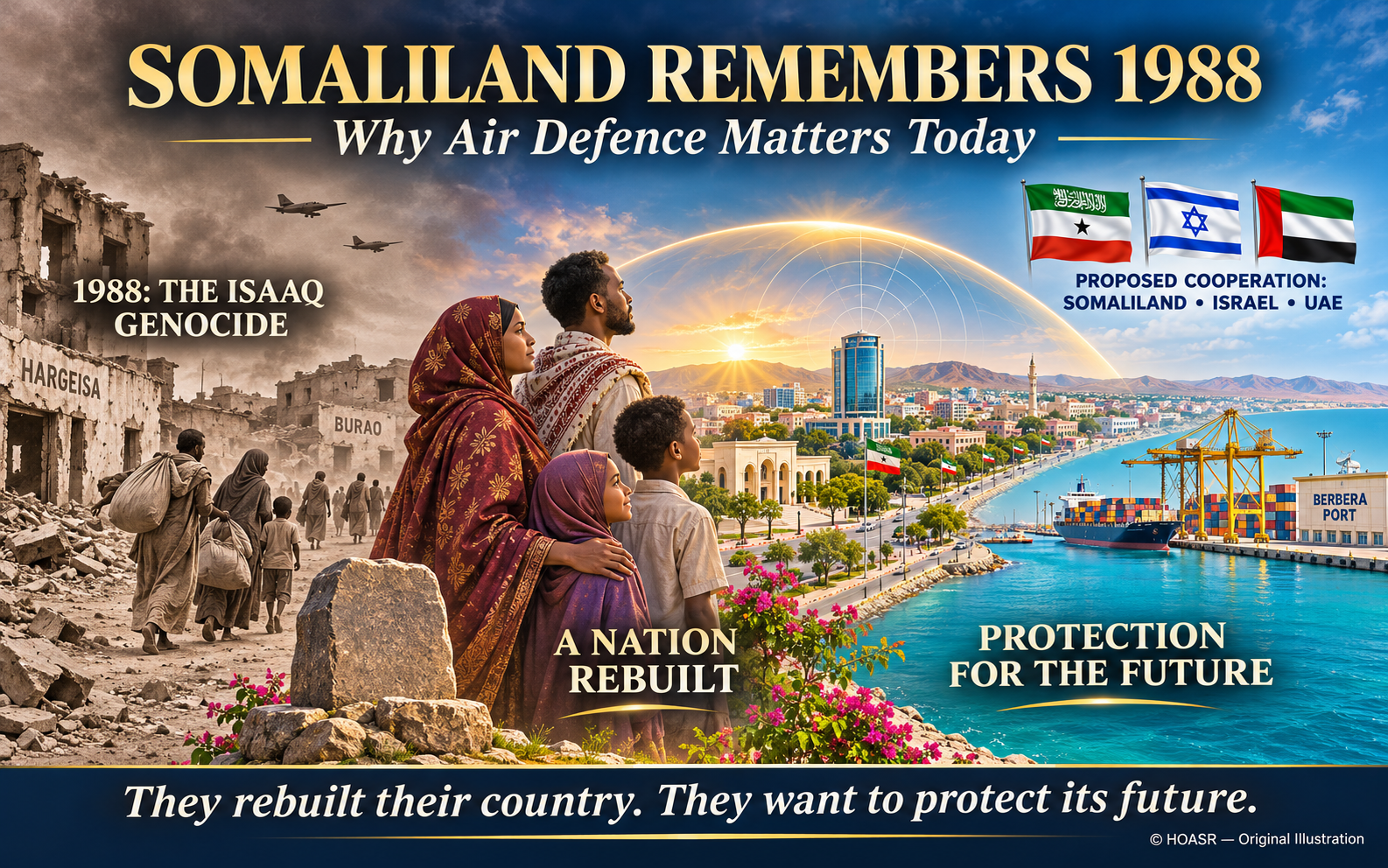
The memory of the Isaaq genocide shapes Somaliland’s appeal for air-defence support. The protective arc represents proposed cooperation, not a deployed system. © HOASR
For Somalilanders, air defense begins with the memory of the Isaaq genocide. This editorial examines how the destruction of 1988, reports of the revived 26th Division and Somalia’s expanding military partnerships explain Somaliland’s appeal for Israeli defensive support.
For Israeli readers the request begins with a history of civilians attacked from the air
When Somalilanders ask Israel for air defence, they are speaking from the experience of the Isaaq genocide. In 1988, Somalia’s military dictatorship led by Gen. Siad Bare, turned aircraft and artillery against Hargeisa and Burao as part of a wider campaign against Isaaq civilians.
Families fled the destruction, returned and rebuilt their towns. They raised children who grew up with the consequences.
Reports of renewed Somali military organisation in the east now revive a question that has never been merely theoretical: what would protect them if political hostility again became military action?
That question connects the concerns of President Abdirahman Mohamed Abdullahi Irro with those of ordinary households. His adviser Mohamed Osman Fadal has publicly sought Israeli air-defence assistance, while Irro has challenged attempts to establish Somali federal forces in eastern Sool in Somaliland.
Jonathan Pollard’s World Israel News commentary proposal for an Israel–UAE defensive partnership enters a discussion already under way in Somaliland. Its urgency becomes clearer once the history behind it is understood.
Somaliland existed before the union
Somaliland was formerly a British protectorate. It became independent on June 26, 1960, before entering a union on July 1 with the former Italian-administered territory to its south. The British instrument ending protection explicitly anticipated Somaliland becoming an independent country. The Somaliland Order in Council of 1960 records that transition.
After the Somali state collapsed in 1991, Somaliland declared the restoration of its independence within the former protectorate’s boundaries. This is the basis of its territorial claim, which Mogadishu rejects.
Somaliland’s argument concerns the restoration of a previously independent state and decades of separate government. It cannot be explained logically as territory suddenly carved out by Israeli recognition.
Those historical boundaries do not resolve every contemporary disagreement over political allegiance or control. Communities in the east have their own grievances and political positions.
Nevertheless, Somaliland’s historical case deserves to be understood before its search for recognition is simply dismissed as an attempt to redraw Africa’s map.
The Isaaq genocide changed the meaning of security
As I wrote in this Blog earlier The Isaaq Genocide was a campaign of persecution and mass violence against a population the Barre regime associated with the Somali National Movement, the armed opposition known as the SNM.
Families and communities were punished for presumed support for the insurgency. Yale University’s Genocide Studies Program identifies the case as the Isaaq genocide, while the Lemkin Institute’s statement places the atrocities within the history of genocide and Somaliland’s subsequent pursuit of security.
After SNM forces entered Burao and Hargeisa in May 1988, government forces subjected the cities and their inhabitants to devastating violence. Africa Watch documented killings, aerial bombardment, artillery attacks and mass displacement.
Its investigation described the punishment of civilians for their presumed support for SNM insurgents. A Government at War with Its Own People establishes why this history cannot be reduced to battles between two armed forces.
An American investigation independently documented the devastation. The U.S. Government Accountability Office reported in 1989 that its inspection broadly confirmed an estimate that 70 percent of Hargeisa had been damaged or destroyed.
Refugees from Hargeisa and Burao described walking at night and hiding by day to avoid military aircraft. The GAO report provides outside corroboration of what an undefended sky meant for fleeing civilians.
Israeli readers do not need to equate different peoples’ tragedies to understand this experience. They need to recognise what happens to political trust when a state turns its weapons against its own people it claims to represent.
For many Somalilanders, restoring independence became inseparable from the determination that their survival would never again depend entirely on decisions taken in Mogadishu. That conviction gives today’s air-defence appeal its moral and political foundation.
Recognition met a campaign of rejection
Israel formally recognized Somaliland on December 26, 2025, establishing a relationship through which the two governments could engage directly. Israel’s recognition announcement also proposed cooperation in agriculture, health, technology and the economy. For Somaliland, this was a diplomatic breakthrough after decades of exclusion.
Somalia, Egypt, Türkiye and Djibouti condemned the decision and reaffirmed Somalia’s territorial integrity. The African Union subsequently called for recognition to be revoked. Reuters’ account of the joint condemnation and the AU declaration document that pressure – see my analysis
That campaign has not reversed Israel’s decision. It has, however, reinforced a political narrative in which Somaliland’s diplomacy is treated as an assault on another state.
For Hargeisa, the danger is that the same narrative could eventually be used to justify force: an attack described internationally as the restoration of national authority.
Diplomatic opposition alone does not prove preparation for war. But the distinction becomes harder to dismiss when it accompanies developments in military reorganisation and capability.
My concern is that this same argument could offer diplomatic cover for coercion. Military action might be presented as restoring national authority before outside audiences considered the people exposed to it.
The return of the 26th Division reopens an old wound
The number 26 has a particular resonance in Somaliland. Historical documentation associates General Mohamed Said Hersi Morgan, known as “The Butcher of Hargeisa” with command of the former Somali army’s 26th Division in the Hargeisa region.
The Landmine Monitor’s historical account records that connection. Therefore, reviving this Division’s reorganization carries a meaning far beyond routine military administration.
Kaab TV reported on October 4 that Somalia had reconstituted the division and appointed Lieutenant Colonel Abdirahman Awad Abdirahman as commander. It described approximately 2,500 personnel designated for the formation and an intended federal military presence across northeastern areas.
Although this is a reported establishment, rather than an independently verified count of combat-ready troops deployed around Las Anod. Nevertheless, The report on the division’s reorganisation gives the present concern a concrete basis.
President Irro himself addressed the issue publicly on November 3, opposing attempts to establish the formation in eastern Sool and accusing Mogadishu of encouraging conflict.
Dawan Africa’s account of his speech places this concern within the presidency’s own assessment. For survivors of the earlier atrocities , the designation reaches into memories that remain intensely personal.
Today’s recruits do not inherit individual guilt for crimes committed before their service. But the psychological consequences of reviving the name remain real.
My reading is that the designation can intimidate a population familiar with its historical associations, whether that effect is deliberate or disregarded. Calling the formation “national” does not answer those fears.
Las Anod raises a question beyond local control
Las Anod has been outside Hargeisa’s control since Somaliland forces were defeated there in 2023. The local administration rejects Somaliland’s authority, and Somaliland government has offered to resolve their grievances through peaceful dialogue and reconciliation with no success so far.
The separate question concerns the consequences of Somalia’s expanding federal military role in the dispute. Local forces acquiring additional personnel, funding and external support would alter the balance Somaliland faces.
The danger, in my assessment, is that further military pressure could be presented as Somalia recovering territory from “SNM separatists”. That description would reduce a contemporary civilian society and its institutions to the name of a historical liberation movement.
This could make escalation easier to explain abroad while obscuring what it means for people on the ground. Somaliland’s concern is that the diplomatic argument used to deny its recognition could become the political language used to justify force.
Fadal has explained what Somaliland is seeking
The request for protection is already public. In remarks attributed to a Middle East Eye interview, presidential adviser Mohamed Osman Fadal said, “We need air-defense systems.”
He connected the request with Türkiye’s military aviation presence and its expanding relationship with Somalia. The Jerusalem Post’s October 6 account brought that concern directly to Israeli readers.
Egyptian military assistance also forms part of the wider picture. Reuters documented a shipment of artillery and other weapons to Somalia in September 2024. Reuters’ report nevertheless illustrates the foreign assistance that describes Somaliland’s assessment of future capabilities.
Claims of covert Chinese weapons supplies directed against Somaliland require stronger corroboration. Reporting on Chinese-origin arms in Galkayo rests on allegations by Puntland officials.
The Somali Digest’s account raises questions about diversion without resolving them. Somaliland’s case for protection is strong enough to stand on documented developments without turning such allegations into facts.
Pollard gives the air-defence debate a practical direction
Jonathan Pollard’s World Israel News commentary proposes Israeli defensive technology supported by Emirati financing. He describes an incremental approach, beginning with protection against selected low-altitude threats and potentially expanding into a broader network.
He names Red Sky and Barak MX as possibilities while acknowledging the costs and the need for training, maintenance and supporting infrastructure. No comprehensive package has been publicly announced.
The significance of the proposal lies in the partnerships. Israel has established a direct diplomatic relationship with Somaliland; the UAE has commercial interests in Berbera; Somaliland wants greater protection for its people and institutions.
Pollard connects those interests to the question of sustaining a defensive capability. That is the essential contribution of his article.
My assessment is that the strongest case concerns deterrence. A government expecting an exposed population to yield quickly may calculate differently when the outcome becomes less certain.
Defensive capability could reduce the attraction of military force and give diplomacy greater room to operate. Somaliland’s objective would be to make another national tragedy less likely.
The public interest extends beyond ports and strategic facilities. Hospitals, water supplies, electricity networks and residential neighbourhoods sustain everyday life.
Somaliland’s partnership with Israel will acquire deeper meaning if it helps protect the society that welcomed recognition. The safety of civilians should remain paramount to a discussion easily dominated by equipment names and regional competition.
Security cooperation is becoming institutional
Somaliland’s cooperation with Ethiopia already extends beyond trade. On November 14, Somaliland’s army chief attended the graduation of Somaliland officers at Ethiopia’s Defence Command and Staff College. Reporting on the ceremony establishes continuing military education and cooperation.
The Israeli relationship has its own publicly stated security dimension. During his January 6 visit to Hargeisa, Foreign Minister Gideon Sa’ar said the two countries would cooperate on defence and develop a strategic partnership. His official statement places the current debate within an existing diplomatic commitment to cooperation.
For Somaliland, sustainable protection would mean more than acquiring equipment. It would involve local expertise, accountable national command and support that lasts beyond a political announcement. Its own purpose is the protection of its population and its freedom to decide its future.
The Scoop: Never Again
Israeli readers considering Somaliland’s appeal should begin with the Isaaq genocide and the families who hid from military aircraft in 1988.
Against that history, the revival of the 26th Division, reports of Somalia’s federal military expansion inside Somaliland territory and Mogadishu’s growing access to foreign military assistance carry a significance that diplomatic language about territorial integrity cannot erase.
None of this makes another war inevitable. However, it explains why apprehension in Somaliland runs from the presidency to ordinary households and why demands for air defense cannot be dismissed as manufactured fear.
The anxiety is real for people whose history makes the consequences of exposure painfully clear. Somaliland cannot postpone preparation until an attack becomes certain.
Pollard’s proposal deserves attention because it recognises that a partner’s vulnerability requires a practical response.
Somaliland’s demand for air defense expresses a determination that its population will never again be left exposed to the power of a government claiming the right to rule it.
Their request is that the next generation should be able to live peacefully without the same fear of what may come from the sky.
Israel’s recognition has survived the campaign to reverse it. The next question is how the relationship can help protect a partner whose freedom to make that choice remains contested.
Somalilanders should not have to experience another genocide before that request is taken seriously.
Related Topics
Related Posts