Geopolitical Analyst: Bridging Somaliland & Israel to the world
Somaliland Leaders Built A Democracy. The World Keeps It Waiting
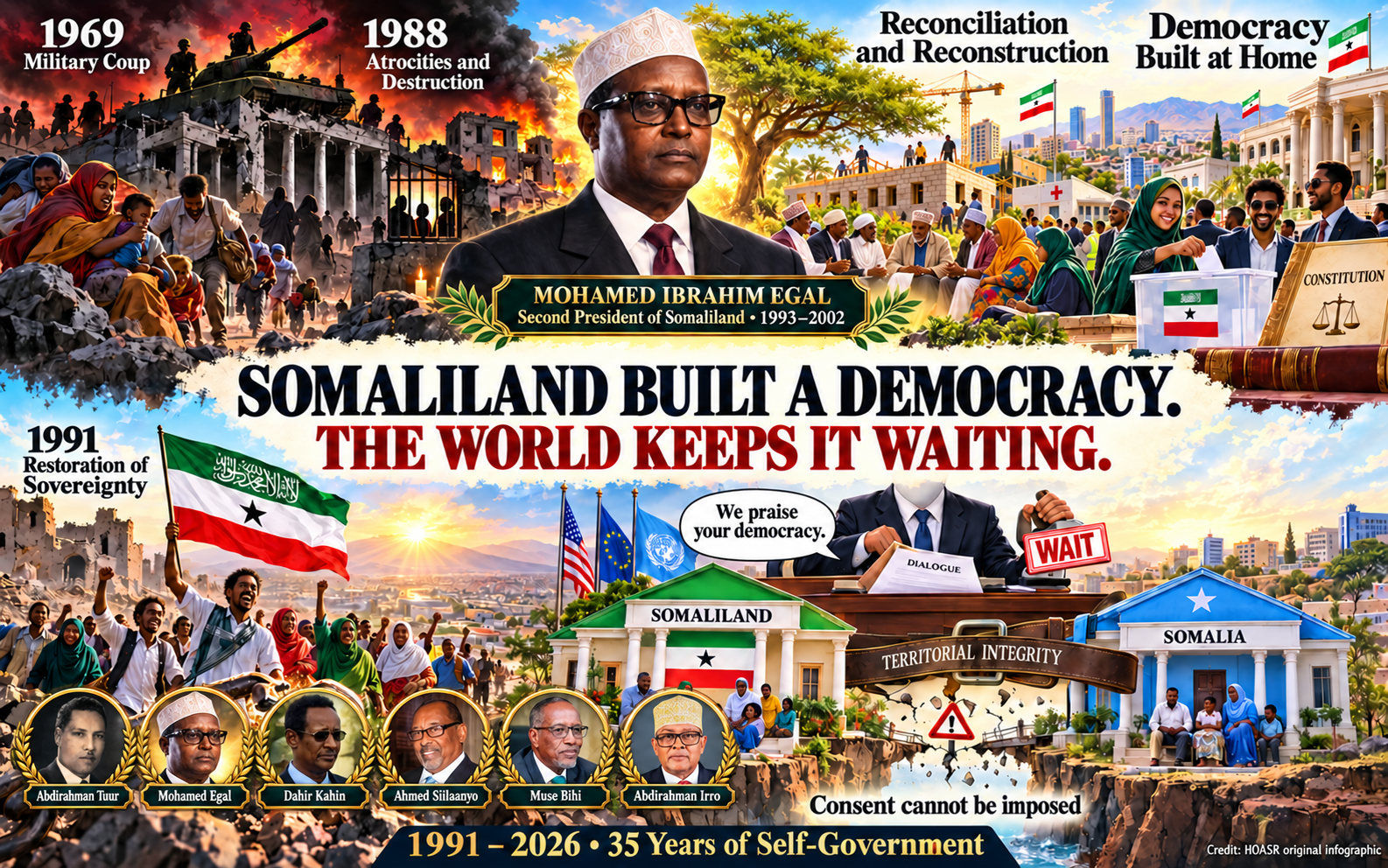
From dictatorship and destruction to reconciliation and constitutional government, Somaliland’s journey spans thirty-five years of self-government. Egal and the six presidents represent that institutional history, while the diplomatic metaphor challenges praise without recognition and reunion without consent. Credit: HOASR Original Infographics.
Egal’s legacy and the cost of praising self-government while withholding political standing
Somaliland has spent thirty-five years building the institutions international diplomacy says it wants Africans to build. Its people negotiated peace, restored public administration and developed competitive elections. Governing parties have lost office, and constitutional succession has survived the death of a president.
Yet most governments still treat Somaliland’s sovereignty as a question to postpone. The contradiction is plain: they praise its capacity to govern itself while withholding the political standing that would help it govern more effectively.
Israel’s recognition on 26 December 2025 broke a diplomatic barrier, as the EU statement acknowledged. It did not settle Somaliland’s wider international status. The African Union Commission rejected recognition, while the EU reaffirmed Somalia’s territorial integrity. Those responses explain the resistance. They do not answer why Somaliland’s record and distinctive history have failed to produce a serious change in policy.
Mohamed Haji Ibrahim Egal’s life brings that failure into focus. He helped lead Somaliland into union with Somalia, served as prime minister of the Somali Republic, endured detention under military rule and later helped establish Somaliland’s constitutional order.
His journey crossed the hope of union, the destruction of civilian government and the difficult work of reconstruction. The institutions he helped build deserve more than congratulations followed by another instruction to wait.
The statesman who believed in union
Egal headed Somaliland’s government when it became independent from Britain on 26 June 1960. Five days later, it joined the former Italian-administered territory to form the Somali Republic. He subsequently served as prime minister from 1967 to 1969 under President Abdirashid Ali Sharmarke. His political history matters because it undermines a convenient dismissal claims that Somaliland’s independence case did not emerge simply from people who had never believed in Somali unity. Somalilanders were then, not now, the sacrificial lamb for Somali Unity.
Egal’s leadership also offered a practical alternative to regional confrontation. A March 1968 US memorandum credited him with pursuing peace with Kenya and Ethiopia and giving economic development greater priority than military expenditure. Washington wanted to strengthen his position and encourage those policies. It understood that regional peace and civilian government could reinforce each other.
President Sharmarke was assassinated on 15 October 1969. Six days later, the military seized power. A contemporary State Department assessment recorded the dissolution of the National Assembly, suspension of the constitution and detention of ministers. Egal’s administration became the last civilian parliamentary government before military rule. The coup attacked a constitutional system, not merely an individual leader.
Years of detention interrupted his career, with an intervening ambassadorial posting to India. His biographical record documents that interruption. In 1993, delegates at Borama selected him as Somaliland’s second president, succeeding Abdirahman Ahmed Ali Tuur. The presidential chronology makes the distinction important: this was election by conference delegates, before the later system of direct presidential voting.
What Western diplomacy accommodated in 1969
The archives contain a revealing comparison. On 28 October 1969, one week after the coup, a White House memorandum recorded that Britain and Italy had already recognized Somalia’s new military government. It recommended a discreet American return to routine relations, despite uncertainty about the regime’s intentions. Another memorandum reported that Egal remained under closely guarded house arrest.
Recognition of a government is legally different from recognition of a state. That distinction does not excuse the political double standard. A US memorandum recorded that Britain and Italy had recognized Somalia’s military government within a week of the 1969 coup, while Washington prepared to restore normal relations.
Those deliberations prioritized accommodation of the military officers in power, rather than making a civilian caretaker administration and the restoration of constitutional government conditions for engagement.
The draft American instructions explicitly invoked similar responses to changes of government elsewhere in Africa. Strategic convenience made diplomacy move quickly after democracy was overthrown. Unfortunately, Somaliland’s constitutional achievements have inspired far less urgency.
A national history larger than its presidents
Egal’s background connected commercial society, colonial education and the generation responsible for independence. Those influences help explain his political formation. They should not reduce either his career or Somaliland’s achievement to clan identity. A durable state must serve citizens across the communities that helped create it.
His former marriage to Edna Adan Ismail connects this history to another distinguished record of public service. Her work in nursing, maternal health, opposition to female genital mutilation and Somaliland’s foreign ministry stands in its own right. Their separate careers illuminate two inseparable tasks of reconstruction: establishing public institutions and improving people’s lives.
This wider view matters. Foreign attention often reduces Somaliland to presidents, ports and a dispute over recognition. The society behind those headlines includes teachers, health workers, traders, women’s organizations and families who sustained everyday life while public institutions were rebuilt. Recognition should expand their opportunities, rather than merely increase access to useful geography.
From negotiated peace to constitutional government
Somaliland declared the restoration of its independence in 1991, before Egal became president. He inherited a fragile administration recovering from war, with armed groups, competing clan interests and scarce revenues. His task was to turn political legitimacy into government capable of administering services, establishing security and sustaining public authority.
Borama drew traditional deliberation and community negotiation into that work. Interpeace and APD document the locally driven settlements and the contributions of elders, political leaders, businesspersons, women and diaspora communities. Egal deserves substantial credit for consolidating the administration. He worked within a national effort whose legitimacy could not be manufactured by presidential decree.
The transition was neither smooth nor uncontested. Renewed fighting in the 1990s exposed the weakness of early settlements. Somaliland’s achievement was its repeated return to negotiation and its gradual development of institutions able to manage political differences. Egal’s contribution was to help carry customary consensus towards constitutional government, rather than simply replace one form of authority with another.
The 2001 constitution, approved in the referendum of 31 May, affirmed independence and established a framework for multiparty politics, public rights and separate branches of government. Egal was central to that transition, but it remained a collective political achievement. Its value lay in creating rules that could endure beyond their principal advocate.
That test came when he died in May 2002. Vice-President Dahir Riyale Kahin assumed office under the constitutional succession arrangements. Government continued without requiring a new ruler to establish legitimacy through force. Egal’s legacy was therefore more substantial than his years in office: he helped leave an order capable of surviving his absence.
Democracy deserves scrutiny and political standing
The November 2024 election tested that inheritance. Opposition candidate Abdirahman Mohamed Abdullahi, known as Irro, defeated incumbent Muse Bihi Abdi. The observation findings described a peaceful, well-managed process with widely accepted results. An incumbent’s defeat and an orderly transfer of office are concrete evidence of political competition.
The same mission issued 26 recommendations, including measures against election delays, stronger ballot secrecy, improved electoral administration and wider political competition. These shortcomings require reform. Somaliland’s democratic case is strongest when it welcomes scrutiny and demonstrates that institutions can correct themselves. It does not depend on pretending the system is complete.
The Las Anod conflict also demands accountability. Amnesty International reported indiscriminate shelling by Somaliland forces, civilian casualties and damage to civilian facilities in 2023. Its findings require independent investigation and serious attention to local grievances.
These are obligations for Somaliland’s leaders. They are not a reason to place its entire population under an indefinite diplomatic penalty. Recognized governments face pressure to investigate abuses and reform; they do not ordinarily lose international standing until every failure is repaired. Somaliland should face demanding standards, supported by engagement that strengthens accountability rather than exclusion that offers no path forward.
Praise cannot become a substitute for policy
Western governments cannot plausibly claim ignorance of Somaliland’s democratic progress. In November 2024, the British government congratulated Somalilanders on peacefully exercising their voting rights and acknowledged observers’ positive preliminary assessment. In the same answer, it reaffirmed non-recognition and referred the status question to dialogue between Mogadishu and Hargeisa.
That juxtaposition captures the problem. Somalilanders’ consent matters when they select a president, but receives far less weight when they seek an international political relationship of their own.
Yes, dialogue is necessary. But Hargeisa has pursued it in good faith for more than a decade, with no clear route to a settlement, while Mogadishu behaves as though it owns Somaliland.
Why should the international community accommodate Villa Somalia’s delaying tactics rather than insist on a defined process, timetable and measurable progress? Treating Mogadishu’s consent as an indefinite precondition gives a government that has not administered Somaliland for thirty-five years a permanent veto over its future.
That is not neutral diplomacy. It is a double standard that allows obstruction to prevail over democratic consent
There are genuine legal and regional questions. Recognition is not a prize automatically awarded for holding elections, and democracy alone does not settle statehood. But that is an argument for examining Somaliland’s history and governing reality seriously. It cannot justify repeating the same refusal regardless of what its institutions achieve.
Western assistance to development and elections should be acknowledged. The criticism is not that every partner has done nothing. It is that assistance and applause have become easier than confronting the political framework that limits Somaliland’s opportunities. Helping institutions function while indefinitely withholding broader diplomatic standing leaves the central contradiction unresolved.
The AU must answer its own exceptional case
Somaliland’s claim invokes separate colonial boundaries and the restoration of a state that became independent before entering the 1960 union. That history distinguishes it from a generic claim to carve a new territory from an existing country. It requires legal analysis, but it cannot honestly be dismissed without one.
As documented by International Crisis Group, the AU’s 2005 fact-finding mission identified Somaliland’s circumstances as historically exceptional, recommended a special approach and rejected automatically treating its recognition as the opening of a continental “Pandora’s box.”
The mission did not grant recognition or issue a binding legal settlement. But twenty-one years later, its central finding still demands an answer: why does a case the AU itself considered exceptional remain subject to a blanket refusal?
The AU’s rejection of Israel’s recognition sharpens that contradiction. Opponents should identify the concrete chain of separatist recognition they believe Israel’s decision has triggered, rather than repeat a prediction as though it were evidence.
Other movements may invoke Somaliland without sharing its history, former sovereign status or legal foundations. The organization has demonstrated its determination to oppose recognition; it should show equal determination in explaining what became of its own mission’s recommendations.
The danger also runs in the opposite direction. By rewarding obstruction and leaving peaceful self-government without a credible diplomatic pathway, the AU risks establishing a precedent that democratic achievement counts for less than political resistance. Somaliland’s case requires serious scrutiny, but so does the policy keeping it unresolved. The absence of an automatic entitlement to recognition cannot become an automatic entitlement to deny a people a fair hearing indefinitely.
Exclusion has an economic and democratic price
Non-recognition affects ordinary life. International reporting describes constraints on access to international finance and investment. Travel and documentation also remain complicated by limited recognition. Private enterprise and diaspora support have helped Somaliland develop, but resilience does not remove those barriers.
Its relative stability can make delay convenient for foreign governments. Somaliland continues to function, so its status rarely receives the urgency attached to a state in collapse. The people who maintained institutions receive praise while the diplomatic framework remains largely unchanged. Survival becomes an excuse to postpone the relationships that could make society more prosperous.
For generations born under Somaliland’s flag, this is more than a dispute over terminology. They have been taught that voting, peaceful competition and public accountability matter. When those achievements produce little change in international opportunity, democratic confidence can weaken. A democracy needs livelihoods and credible prospects as well as ballot boxes.
There is a strategic cost too. Berbera’s importance attracts attention, but a country cannot build its future solely around what external powers want from its coastline. Security cooperation should sit alongside education, courts, employment and accountable government. Somaliland’s citizens are political partners, not an accessory to a port or runway.
Recognition needs a route rather than another waiting room
International partners should move from open-ended postponement to a defined process capable of producing a decision. African participation and direct Somaliland representation are essential. The historical claim, constitutional record, territorial disputes and regional consequences should be examined against published questions and a timetable. Another assessment without responsibility for follow-through would merely repackage the delay.
Diplomatic engagement and practical cooperation should deepen while that work proceeds. Electoral reform, judicial capacity, independent journalism, educational partnerships and workable development-finance arrangements can strengthen institutions now.
Somaliland’s government must show that closer engagement produces more inclusive administration and stronger accountability. Political standing and democratic responsibility should advance together.
Any dialogue with Somalia in the future should ONLY address security, movement, economic relations and disputed areas through a defined agenda and measurable progress. It should help both societies manage their relationship as neighbors peacefully. It must not allow disagreement over final status to prevent practical cooperation indefinitely or turn dialogue into a permanent veto over Somaliland’s political future.
Egal’s experience supplies the warning. Civilian institutions can be destroyed either by military dictators or authoritarian presidents, and rebuilding them takes far longer than suspending them. Somaliland’s constitutional order is the product of political labor, community negotiation and sacrifice. Its durability should encourage investment in that achievement, not complacency about how long it can survive rejection and exclusion.
The international community does not have to declare Somaliland flawless to recognize the seriousness of its case. It does have to explain why peaceful self-government continues to command less urgency than familiar geopolitical bargains. Governments that praise democracy should be prepared to defend the conditions that allow it to endure.
Somaliland built institutions that could outlive a president. The world should stop treating their survival as permission to leave their people waiting in vain.
Egal experienced both civilian leadership and military repression. When he returned to lead Somaliland, he helped establish institutions intended to survive individual presidents. Following his death in 2002, his vice-president, Dahir Riyale Kahin, succeeded him constitutionally.
Presidential authority subsequently passed through elections to Ahmed Mohamed Mohamoud Siilaanyo in 2010, Muse Bihi Abdi in 2017 and Abdirahman Mohamed Abdullahi “Irro” in 2024. That succession is the legacy Western leaders should examine: public authority sustained through constitutional rules and electoral competition, rather than military seizure.
The system remains imperfect, but its capacity to transfer power peacefully through credible elections based on universal adult suffrage deserves practical support.
The lesson of that history is clear. Somaliland’s people should neither be forced back under Villa Somalia nor see their own constitutional order displaced by another military regime.
Thirty-five years of self-government should have produced a credible route out of diplomatic exclusion. Instead, Somalia, Türkiye, Egypt, Qatar and Saudi Arabia have jointly opposed recognition, while China has separately rejected it.
Their positions reinforce the barriers around Somaliland. Western governments should consider whether continued hesitation strengthens the very pressures that could weaken or destroy a willing democratic partner.
Taiwan’s partnership and Israel’s recognition matter, but neither can substitute for sustained Western diplomatic and economic engagement. Taiwan cannot be expected to shoulder the wider burden of supporting another internationally isolated democracy.
Somaliland’s resilience is not an unlimited resource, and Berbera’s strategic value will not automatically preserve the political institutions that make it a reliable partner.
Western capitals risk losing both democratic influence and strategic opportunity if they wait until those institutions are weakened before deciding they deserve support.
Egal’s legacy offers a foundation to strengthen now; it should not become an achievement the West admires only after it has been lost.
The Scoop: The Danger of Somalia and Somaliland under the illusion of Somali unity
Somaliland’s democracy was rebuilt from the wreckage of dictatorship. The 1969 coup destroyed civilian constitutional government. Repression, genocidal violence and war later devastated communities and cities.
After restoring sovereignty in 1991, Somaliland faced further internal conflict, returned to reconciliation and gradually rebuilt public institutions. Egal was a among Somaliland’s leaders before and after him who helped, and continue to turn that negotiated peace into constitutional government.
Thirty-five years of self-government represent a political achievement sustained through hardship, resilience, patience, determination, not a temporary arrangement awaiting permission to exist and reunite a second time with Villa Somalia.
Invoking theoretical daydreams of territorial integrity and forced re-union cannot ever erase that lived history. Somaliland and Somalia have been governed separately for thirty-five years. Like a couple separated after profound trauma, their relationship cannot be repaired by outsiders ordering them back beneath the same roof.
If reunion were pursued through coercion rather than consent, it would endanger civilians on both sides and reopen conflicts that diplomacy should preemptively prevent. A familiar one border formula is no substitute for confronting those consequences.
Western governments should therefore explain how indefinite postponement serves peace. Praising Somaliland’s elections while leaving its political future dependent on Mogadishu’s approval rewards obstruction and weakens confidence in democratic choice.
Responsible diplomacy should support accountability, address disputed areas and establish practical arrangements for peaceful coexistence. Somaliland’s institutions remain unfinished, but they deserve sustained engagement.
The world should help preserve what its people rebuilt, rather than gamble with that achievement in pursuit of a forced re-union that is beyond repair and cannot safely be imposed.
Related Topics
Related Posts