

Geopolitical Analyst: Bridging Somaliland & Israel to the world
Somaliland’s Financial Diplomacy Advances as Investment Opportunities Grow
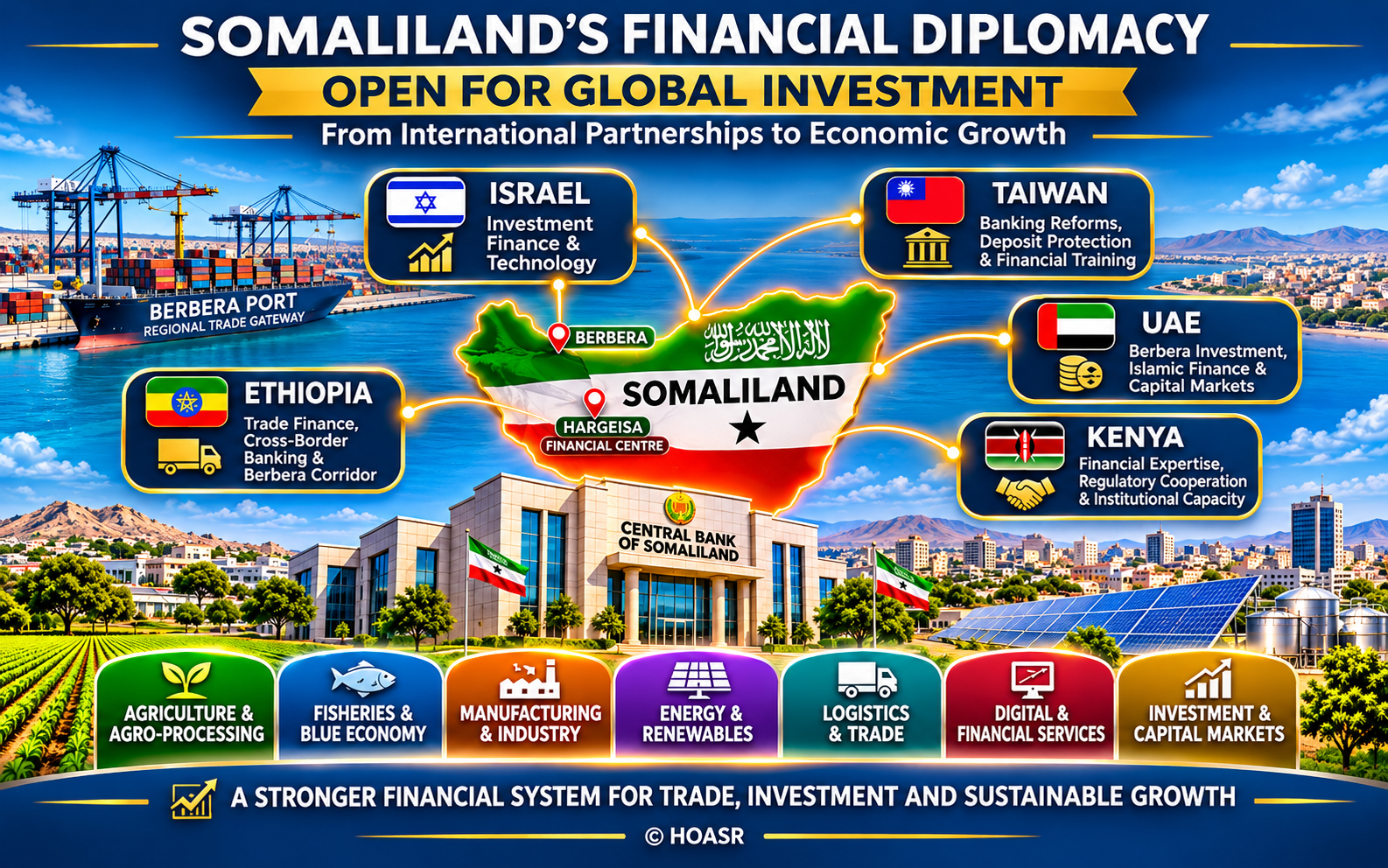
Somaliland strengthens international financial partnerships to expand banking services, investment financing and regional trade. © HOASR 2026.
From Taiwan’s banking expertise and Israel’s investment diplomacy to the UAE’s financial experience and Ethiopia’s trade corridor, Somaliland is laying the groundwork for a more internationally connected economy.
From Recognition to Economic Opportunity
For much of the past three decades, Somaliland’s economy has depended on the determination of its entrepreneurs, traders, telecommunications companies and diaspora communities.
They established businesses, maintained international commercial connections and developed financial services which produced a resilient private sector economy despite the country’s limited access to conventional international banking institutions.
But Somaliland’s economic ambitions are now moving beyond the conditions under which that system developed. The emphasis now is on attracting foreign investment, expanding trade and strengthening relationships with international financial institutions.
At the centre of this effort is the Central Bank of Somaliland, led by Governor Abdinasir Ahmed Hersi, whose recent engagements with financial institutions in Taiwan, Ethiopia, the United Arab Emirates and other international partners suggest an increasingly forward-looking approach to economic development.
Opening the country to international investment requires a financial system capable of supporting the businesses and institutions willing to invest.
Israel: Turning Diplomatic Recognition into Investment Partnerships
The most visible expression of Somaliland’s new economic diplomacy came during President Irro’s June 2026 visit to Israel.
The President’s delegation, which included Central Bank Governor Hersi, held discussions with Israeli Finance Minister Bezalel Smotrich on June 15. Their agenda extended beyond general expressions of economic cooperation.
According to the Somaliland Ministry of Foreign Affairs, the discussions addressed access to international financial markets, investment opportunities and the development of financing mechanisms and guarantees for major infrastructure and economic projects.
These subjects are particularly relevant to Somaliland’s circumstances. International investors frequently require dependable financial guarantees, clear arrangements for transferring capital and confidence that projects can be financed over several years.
Two days later, President Irro’s delegation also discussed trade, manufacturing, small-business development and opportunities associated with Berbera with Israeli Economy and Industry Minister Nir Barkat.
The economic diplomacy reached a wider commercial audience on June 18, when President Irro addressed the Somaliland–Israel Business Forum in Tel Aviv. According to the Central Bank’s account of the event, more than 200 Israeli business executives, investors and company representatives participated.
Governor Hersi delivered a message that captured the government’s emerging economic direction: Somaliland is open for business. He presented opportunities in agriculture, fisheries, renewable energy, logistics, manufacturing, telecommunications, financial services and technology.
He also outlined the Central Bank’s work on payment modernization, supervision, financial compliance and Islamic finance.
The next stage will depend on converting those discussions into financing arrangements, commercial projects and investments capable of creating employment and expanding domestic production.
Taiwan: Building the Banking Institutions that Investment Requires
While Israel has emerged as an important partner in Somaliland’s investment diplomacy, Taiwan is contributing expertise in the equally important work of financial institution-building.
In September 2025, Governor Hersi held high-level meetings in Taipei with Taiwan’s Central Bank and Financial Supervisory Commission. The discussions covered banking supervision, monetary stability, regulatory development, technical training and stronger financial infrastructure.
Taiwan’s contribution subsequently developed into a more concrete institutional partnership. On June 18, 2026, the Bank of Somaliland and Taiwan’s Central Deposit Insurance Corporation signed a memorandum of understanding on deposit protection and financial stability.
The relationship advanced further on August 31, when the two institutions agreed on a one-year implementation plan covering technical assistance, regulatory development, staff training and institutional capacity.
Deposit insurance, when properly designed and financed, can protect eligible bank depositors and improve confidence in financial institutions. Taiwan’s experience offers Somaliland access to established methods of bank monitoring, crisis management and financial supervision.
The partnership remains a work in progress, but it shows that the Central Bank is pursuing specialized international expertise rather than attempting to develop every financial institution independently.
On August 18, 2026, Somaliland’s Representative in Taipei, Ambassador Mahmoud Adam Jama Galaal, met senior executives of Taiwan’s Export–Import Bank to explore trade financing, commercial cooperation and stronger connections between businesses and financial institutions.
The same day, Somaliland’s representative office held discussions with TaiwanICDF on expanding development cooperation, including the possibility of investment and lending mechanisms for larger productive projects.
These engagements could become particularly valuable for Somaliland’s manufacturing, agricultural processing, energy and infrastructure sectors.
They also demonstrate how the relationship with Taiwan is evolving from technical development assistance toward broader discussions of trade, finance and investment.
The UAE: Moving Beyond Port Investment into Financial Development
The United Arab Emirates already occupies an important place in Somaliland’s economic development through DP World’s investment in Berbera.
The modernization of Berbera Port, accompanied by the Berbera Economic Zone and the associated transport corridor, has strengthened Somaliland’s potential role as a gateway serving markets across the Horn of Africa.
The involvement of British International Investment alongside DP World provides another example of international institutional capital participating in Somaliland’s infrastructure development. A December 2025 evaluation examined the development impact of that investment. But Somaliland’s financial cooperation with UAE-based institutions is also expanding into banking modernization.
Berbera has already demonstrated that international investment can be mobilized for major infrastructure. The next ambition is to extend that investment experience into a broader range of productive sectors.
For an economy seeking to expand electricity generation, industrial facilities, transport infrastructure and domestic manufacturing, access to a wider range of financing strategies could become increasingly important.
Ethiopia: Connecting the Berbera Corridor to International Trade Finance
Somaliland’s financial diplomacy with Ethiopia has a particularly practical commercial purpose.
In August 2025, Governor Hersi met the then Governor of the National Bank of Ethiopia, Mamo Mihretu, in Addis Ababa. Their discussions addressed cross-border payments, trade settlement, foreign-exchange transactions, banking regulation, trade finance and the financial services needed to support the Berbera corridor. Both sides reportedly agreed to establish a joint technical working group.
In a subsequent interview with The Reporter Magazine, Governor Hersi explained the importance of developing direct banking connections and practical arrangements for trade financing.
He referred to letters of credit, financial guarantees and risk-sharing mechanisms that could help businesses on both sides of the border conduct trade more efficiently.
Berbera’s geographical advantages and modern port infrastructure create an opportunity to serve a larger share of Ethiopia’s import and export trade. Yet the development of a competitive trade corridor requires more than roads, warehouses and shipping facilities.
Importers and exporters also need financing, insurance, dependable payment settlement and banking relationships that allow transactions to be completed efficiently. Better financial connectivity could lower commercial costs and make the corridor more attractive to Ethiopian businesses.
The August discussions did not themselves establish an operational cross-border banking system. But they identified practical financial arrangements that Somaliland and Ethiopia would need to develop to support expanded trade.
This represents an important shift from promoting Berbera’s strategic location to addressing the financial requirements that could make greater use of the corridor commercially feasible.
Kenya and International Expertise: Investing in the Central Bank Itself
The Central Bank’s international outreach has also included professional cooperation with financial institutions in Africa.
In June 2025, a Somaliland delegation attended the International Association of Deposit Insurers’ African regional conference in Mombasa, hosted with Kenya’s Deposit Insurance Corporation.
The delegation engaged with specialists from several African and international financial institutions on depositor protection, banking stability and the management of financial-sector risks to learn from established regulatory systems and develop professional relationships.
In August 2025, experts associated with Somaliland’s Central Bank modernization programme, including Austin Albert and Mankolo, met the Minister of Finance and senior Central Bank officials to discuss financial infrastructure, a national payment system and closer coordination between monetary and fiscal policy.
More recently, in November 2026, the Bank welcomed Bermudian economist Ywione Darrell through the Overseas Development Institute’s fellowship programme.
Darrell, who studied Economics for Development at the University of Oxford, has been assigned to support monetary policy, planning, economic research and staff development over a two-year period. His appointment adds another strategy to the Bank’s effort to strengthen its professional expertise.
These initiatives usually receive less public attention in Hargeisa than presidential visits or investment forums. Yet they are essential to creating the institutional environment in which international investment can operate successfully.
The Scoop: From Economic Diplomacy to a Modern Investment Economy
The broader picture is becoming clearer. The country is no longer relying solely on its strategic location, political stability or the determination of its entrepreneurs to attract international attention.
Somaliland’s government is pursuing international investment while the Central Bank works to develop the financial institutions and services required to support it. These initiatives are at different stages. Some have produced signed agreements and implementation programmes. Others remain consultations, proposals or exploratory discussions.
The financial agreements and meetings of the past eighteen months have not yet delivered every result Somaliland needs. But they have helped establish relationships through which banking expertise, investment finance and new commercial opportunities can develop.
Additionally, there is still work to be done on banking supervision, deposit protection, cybersecurity and the regulation of mobile-money services which require continued attention. Successful private-sector innovation must be supported by safeguards that strengthen confidence and protect customers.
However, those challenges should be understood within the larger modernization effort rather than be allowed to overshadow it. The central priority is to ensure that financial reform proceeds alongside investment promotion, providing the predictable and dependable services that businesses need.
Somaliland has already demonstrated its ability to build a functioning economy under difficult circumstances. It is now working to create the financial connections and institutions required for a more ambitious stage of economic growth.
For international investors looking toward the Horn of Africa, the government’s message is increasingly clear. Somaliland is open for business. Its financial institutions are working to support that invitation.
Related Topics
Related Posts