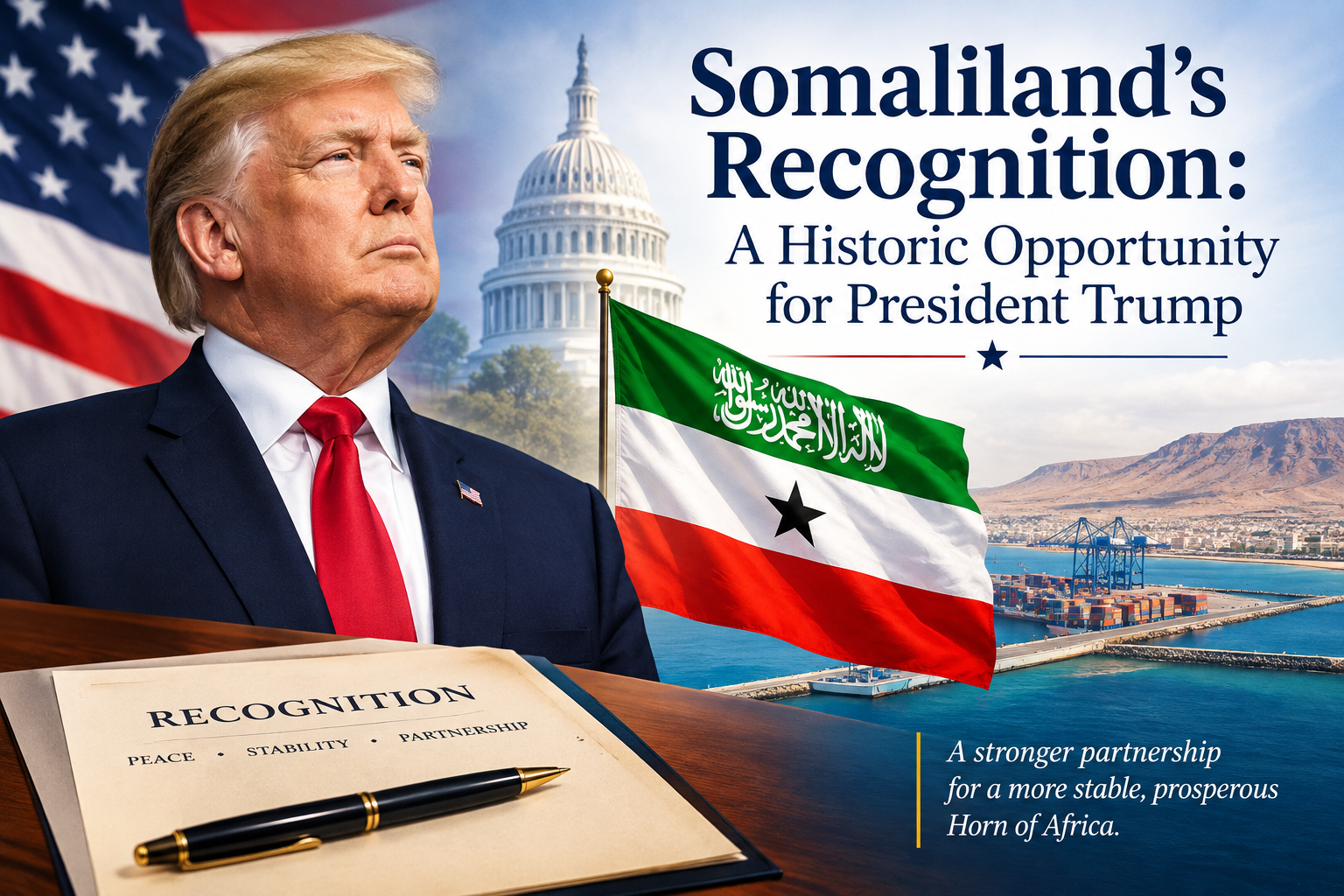
Somaliland’s Recognition: A Historic Opportunity For President Trump
A Moment for Strategic Leadership
Throughout modern history, decisions on diplomatic recognition have helped reshape international relations and create new political realities. From Kosovo’s declaration of independence and its subsequent recognition by the United States under President George W. Bush to the emergence of South Sudan as an independent state during President Barack Obama’s administration, American foreign policy has played a significant role in shaping the international status of emerging states. Under President Joe Biden, the United States also recognized the Cook Islands and Niue as sovereign states in their own right, strengthening their international engagement.
Today, President Donald Trump has an opportunity to make a consequential contribution to this diplomatic legacy by formally recognizing the Republic of Somaliland. Such a decision would not simply address a longstanding political question; it could also open a new chapter in American engagement with the Horn of Africa, a region of growing strategic importance.
More Than Three Decades of Self-Governance
Since restoring its independence in 1991, Somaliland has pursued a distinct political path, focusing on building its own governing institutions, maintaining internal stability, and developing a system of electoral politics. Over more than three decades, it has established functioning institutions, held multiple elections, and sought to strengthen the foundations of democratic governance despite significant economic and security challenges.
These achievements deserve serious consideration in international diplomatic discussions. Somaliland’s experience demonstrates the importance of locally driven institution-building and the determination of a society to manage its political affairs through its own institutions.
Although challenges remain, particularly in economic development, democratic consolidation, and the resolution of territorial disputes, Somaliland’s record provides a substantive basis for a constructive international dialogue on its status and future.
Why Somaliland Matters to the United States
The case for Somaliland’s recognition extends beyond questions of historical identity and political self-determination. It also intersects with important American interests in regional security, maritime stability, economic cooperation, and the protection of international trade routes.
Situated along the Gulf of Aden, near the Bab el-Mandeb Strait and the Red Sea corridor, Somaliland occupies a strategically significant position connecting the Indian Ocean with some of the world’s most important maritime routes. Developments in this region have direct implications for international commerce, freedom of navigation, and broader security dynamics.
The Port of Berbera and its associated economic development initiatives offer opportunities for expanded trade, infrastructure investment, and regional connectivity. With a carefully developed framework for cooperation, Somaliland could become a more significant partner in efforts to strengthen maritime security, combat transnational threats, and promote economic resilience across the Horn of Africa.
Formal recognition could provide a clearer framework for bilateral engagement, although its practical benefits would depend on subsequent diplomatic agreements, institutional cooperation, and investment.
Recognition as a Diplomatic Opportunity
Recognition is a sovereign political decision, and the circumstances surrounding Kosovo, South Sudan, the Cook Islands, and Niue differ from Somaliland’s situation. Nevertheless, these cases demonstrate that international status can evolve through sustained diplomacy, political engagement, and decisions by individual states.
For Somaliland, recognition would represent an important step toward broader international participation. It could facilitate more formal diplomatic relations, encourage international investment, and create new opportunities for cooperation in education, technology, infrastructure, trade, and security.
At the same time, a successful diplomatic approach would require careful engagement with regional partners, including the African Union and neighbouring countries. Addressing regional concerns through dialogue and confidence-building would be essential to ensuring that any progress contributes to stability rather than deepening existing tensions.
The United States could help facilitate such engagement by encouraging constructive dialogue, assessing Somaliland’s institutional record, and examining the potential strategic benefits of a more formal relationship.
An Opportunity for President Trump’s Foreign Policy Legacy
President Donald Trump has repeatedly emphasized strategic partnerships, national interests, and a foreign policy focused on tangible outcomes. Somaliland presents an opportunity to apply these priorities in the Horn of Africa through a policy that recognizes local political realities while pursuing broader regional objectives.
A decision to recognize Somaliland would require careful legal, diplomatic, and strategic assessment. It would also require consideration of the possible responses of regional governments and international institutions. However, these complexities need not prevent serious discussion of the options available to Washington.
By initiating a substantive review of Somaliland’s case and engaging relevant regional stakeholders, President Trump could help move a longstanding issue onto a more constructive diplomatic path.
If the United States ultimately decides to extend formal recognition, the decision could become a defining moment in its engagement with the Horn of Africa. It would signal a willingness to reassess established diplomatic positions in light of evolving political realities and strategic interests.
A New Chapter for Somaliland and the Horn of Africa
Ultimately, Somaliland’s pursuit of recognition is about more than diplomatic status. It concerns international participation, economic opportunity, political representation, and the aspirations of a society that has spent decades developing its own institutions.
Recognition alone would not resolve every challenge facing Somaliland, nor would it automatically guarantee peace, prosperity, or regional cooperation. Those outcomes would depend on effective governance, sustained economic development, and constructive relations with neighbouring states.
Nevertheless, a carefully considered recognition policy could create opportunities for a new framework of engagement between Somaliland, the United States, and the wider international community.
President Trump has an opportunity to make a lasting contribution to American diplomacy by giving Somaliland’s case the serious consideration it deserves. Through strategic leadership, sustained dialogue, and a clear assessment of mutual interests, Washington could help shape a new chapter in the political and economic future of the Horn of Africa.
The time has come for Somaliland’s aspirations to receive serious, constructive, and sustained international consideration. For President Trump, this could be an opportunity not only to make history, but also to advance a more strategic and forward-looking American partnership in one of the world’s most important regions.