
Southern discomfort: Confronting America’s racist history
How does a society memorialize the sins of its history? The very first step is to recognize that sins were indeed committed.
For some, as America approaches its 250th anniversary this year, the debate over that initial acknowledgment remains an open issue, and an increasingly heated one. In recent years, while celebrating the remarkable achievements of the world’s first modern democracy, attention has been paid to its long mistreatment of African Americans, from brutal slavery to more recent forms of prejudice and inequality.
There are those who say that those historical negatives have been over-emphasized. Most notably, President Trump said last week that as a result of landmark legislation in the 1960s that banned racial discrimination in employment and voting, “white people were treated very badly.” He has also called on the Smithsonian Museum to revise its narrative of US history, saying it is too “divisive” in regard to race and slavery. Others insist that racial injustices have been downplayed for far too long and that only an honest reckoning on these issues can lead to national healing.
That was the dramatic and powerful message of three prominent civil rights sites I visited recently, each telling a dark, shameful story. Through basic facts and high-technology they convey a narrative of centuries of black suffering in America at the hands of whites who treated them, at best, as less than equal, and at worst, as virtually inhuman. Much of what I saw was hard to look at – yet harder to look away from.
It seems fitting, as we mark the 97th birthday of Rev. Martin Luther King Jr. (MLK) on January 19, to reflect on the civil rights movement he led in the 1950s and ‘60s, the impact his life – and violent death at 39 – had on the struggle for racial equality, and the long history of racial injustice and violence that dates back to America’s earliest days.
My own grappling with these issues of late has taken me many hundreds of miles in recent days to Atlanta, Georgia and Montgomery, Alabama, visiting several civil rights national landmarks and museums – and many years back in my memory to my own early encounters with racism.
Growing up in the 1950s in Annapolis, Maryland, just south of the Mason-Dixie Line, I first became aware of the extent of the racial divide between African American and white people one day when I was about 10 years old and at the movies.
My older brother and I were watching one of those three-hour-plus epic films popular at the time, like “Ben Hur” or “Spartacus.” At intermission, when we came out to the lobby to buy some candy, I caught sight of, through the glass door, a group of African Americans – then commonly referred to as “colored” – outside the theater. They were carrying signs and calling out, though I couldn’t make out the details. My brother explained that they were protesting the theater’s “white only” policy, off-limits to people of color. I also learned that the other two movie theaters in town had the same policy, and that in a neighborhood in a different part of town there was a “colored movie theater” (which happened to be owned by a member of the synagogue).
I was taken aback. It had never occurred to me that I saw no black people when I went to the movies. I was also unaware that the public elementary school I attended, a short walk from home, was segregated until I was in fourth grade. A landmark Supreme Court decision in 1954 ruled that segregated schools across the country were illegal. But integration in Anne Arundel County, where I lived, began a year later and progressed slowly, one grade per year, due to local resistance. The local schools weren’t fully segregated until 1966.
When you’re young, you tend to accept your surroundings as normal. I didn’t know at the time that public bathrooms and water fountains in town were labeled “White” or “Colored.” (I also didn’t know that a local country club had a sign banning Jews. My father, the only rabbi in town, played a key role in opening the club to Jews and some nearby beaches to blacks.)
‘Legacy Of Violence… And Injustice’
There were several far more troubling facts I’ve only now come to know about Annapolis — and hundreds of other towns and cities throughout the country — after my visit to the South. My wife and I spent two days at The Legacy Museum and the National Memorial for Peace and Justice, deeply compelling major sites in Montgomery, Alabama, devoted to presenting the hard, awful facts of much of the black experience in America. It was there that I learned that at least five lynchings of black men by white mobs took place in or near Annapolis between 1875 and 1922. (A historic marker was placed in the center of town in 2021, noting “the legacy of violence, intimidation and injustice that has not previously been acknowledged.”)
That discovery was part of a dramatic lesson in American history for me that, to my embarrassment, I had not fully understood until now. It began in Atlanta, where my wife I were visiting family, when we toured the National Center for Civil and Human Rights, which reopened in November after a $58 million, 10-month expansion and renovation. The impressive, state-of-the-art museum is centered on the life and career of MLK. It emphasizes his insistence on non-violent protests that underscored the moral difference between the restraint and dignity of civil rights advocates, and the violence and hate-spewed language of those who countered them, including officers of the law.
In addition to housing many of MLK’s writings, the museum’s galleries feature interactive displays that include touchscreens, videos, and audio to highlight major events in the civil rights struggle, including Freedom Riders being beaten as they seek to sign up black voters; the huge March on Washington in 1963 for the right to vote, where MLK delivered his “I Have a Dream” speech; and the somber cortege at MLK’s funeral, after his assassination by a white racist five years later.
Videos show clips of civil rights volunteers being trained to remain silent and curl up bodily to protect against body blows if attacked. One of the most popular and emotionally difficult exhibits is a recreated lunch diner counter where you, as a seated civil rights protester, are asked by a museum staffer to put your hands down on the counter and put on a pair of headphones. You are told that you will hear through those headphones taped shouts, taunts and curses aimed at you, to simulate real-life experiences. Your task is to stay calm and keep your hands in place on the counter during the 85-second verbal assault in your ears. A box of tissues is nearby for those who come away tearful, shaken by the experience.
Overall, the museum – largely funded by private sponsors and donors, including Atlanta-based Coca Cola – focuses on the 20th-century-history of the black experience in America in a forthright manner, including positive signs of headway as well as outrageous injustice. “It’s the story of black progress and white backlash,” noted Kama Pierce, the curator of the new exhibit, in a New York Times report. “We feel like we’re still in this cycle in this country.”
New Perspective in ‘The Cradle of the Confederacy’
From Atlanta, it was on to Montgomery, a 200-mile drive south to Alabama’s state capitol, which for a brief time in 1861 hosted the first White House of the Confederacy. We spent two days visiting two remarkable civil rights sites, a few blocks from each other, that opened in 2018. One is The Legacy Museum, which tells the story of slavery in America, dating back to the 1600s, and its legacy. The other, as cited above, is The National Memorial for Peace and Justice, the first memorial dedicated to the thousands of black victims of lynching, many of which were undocumented. Both projects were created under the direction of Bryan Stevenson, a civil rights attorney and founding executive director of the Equal Justice Initiative (EJI), a non-profit that describes itself as “challenging racial and economic injustice, and protecting basic human rights.”
Stevenson, a MacArthur Grant Fellow and author of a highly praised memoir, “Just Mercy: A Story of Justice and Redemption,” says he chose Montgomery, in part, for the locale because of its authenticity as the “Cradle of the Confederacy” at the time of the Civil War. But also because it’s the city where, a century later, the successful boycott against segregation on city buses began, thanks to activist Rosa Parks, and where MLK led an historic, five-day march to Selma, Alabama for black voting rights.
Stevenson has said that Montgomery’s transition from a center of the domestic slave trade to a starting point for racial healing indicates that it could be a model for other cities in the U.S.
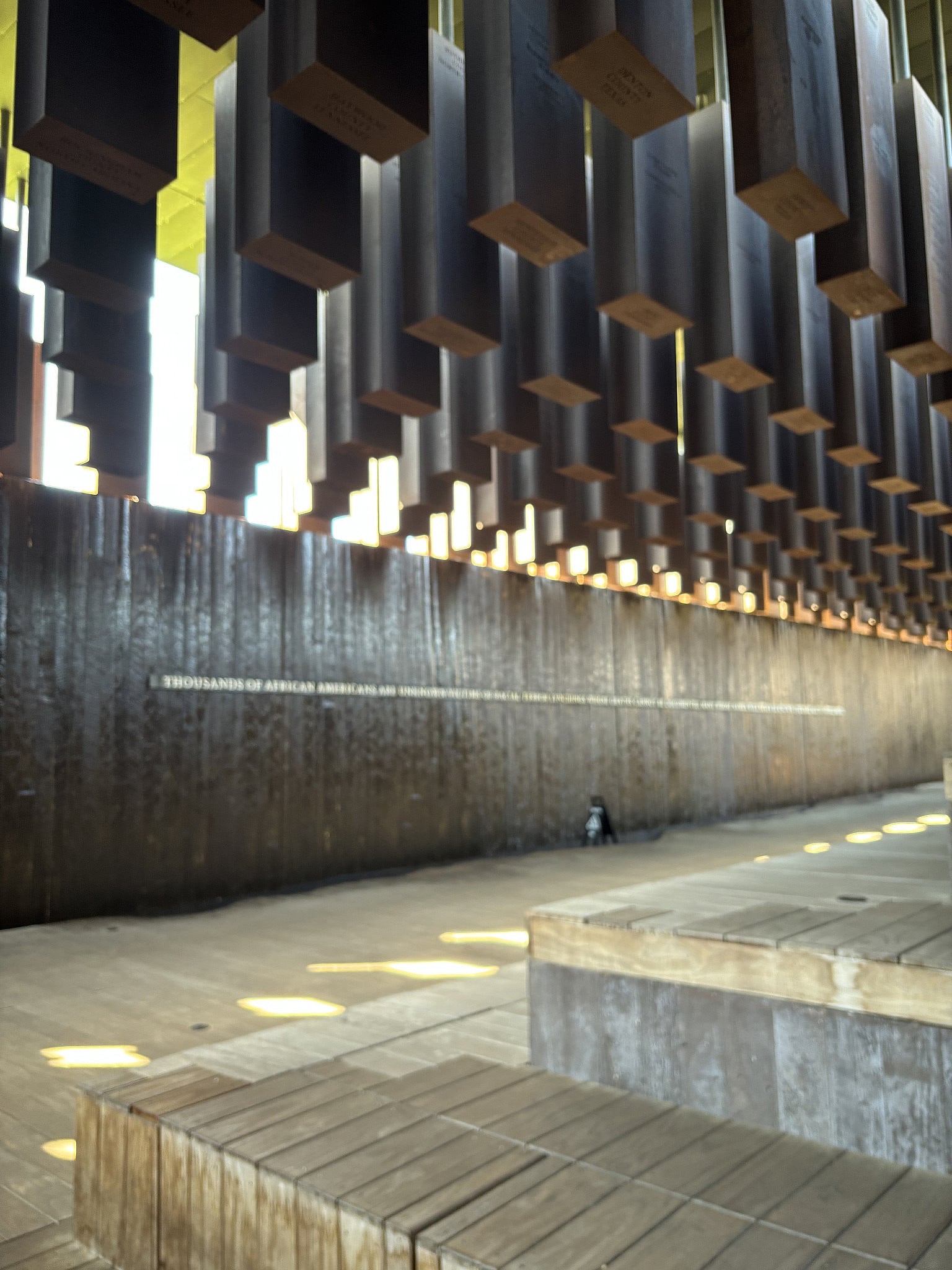
Both the museum and the memorial have a strong, visceral impact on visitors. They utilize a wide range of creative elements, from engraved steel monuments to high-tech holograms, to drive home the horror and inhumanity of how slaves were treated. Even after the Civil War, when they were legally free, thousands of African Americans were tortured and lynched by white mobs as recently as 1955.
The museum was built on land where slaves were warehoused before being sold in the mid-19th century. The essential message of the many exhibits, first-person narratives, videos, short documentaries, interactive technologies and maps is based on two prominently displayed messages. One, on a wall, reads: “Slavery Did Not End. It Evolved.” The other, written on a large American flag, reads: “From Slavery to Mass Incarceration.” The unifying theme is that racial inequality began with slavery, and that today, centuries later, blacks are often still presumed dangerous and guilty. The museum is based on the belief that only in confronting and absorbing the hard truths of history can justice be advanced.
For me, those hard truths were conveyed not only through facts and statistics, but most eloquently through the hundreds of haunting sculptures at both the museum and the nearby National Memorial for Peace and Justice. Created by Ghanaian artist Kwame Akoto-Bamfo, they show the fear and trauma on the faces of enslaved men, women and children.
The memorial is built on more than five acres of hilltop land and, on entering the peaceful area, one feels the presence of sacred space, honoring the thousands of African Americans tortured and lynched, often in the presence of thousands of spectators. The visitor soon confronts some 800 six-foot-high steel monuments suspended from above and engraved with the names of the sites, victims and dates of lynchings. The feeling evoked is of a cemetery headstone, hanging above, like a lynching victim.
What we learned – and what was not taught in schools across the country – is that while most of the 4,400 documented lynchings took place in 12 Southern states, all but seven of the Continental United States had at least one lynching in the period between 1877 and 1950. Also shocking was that these murders were “acts of terrorism because they were carried out with impunity, sometimes in broad daylight, often ‘on the courthouse lawn,’” according to EJI research. The lynchings were not “frontier justice” because many took place in cities with court systems.
Walking down from the hilltop and reading the names, the reasons given for the lynchings, and the gruesome violation of the bodies was gut-wrenching. As a tool of oppression, lynchings were common punishment for minor social transgressions, for approaching a white woman, or for voting. They often were announced in advance in newspapers that encouraged people to come and celebrate the spectacle.
One Mississippi newspaper front-page is reproduced and on display, with a headline announcing the time and place of an upcoming lynching where the victim “will be burned.” The article notes that the governor announced that he is “powerless to prevent it” and that a Baptist pastor intends to attend the lynching and “entreat the mob to use discretion.”
No one was ever charged for these public murders.
Echoes of Yad Vashem
As an American Jew born soon after the Holocaust, and coming of age during the 1960s’ era of civil rights activism, I recognize the impulse to memorialize one’s own – millions of all-too-often-forgotten victims of racial and ethnic hatred. That applies to Africans and African Americans who were enslaved, tortured and killed on these shores as well as the millions of European Jews rounded up and methodically murdered by the Nazis.
Standing in front of a huge wall at the National Memorial for Peace and Justice, I read the following words and thought of the victims of slavery and the victims of the Holocaust:
“For the hanged and beaten. For the shot, drowned and burned. For the tortured, tormented and terrorized. For those abandoned by the rule of law.
“We will remember. …”
The impetus and message is the same: “Zachor,” remember, as commanded in the Bible.
That imperative to remember is the concluding message of a remarkable essay published in The Atlantic (December, 2022), entitled, “How Germany Remembers The Holocaust, And What America Can Learn About Atonement.” Written by Clint Smith, an Atlantic staff writer, it focuses on the complexities of Germany’s various efforts to memorialize the millions of Jews killed in the Holocaust by providing of tours of concentration camps, creating major memorials and placing small concrete blocks on the street in front the homes of Jewish victims. The blocks, called a Stolperstein, are covered with a brass plate with the name and dates of birth and death of the victims. There are now more than 90,000 such stones set into the streets and sidewalks of 30 European countries, noted Smith, who observed: “Together, they make up the largest decentralized memorial in the world.”
He cites the National Memorial for Peace and Justice in Montgomery as having “a similar emotional texture to the Memorial to the Murdered Jews of Europe,” a vast maze of several thousand concrete slabs in the center of Berlin.
In the end, though, Smith writes: “It’s impossible for any memorial to slavery to capture its full horror, or for any memorial to the Holocaust to express the full humanity of the victims. No stone in the ground can make up for a life. No museum can bring back millions of people. It cannot be done, and yet we must try to honor those lives and to account for this history, as best we can. It is the very act of attempting to remember that becomes the most powerful memorial of all.”