


The Indisputable Zionism of the Black Panther Party–Why it Matters Now (part 2)
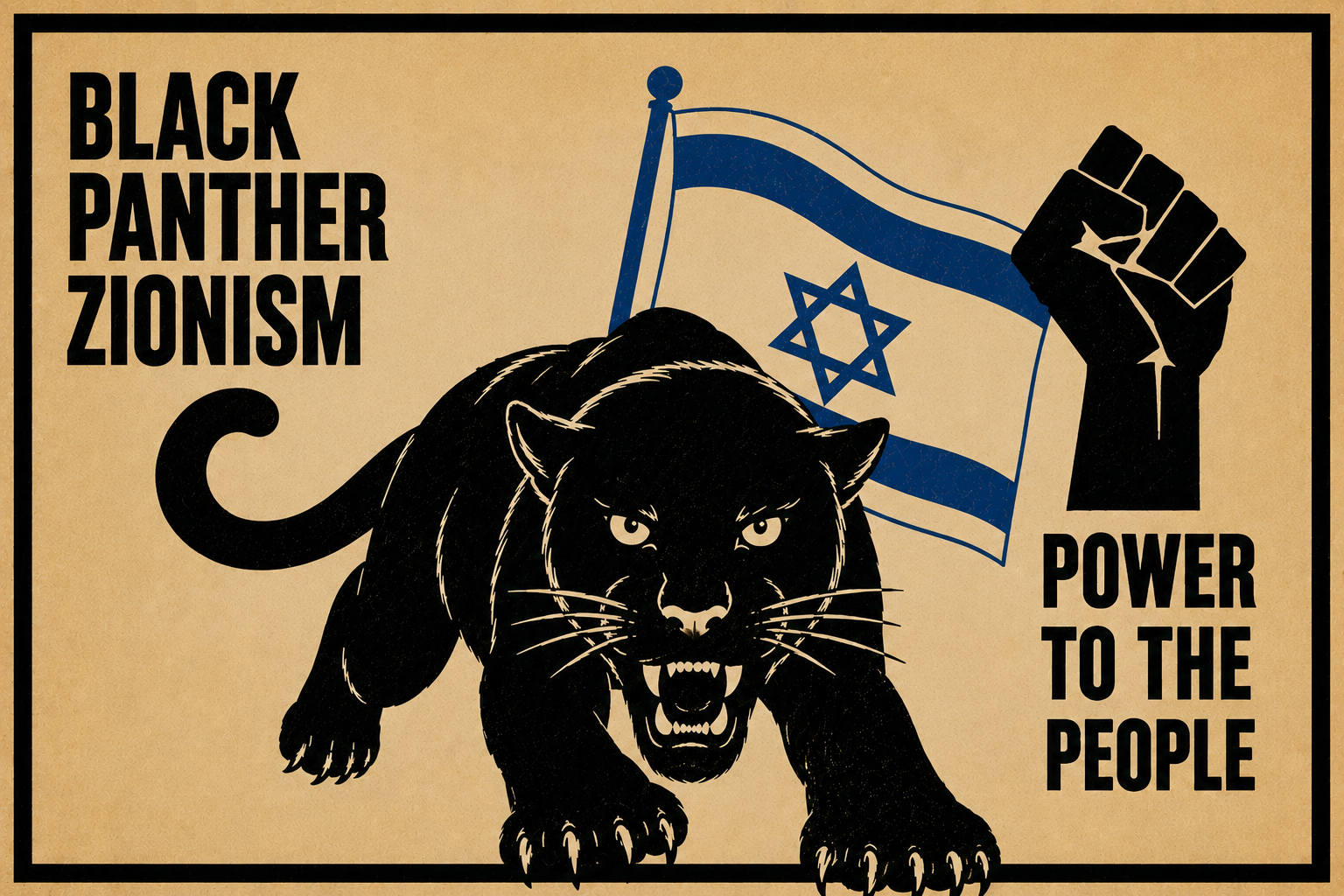
(Part 2: The early Black nationalists’ love of Zionism, Malcolm X as a closeted Zionist, the Black Panther Party’s rebuke of the holy war against Israel, and the real point of this story)
In part 1 (immediately below this article), I reviewed early Zionist thought and showed how the Black Panther Party’s 1966 ten-point platform reflected Zionist philosophy. I suggested that this overlap between Black and Jewish liberation had to be more than a coincidence. I received feedback indicating that some of my points were a stretch. Maybe. Or not. In this final part, we will see how and why this relationship between Black and Jewish liberation first developed, and the power of the Jewish story.
How the early Black Nationalists Came to Embrace Zionism
Edward Blyden and W.E.B. Du Bois were two of the most influential figures in the late 19th- and early 20th-century Pan-African and Black Nationalist movements. But Blyden was widely known as the father of Pan-Africanism. According to Dickinson College Africana Studies Professor Nadia Alahmed, Zionism was a significant influence on 19th-century Black nationalists such as Blyden because “they saw a powerful connection between the goals of [Zionism and Black nationalism] from which it grew: an oppressed people fighting for land and sovereignty in their historical, ‘ancestral’ lands.”[1]
Blyden felt strongly that Zionism, the plight of the Jews, and Black nationalism were interrelated, and he expressed these beliefs in his 1898 pamphlet, “The Jewish Question.” In that pamphlet, Blyden warmly recounts growing up in St. Thomas, the West Indies, where his neighbors and friends were Jews. This experience led him to visit Palestine and take a deep interest in Jewish history and “especially in that marvelous movement called Zionism” which “in some respects, is similar to that which agitates thousands of descendants of Africa in America,…”[2]
Blyden saw it as his “privilege and my duty” to study Zionism, “as the history of the African race—their enslavement, persecution, proscription, and sufferings—closely resembles that of the Jews.”[3] To Blyden, “There is hardly a man in the civilized world—Christian, Mohammedan, or Jew—who does not recognize the claim and right of the Jew to the Holy Land;..”[4]
By Professor Alahmed’s account, “W.E.B. Du Bois’ scholarship and activism created one of the most lasting, multidimensional, and complex impacts on Black radical political philosophies.”[5] Du Bois, a founding member of the NAACP, was among the foremost Black intellectuals of his era. Du Bois saw a direct link between Zionism and the “African movement” of his time, stating in a 1919 editorial that “The African movement means to us what the Zionist movement must mean to the Jews, the centralization of race effort and the recognition of a racial fount.”
Almost thirty years later, Du Bois remained a champion of the Zionist cause. “Everyone knows the way in which the Jewish religion is wound through Palestine and from there how the thread runs through all modern history,” Du Bois wrote in his May 8, 1948, Chicago Star editorial where, just a week before the U.N. vote, he passionately pleaded the case for a Jewish state: “In the meantime, a million displaced Jews are begging to be allowed to migrate to Palestine, where there’s room for them, where there is work for them to do, where what Jews have already done is for the advantage, not simply of the Jews, but of the Arabs.” A week later, the U.N. voted to create the State of Israel and a separate Arab state. The Jews accepted their new state. The Arabs declared war instead and lost.
In his 1952 address to a New York City audience commemorating the ninth anniversary of the Warsaw Ghetto uprising, Du Bois doubled down on his view that there is a deep connection between the Jewish and Black experiences of oppression. There, he described his pre- and post-WWII visits to Warsaw, and compared the hate, destruction, and genocidal remnants he observed in 1949 Warsaw to the hateful and often murderous racism in America: “Nothing in my wildest imagination was equal to what I saw in Warsaw in 1949…The result of these three visits, and particularly, of my view of the Warsaw ghetto, was not so much clearer understanding of the Jewish problem in the world as it was a real and more complete understanding of the Negro problem….No, the race problem in which I was interested cut across lines of color and physique and belief and status and was a matter of cultural patterns, perverted teaching and human hate and prejudice which reached all sorts of people and caused endless evil to all men.”
Through De Bois and Blyden, two intellectual giants of Black Nationalism and Black consciousness, we see both a visceral and a practical connection between the Black American experience and Zionism, as well as the Jewish plight. The profound influence of these two leaders embedded this pro-Zionist perspective in the Black American experience during the first half of the 20th century.
By the mid-to late 1950’s, however, anti-Zionist views began to emerge within the Black community, particularly from the Nation of Islam and later, Malcolm X. Both were highly critical of Israel and its creation. In late 1959, NOI leader Elijah Muhammad met with Egypt’s authoritarian President Gamal Abdel Nasser, who convinced him that the NOI was an ideal movement for propagating the Arab cause against Israel in the U.S.
But even Malcolm X could not resist Zionism’s appeal. In a May 1964 letter to Amsterdam News (pp.54-55), Malcolm X recognized Zionism as an effective nationalism strategy that Pan-Africanists should emulate. As he observed, “We can learn much from the strategy used by the American Jews. They have never migrated physically to Israel, yet their cultural, philosophical and psychological ties to Israel have enhanced their political and economic and social position right here in America. Pan-Africanism will do for people of African descent all over the world the same that Zionism has done for all Jews all over the world.”
Malcolm X’s admission that Zionism was a strategy Black Nationalists should emulate must have created too much dissonance for him to bear. Just four months later, he turned up the antizionist vitriol with the publication of “Zionist Logic” in The Egyptian Gazette. In this Jew hatred screed, Malcolm X incorrectly described Zionism as religious-based and claimed that “their Jewish G-d has chosen them to replace the outdated European colonialism with a new form of colonialism.” Using a dictionary definition of a Jew-hatred trope, Malcolm X went on to claim that “the Zionists have mastered the science of dollarism” and that “The number one weapon of 20th-century imperialism is Zionist dollarism, and one of the main bases for this weapon is Zionist Israel.” Apparently, Malcolm X did not know that Zionism was a secularly rooted liberation movement and that Israel in 1964 was a financially struggling nation.
To Malcolm X, Zionism was a model of liberation that “people of African descent” should emulate, yet when it came to the Jews, they were not entitled to the benefits of their own liberation model. It’s a double standard that persists to this day.
In March 1964, Malcolm X left Elijah Muhammad’s Nation of Islam. On February 21, 1965, Malcolm X was murdered while giving a speech at New York City’s Audubon Ballroom in Harlem, reportedly by members of the Nation of Islam.
The Black Panther Party led the way in the Black Power movement of the 1960s. Regarding Zionism and Israel, the original BPP narrative held that Zionism and Israel were a colonialist, imperialist project and ethnically discriminatory, as Malcolm described them in “Zionist Logic.” A study by the American Jewish Committee quotes Panther Minister of Information Eldridge Cleaver as saying in a December 1969 interview that “Zionists, wherever they may be, are our enemies. We totally support the armed struggle of the Palestinian people against the watchdogs of imperialism.”
While Israel had nothing to do with the Black plight in America, the BPP appeared obsessed with the Jewish state and with Zionism’s success as a Jewish liberation movement. As Michael Fischbach notes in Black Power and Palestine (Stanford University Press, 2019, p.114), “In fact, of the forty-three issues of the Black Panther that ran from June 1, 1969, until March 28, 1970, the party ran thirty-three articles or other items in support of the Arabs or attacking Israel.”
Fischbach also points out (p.117) that in March 1970, the BPP’s international section in Algeria issued a statement that read, “The Palestinian liberation struggle stands in the vanguard of the struggle against the Zionist menace that plagues the people of the entire Arab world in general, and has usurped the national rights and freedom of the Palestinian people in particular. . . . The Black Panther Party unconditionally and firmly supports the just struggle of the Palestinian people and their war of national salvation against the lackey state of Israel and its imperialist backers.”
Four months later, however, we see the beginnings of a dramatic ideological about-face within the BPP on Israel and Zionism. As Fischbach notes (p.123), when BPP leader Huey Newton was released from prison on August 26, 1970, after serving two years, he held a press conference where he stated that “Our situation is similar in so many ways; we say, that morally perhaps, the Jewish people can make a case for separatism and a Zionist state based upon their religion for self-defense. We say, morally, perhaps we could accept this, but politically and strategically we know that it is incorrect.”
Almost four years later, on May 25, 1974, the BPP issued a new policy statement that was nothing short of a tectonic shift. In this statement, the BPP called upon “the Jews” to recognize Palestinian claims and for the “Palestinian Liberation Movement to recognize the existence of the state of Israel as the national sovereignty of the Jewish people.” No longer did the BPP consider Israel the “Zionist menace that plagues the people of the entire Arab world.” Rather, “the Party asserts that the fact the existence of the State of Israel will prove no real hardship to the Arab peoples, if the Jews and their 400,000 comrades living in Israel throw off their mutual yoke of oppression, and build a people’s government serving the human interests of all.”
But the BPP policy statement went further, rebuking Islamic radicalism: “The peoples of the Arab nations need only turn their attention away from the so-called Holly War over with what is now called Israel, to their own oil-rich countries, and throw off the yoke of their oppressive regimes.”
Reminiscent of De Bois and Blyden, the BPP policy continued by noting the role Jews played in the fight for equality both for themselves and the Black people, and how the holocaust explains Jewish sensitivity to social justice struggles. Then, in another mind-blowing rebuke, the policy statement continues by chastising the Arab nations, claiming that “the rulers of the Arab states are not interested in the self-determination of the Palestinians…or peace in the Middle East” and that “the war against Israel is diversionary.” This is what Israel and Zionists had been saying all along!
On August 22, 1989, Huey Newton, the ideological force behind the 1974 BBP policy statement, was murdered on the streets of Oakland. By one account, Newton’s murderer, Tyrone Robinson, was a member of the Black Guerilla Family and a drug dealer.
Today, with much of the post-BPP Black Power movement adopting the settler-colonist, antizionism ideology—one derived in part from Soviet Union antizionist propaganda and from what grew out of an alliance between Nazi Germany and radical Islamists in the 40s—the divide between Black and Jewish communities is deeper than ever. This settler-colonist-antizionism ideology is nothing short of a blindfold designed to alter vision and distort history, the effect of which has been to sow division between Blacks and Jews. Yet if our common experiences and histories with their shared narratives were strong enough to reach Malcolm X and eventually the Black Panther Party, they should surely now be capable of bringing Jews and Blacks together again. But there’s a bigger point here.
The Jews had great storytellers among the early Zionists, such as Birnbaum, Pinsker, and Herzl (see part I). With the early Black Nationalists as one example, we’ve seen the power of our story when told well. It became so baked into the archives of Black consciousness that the Jewish story even overcame antipathy toward Israel, reaching the Black Panthers in their 1974 pro-Israel statement. And that is the point here: Telling our story and telling it well.
The power of the Jewish story, when told well, gives vision to the ideologically blindfolded. As Dara Horn asserts, “Our responsibility, not only as Jews but as members of the liberal West descended from Jewish civilization, is to make people curious about that dramatic story to which we owe our world. Jews are among the first groups in history to stand up to tyranny, and to this day they continue to do so. No one can defuse the lie of antisemitism without understanding that story, because it explains how people who want to dominate need that lie as a tool to stop curiosity and crush dissent.”
The Jewish story—our history, struggles, discrimination, oppression, genocide, culture, religion, Zionism, overcoming oppression—is the not-so-secret weapon in our arsenal against Jew hatred. Jews need an army of storytellers because, as Dara Horn also asserts, “There is no way to debunk the lies of antisemitism without investing in teaching the truth about who Jews are, ” and that is the obvious moral to this two-part story. We need to tell our story because the Jewish story is powerful, and we need to do a hell of a lot better job of telling it than we have been.
[1] Alahmed, N. (2023). From Black Zionism to Black Nasserism: W.E.B. Du Bois and the Foundations of Black Anti-Zionist Discourse. Critical Sociology, 49(6), 1053-1064.
[2] Lynch, Hollis, Selected Writings of Edward Wilmont Blyden, 1971, pp.209-210.
[3] Ibid, p. 211.
[4] Ibid, p. 211.
[5] Alhamed, Supa, p.1054

