
Strategist and Diplomat Analyzing Somaliland and Horn Affairs
“Sovereignty for Sale: Hypocrisy on Somaliland”
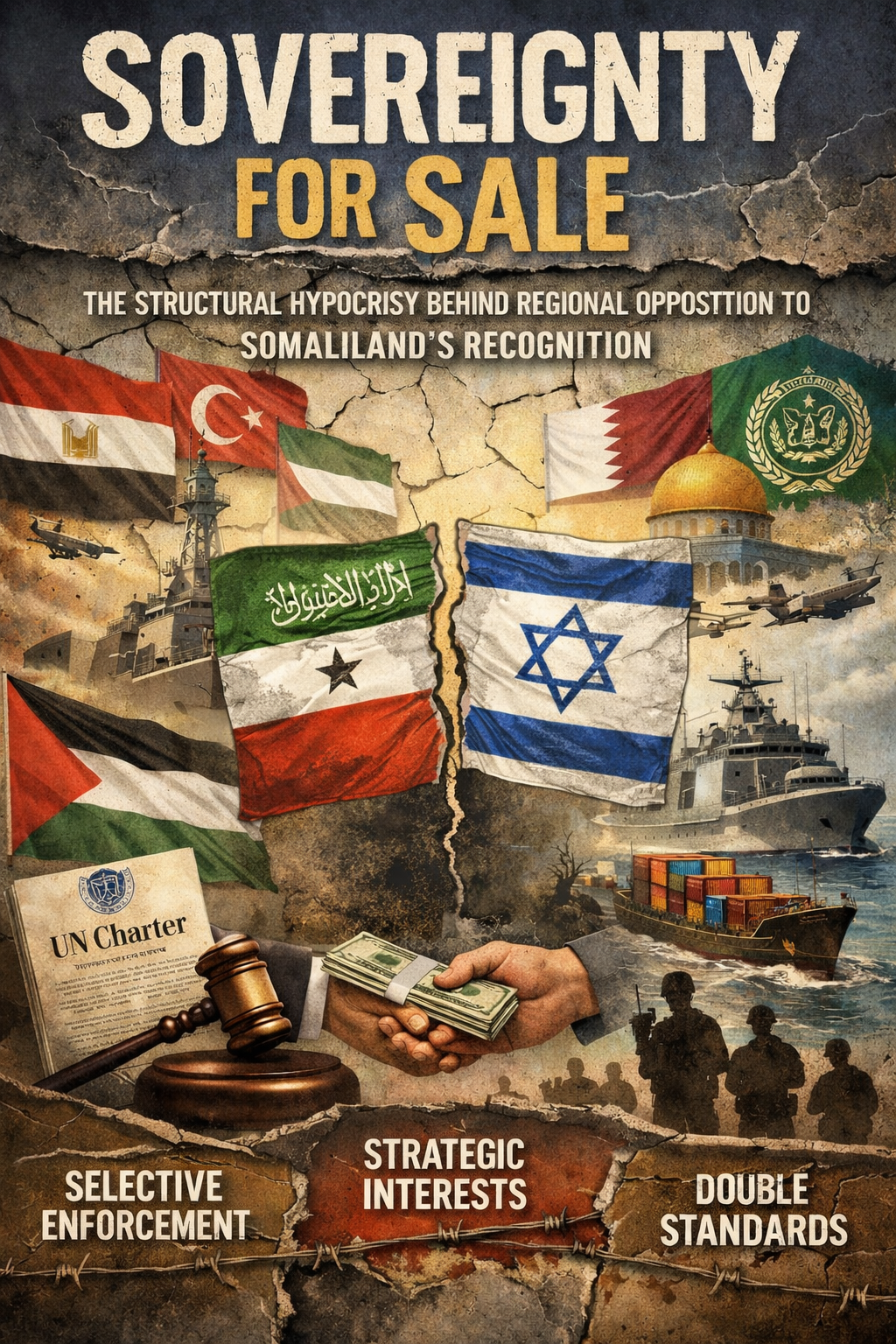
“Sovereignty for Sale: How Selective Law, Strategic Interests, and Double Standards Shape Regional Opposition to Somaliland’s Recognition.”
Sovereignty for Sale: The Structural Hypocrisy Behind Regional Opposition to Somaliland’s Recognition
When Israel announced its formal recognition of Somaliland in late 2025, the response from a coalition of Arab, Islamic, and African states was swift, coordinated, and morally emphatic. Twenty-one governments issued a joint declaration condemning the decision as a “grave violation of international law and the United Nations Charter,” reaffirming Somalia’s territorial integrity and rejecting any alleged linkage between Somaliland’s recognition and the displacement of Palestinians. At first glance, this reaction appeared grounded in legal principle and ethical concern. Yet a closer examination reveals a deeper, systemic reality: structural hypocrisy. The same states that invoke sovereignty, legality, and moral solidarity against Somaliland routinely suspend, reinterpret, or violate these principles when it serves their strategic, economic, or political interests. Somaliland, in this sense, functions as a mirror reflecting the contradictions and selective enforcement of the regional order, wherein norms are applied opportunistically while power remains insulated from accountability.
This article contends that opposition to Somaliland’s recognition is not primarily a defense of international law or Somali unity but a coordinated exercise in double standards. Hypocrisy is not incidental; it is the organizing logic structuring the responses of regional actors, manifested across legal, moral, economic, and security dimensions.
International Law as Instrument, Not Obligation
The principal legal argument mobilized against Somaliland rests on the principle of territorial integrity, intended to safeguard states from external fragmentation and maintain international stability. However, the principle is applied selectively. International law itself recognizes exceptions, particularly in contexts of decolonization, collapse of central authority, remedial secession, and sustained popular consent. The hypocrisy is revealed not in the principle but in its inconsistent enforcement. Many of Somaliland’s critics have supported or acquiesced to territorial violations elsewhere, whether through military intervention, proxy warfare, recognition of breakaway authorities, or prolonged occupation, whenever such actions aligned with national or strategic interests. Others maintain pragmatic relations with de facto authorities lacking international recognition yet deny Somaliland even symbolic legitimacy.
Somaliland’s predicament is particularly inconvenient because it meets the standard empirical criteria of statehood: a defined territory, a permanent population, a functioning government, and the capacity to engage in relations with other states. Its borders align with the former British protectorate, consistent with uti possidetis juris. Rejecting Somaliland while tolerating far weaker, more violent, or less institutionally developed secessionist outcomes elsewhere underscores that international law is being employed as a discretionary instrument rather than as a binding normative framework.
Palestine as a Moral Shield for Political Convenience
A striking manifestation of hypocrisy is the instrumentalization of the Palestinian cause. Somaliland is framed as a potential threat to Palestinian rights solely because it engages diplomatically with Israel, despite having no historical, political, or military involvement in the Arab–Israeli conflict. This framing collapses under empirical scrutiny. Many of Somaliland’s most vocal critics simultaneously maintain extensive trade, intelligence, technological, and security relations with Israel. Some host Israeli businesses or tourists while publicly condemning normalization rhetorically.
In this context, Palestine functions as a moral and rhetorical shield—a device deployed selectively to discipline weaker actors while protecting stronger states from scrutiny. The hypocrisy is twofold: Somaliland is condemned for conduct tolerated—or even practiced—by its critics, and the moral legitimacy of the Palestinian struggle is reduced to a tactical instrument of political messaging.
Erasing Somaliland’s Political Agency
Hypocrisy is also evident in the systematic erasure of Somaliland’s political agency. In regional diplomatic discourse, Somaliland is seldom treated as a political community with historical experience, collective will, or institutional continuity. Instead, it is reduced to an “internal Somali issue,” implying that political legitimacy derives solely from external recognition rather than from governance, consent, or institutional capacity.
This reduction is deliberate. Recognizing Somaliland’s functioning electoral system, constitutional order, and security apparatus would invite an uncomfortable comparison with the internationally recognized Somali federal government, which struggles to assert authority, deliver basic services, or maintain monopoly over force. By denying Somaliland its political subjecthood, regional actors avoid confronting the contradiction between their rhetorical commitment to stability and their tolerance of chronic dysfunction. In practice, unity is defended as an abstraction while Somalilanders themselves are rendered politically invisible.
Egypt: Legal Discourse Masking Strategic Insecurity
Egypt positions itself as a defender of Arab unity and international law, yet its opposition to Somaliland is driven primarily by strategic interests in the Horn of Africa. Central to Cairo’s calculus is the Grand Ethiopian Renaissance Dam (GERD) dispute, where a recognized Somaliland aligned with Ethiopia—and potentially Israel—could provide Addis Ababa with alternative maritime access through Berbera, weakening Egypt’s leverage over trade routes, Nile negotiations, and regional diplomacy.
Beyond the Nile, Egypt’s interests extend across the Horn’s strategic, economic, and security dimensions. The Red Sea and Bab el-Mandeb Strait constitute globally critical shipping corridors. A sovereign Somaliland with international partnerships could establish alternative commercial and security arrangements, diluting Egypt’s influence over these maritime arteries and access to the Suez Canal. Cairo also seeks to maintain leverage over Ethiopia and Eritrea to protect water rights, monitor regional actors, and prevent strategic encirclement. Strengthened Somaliland–Ethiopia ties or foreign involvement in Berbera are perceived as direct threats to Egypt’s authority and regional bargaining power.
Egypt maintains security engagement in the Horn through intelligence sharing, naval coordination, and indirect support for aligned actors. Recognition of Somaliland could enable rival states to access ports, bases, or legitimacy, eroding Egypt’s strategic depth. Economically, Egypt relies on control over trade chokepoints; Berbera’s development threatens alternative pathways, reducing Egypt’s maritime and commercial influence. By opposing Somaliland, Egypt reinforces its symbolic role as a “guardian” of Arab unity, legitimizing interventionist policies in the Horn while selectively applying normative principles. Legal discourse and invocation of Palestine thus serve as strategic veneers, concealing a policy rooted in control, influence, and resource security.
Turkey: Unity as a Mechanism of Influence
Turkey frames its opposition to Somaliland in normative language emphasizing sovereignty and unity, yet its stance is fundamentally strategic and contractual. Over the past decade, Ankara has embedded itself in Somalia’s political economy, security architecture, and infrastructure. Turkey operates Mogadishu’s port and airport, maintains its largest overseas military base, and exercises significant influence over Somali security forces.
These advantages are formalized through exceptional agreements with Somalia, encompassing hydrocarbon and offshore energy contracts that grant Turkish entities extraction and cost-recovery rights, limit Somali regulatory oversight, and establish dispute resolution favoring Turkish jurisdiction. Recognition of Somaliland would create a parallel authority beyond Turkey’s contractual reach, undermining Ankara’s control and economic advantage.
A unified Somalia ensures a single interlocutor through which Turkey channels authority, contracts, and influence. Somaliland’s internationalization threatens this monopoly. The hypocrisy becomes evident when contrasted with Turkey’s relations with Israel: Ankara maintains full engagement with Tel Aviv while resisting Somaliland–Israel relations—not on moral grounds but to protect its strategic architecture. Unity here is not a principle; it is a mechanism of control codified through binding agreements privileging Turkish interests over Somali self-determination.
Djibouti: Security Narratives Concealing Economic Fear
Djibouti frames its opposition in security terms, warning of militarization and instability, while simultaneously hosting multiple foreign military bases and promoting itself as a global security hub. The contradiction is economic. Djibouti’s port economy relies heavily on serving as Ethiopia’s primary maritime outlet. Berbera’s modernization threatens this monopoly, risking revenue loss and diminished geopolitical leverage. Security discourse functions as a façade, legitimizing resistance to competition while masking underlying commercial anxiety.
Federal Somalia: Sovereignty Without Capacity
The Federal Government of Somalia claims custodianship of territorial integrity while exercising limited domestic control. Its authority depends heavily on external military support, international aid, and recognition detached from internal governance. Mogadishu’s selective diplomacy—exploring Israel engagement while condemning Somaliland—underscores the core issue: representation. Recognition of Somaliland would puncture the fiction that sovereignty can exist independently of consent, governance, and legitimacy. Unity is demanded without inclusion; sovereignty is asserted without substance.
Qatar: Financial Leverage, Strategic Alignment, and Media Manipulation
Qatar frames its opposition publicly in normative terms—emphasizing Somali unity, territorial integrity, and anti-secession—while pursuing economic, strategic, and media-focused objectives. Doha co-finances Turkey’s infrastructure, port, and development agreements in Somalia, embedding influence in governance structures and safeguarding a strategic monopoly alongside Turkey, limiting Somaliland’s autonomy.
Qatar further manipulates public perception via media. State-aligned outlets, such as Al Jazeera, have portrayed Somaliland’s independent diplomacy as threatening Arab and Muslim solidarity, fabricating claims that Somaliland might accept foreign Palestinians or act against Arab interests—claims inconsistent with Somaliland’s policies. Media narratives thus function as tools to obscure strategic self-interest and shape regional and international opinion.
Berbera port’s modernization and Somaliland’s diplomatic engagements, particularly with Israel and Ethiopia, challenge Qatar’s embedded networks. This selective framing demonstrates that Qatar’s opposition is rooted not in law, morality, or Somali unity, but in preserving leverage, protecting investments, and shaping perception through misinformation.
Red Sea Geopolitics and Manufactured Threats
Somaliland’s location along the southern Red Sea, adjacent to the Bab el-Mandeb Strait, places it at a pivotal maritime chokepoint. This corridor channels significant portions of global oil, trade, and naval traffic. Berbera port’s modernization and international partnerships are perceived as potential shifts in regional and extra-regional influence.
Regional powers consistently frame Somaliland’s maritime initiatives as destabilizing, despite its record of neutrality, maritime security cooperation, and adherence to international norms. Alleged threats—from Houthis, piracy, or militarization—are invoked selectively and often without empirical evidence, serving primarily as rhetorical devices to justify containment. The asymmetry is evident: states with extensive military bases or arms transfers in the Red Sea face no condemnation, while Somaliland’s diplomatic or commercial engagement is framed as destabilizing.
The narrative of instability functions instrumentally, preserving hierarchical control over maritime trade, military positioning, and Horn of Africa influence. Somaliland’s neutrality and institutional stability, in contrast, make it a potential partner in regional security and trade facilitation. Opposition to its initiatives, therefore, reveals a pattern of manufactured threat perception designed to protect entrenched interests and monopolies in a globally critical maritime space.
Conclusion: Hypocrisy as a Governing Logic
Regional opposition to Somaliland’s recognition is not a principled defense of law, morality, or unity. It is a manifestation of strategic hypocrisy. International law is selectively enforced, Palestine is instrumentalized, sovereignty is abstracted from governance, and unity is defended without consent.
Somaliland is rejected not for violating principles, but for exposing their conditional application. Its recognition challenges a regional order predicated on selective legality, managed instability, and insulation of power from popular legitimacy. The discomfort, therefore, is not with Somaliland—but with what Somaliland reveals.
Related Topics
Related Posts