
What will it take to make the ceasefire in Gaza work?
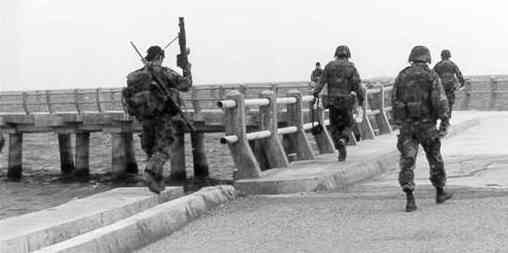
With all the justified jubilation on the return of the hostages and the achievement of a ceasefire in Gaza, it is easy to forget that some of the most important aspects of the ceasefire agreement only exist as vague principles. Guaranteeing a lasting ceasefire in Gaza will take more than a written agreement. Without the right models for implementation, especially when it comes to security, Gaza and Israel face a potentially bleak future marked by further insecurity and future rounds of conflict.
After Hamas frees the hostages, the remainder of the 20 points in the ceasefire agreement rest on the success of a yet-to-be-planned international security mission. Without a robust and successful mission, Hamas and other militants may yet be able to retain and rebuild much of their capabilities while co-opting the other structures, like the “technocratic government” and humanitarian aid and reconstruction authorities that are supposed to be established.
In 2023, my colleagues, Dr. Mary Elizabeth Walters from the US Air Force and Dr. Nir Arielli from the University of Leeds, and I researched and published the best practices from past and ongoing international stabilization missions relevant to Gaza. What we found is that having a separate multinational force to provide security is essential to the success of the mission. Since both Hamas and Palestinian Islamic Jihad continue to exist, their past behavior, as well as the example in UNIFIL in Lebanon, suggests that they will seek either to undermine or to corrupt and co-opt any governance in Gaza. In addition to these groups, there are other smaller terrorist groups and armed clans throughout Gaza, none of whom are likely to wish to fully disarm, and all of whom can use violence to undermine the transition to a future stable territory. To prevent this, Gaza needs more than a monitoring mission – it needs a security and stabilization force.
Not all models of international security force will prove sufficient. Given that Hamas still has robust capabilities to resist disarmament and intimidate businesses, humanitarian organizations, and reconstruction agencies, the multinational force will need to have a range of capabilities, including modern armor, unmanned aerial vehicles, and the capability to detect and neutralize Hamas subterranean facilities and neutralize IEDs.
It will need to have enough personnel to operate in multiple areas of Gaza simultaneously and be responsive enough to prevent a security vacuum for regular people while protecting those engaged in reconstruction and commerce from intimidation by either militant or criminal entities. At the same time, it must be flexible enough to police non-violent civil disorder. While it may be able to transition some of these responsibilities to a local police force, that will be years in the future. This means that the multinational force must plan to be on the ground for years to come.
Even with sufficient capabilities and time, a multinational force in Gaza will likely fail without a sufficiently permissive mandate for the use of force and rules of engagement to support it. Without these mandates and rules of engagement, the multinational force risks following the fate of UNIFIL II in Southern Lebanon, which was hampered by a similar problem. Yet neither robust capabilities nor an expansive mandate with permissive rules of engagement will matter if the participating countries are unwilling to take the steps necessary to enforce the disarmament of Hamas.
All of this leads to a problem of participation: Multinational forces are voluntary. Countries have to decide to put their soldiers in and keep them there throughout the mission. While other, less capable and less trained militaries may be able to help the multinational force, at the core, there must be at least one primary country whose forces are well enough trained and equipped to handle a Hamas-led insurgency. The list of countries whose militaries meet this standard is short (mostly including European, Pacific, and North American countries), and the list of those that Israel would trust with this responsibility is even shorter. Multinational force contributors will have to put their soldiers in harm’s way for an indefinite period – likely at least five to ten years if not more – to help Gaza, but many of the countries that could be effective have other pressing priorities, such as deployments in Eastern Europe or the Pacific. This is to say nothing of the domestic political risk many countries would face if their troops were fighting Palestinian groups threatening Israel’s security, which may reduce the list of potential contributors as well as the motivation of those who may participate.
The security arrangements are not the only aspects of the 20-point agreement that require more detailed work for it to succeed, but they are the foundation on which all else rests. With a robust and motivated international force, it may be possible to slowly begin building a new future for Gaza and Israel, but it cannot succeed unless there is enough willingness from the international community to overcome its challenges and see it through. Without such commitments, the future for Gaza will likely be one of vulnerability to militant groups and criminal organizations, meaning that it will also continue to be a source of insecurity for Israel.
The views, facts, opinions, and conclusions expressed herein are those of the author and do not necessarily represent the views of the US Government, Department of Defense, US Army, US Army War College, or any other government agency. (References to this article should include the foregoing statement.)