
Still Worth A Blessing
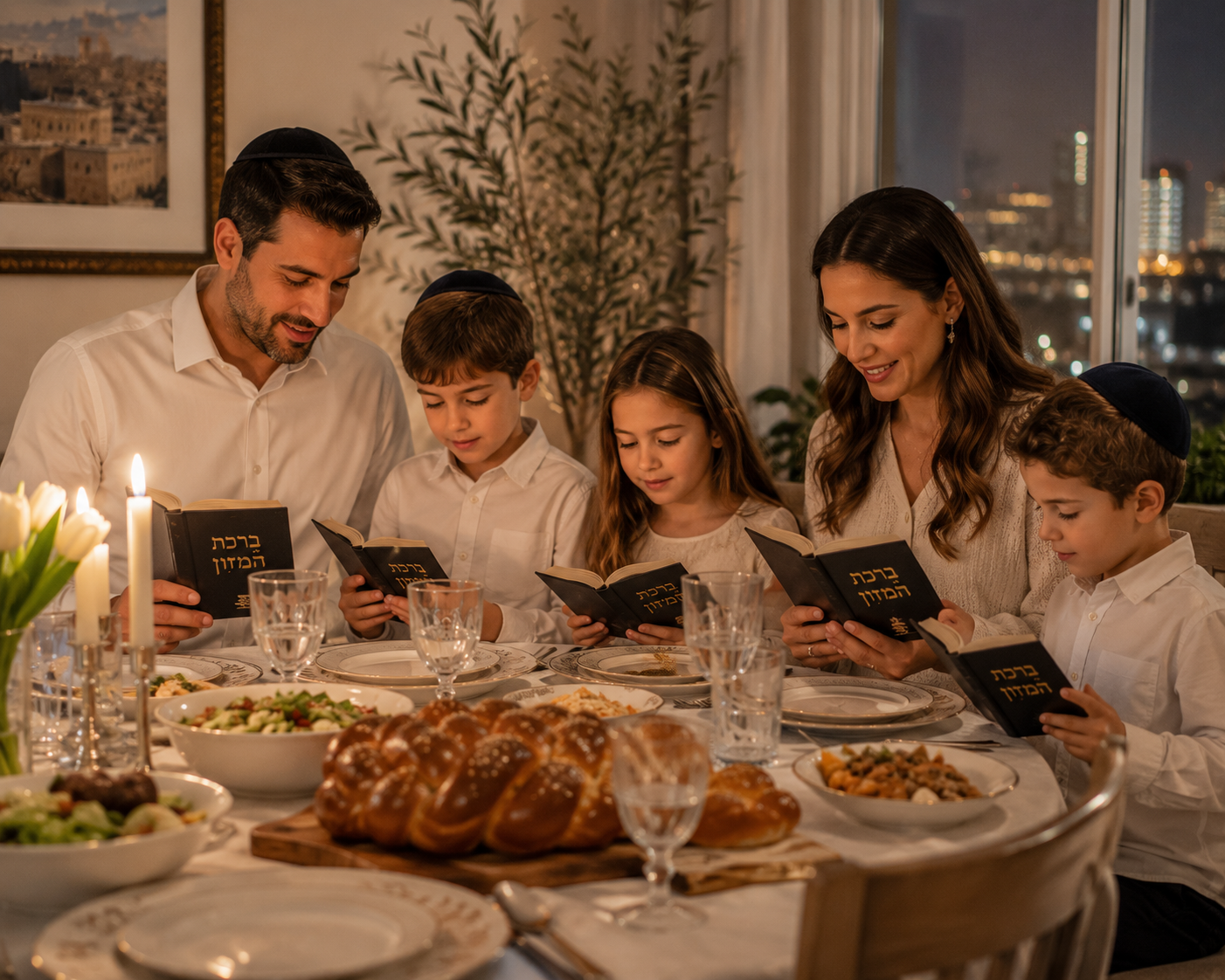
Bircat Hamazon, or Grace After Meals, is so familiar to some people that it is easy to overlook how extraordinary it is. We finish eating, reach for a bencher, and recite words composed across centuries of Jewish history. But the four blessings which make up “benching” do more than just thank God for food. Together, they tell the story of the Jewish people—and teach us how to recognize goodness even when life is painfully incomplete.
The Talmud in the tractate of Brachot 48b explains the historical origin of each blessing in Bircat Hamazon.
The first blessing, Hazan et hakol—“God Who sustains everyone”—was instituted by Moshe when the manna descended in the desert. Each morning, the Jewish people opened their tents and discovered that God had provided precisely what they needed for that day.
The second blessing, Al ha’aretz v’al hamazon—“for the Land and for the food”—was instituted by Yehoshua when the Jewish people entered Israel. They were no longer merely receiving bread from Heaven. They had entered a land in which they could plant, harvest and build a national future.
The third blessing, Boneh Yerushalayim—“Who rebuilds Jerusalem”—was instituted by King David and his son Solomon. David, who established Jerusalem as the Jewish capital, composed the words, “For Israel, Your people, and for Jerusalem, Your city.” Solomon who built the Temple, added the reference to “the great and holy House.”
The blessings appear to form a wonderful progression: sustenance, land, sovereignty, Jerusalem and the Temple. We move from survival to security, from physical provision to spiritual destiny.
And then comes the fourth blessing: Hatov v’hameitiv—God “Who is good and does good.” We might expect this final blessing to have been composed at the high point of Jewish history—perhaps when Solomon dedicated the Temple or when the nation experienced peace and prosperity.
Instead, it was instituted following one of the darkest catastrophes in Jewish history.
Beitar was the final stronghold of the Bar Kochba rebellion. After crushing the revolt, the Romans massacred the city’s inhabitants and refused to allow their burial. Only years later did the Roman authorities finally grant permission for the bodies to be interred. When the Jews arrived to perform the burial, they discovered that the bodies had miraculously not decomposed. The Sages of Yavneh therefore instituted the bracha of Hatov v’hameitiv: God was “good” because the bodies had been preserved, and He “did good” because they were ultimately brought to burial. (Talmud, Brachot 48b).
But how could the Jewish sages compose a blessing over such a small kindness within such an overwhelming tragedy? The Jews of Beitar were still dead. Jewish independence had been crushed. The Temple remained destroyed, and the nation was heading into a long and bitter exile. Burial did not reverse the catastrophe. Yet the chachamim said: there is goodness here, and that goodness must not go unrecognized. Something does not have to be perfect to deserve a blessing.
We often postpone gratitude until everything falls into place. We are thankful when the illness disappears, when the relationship improves, when the financial pressure eases, when the child finds direction or when the country finally feels secure. Until then, the problems feel too big to acknowledge anything else.
Judaism does not ask us to deny the pain we experience. The Sages did not call the destruction of Beitar good. They mourned the dead and understood the magnitude of the national calamity. But they refused to allow the tragedy to erase the goodness that was still there.
Life rarely arrives as a neatly wrapped package. A person may struggle professionally while being blessed with a loving family. A marriage may pass through a difficult period while still containing loyalty and genuine affection. The State of Israel may face war, isolation, and internal divisions while remaining one of the greatest miracles of Jewish history.
The fourth blessing – hatov v’hameitiv may be the most demanding of benching. It’s easy to thank God when manna falls from heaven, when we enter Israel, or the Temple stands in Jerusalem. It is far harder to discover Hashem’s kindness amid loss and disappointment.
But that is precisely where our faith is tested. Sometimes we cannot yet understand the larger story. Sometimes all we can identify is one unexpected kindness within a broken reality. Hatov v’hameitiv teaches us not to dismiss it. It asks us not to become blind to the good that remains. Even in Beitar, even among the fallen, even after defeat, the Sages of Yavneh found one kindness that had not been erased—and they made sure the Jewish people would remember it forever.