
The views expressed herein are solely mine.
Stop Lying: The West Bank Is Not Occupied
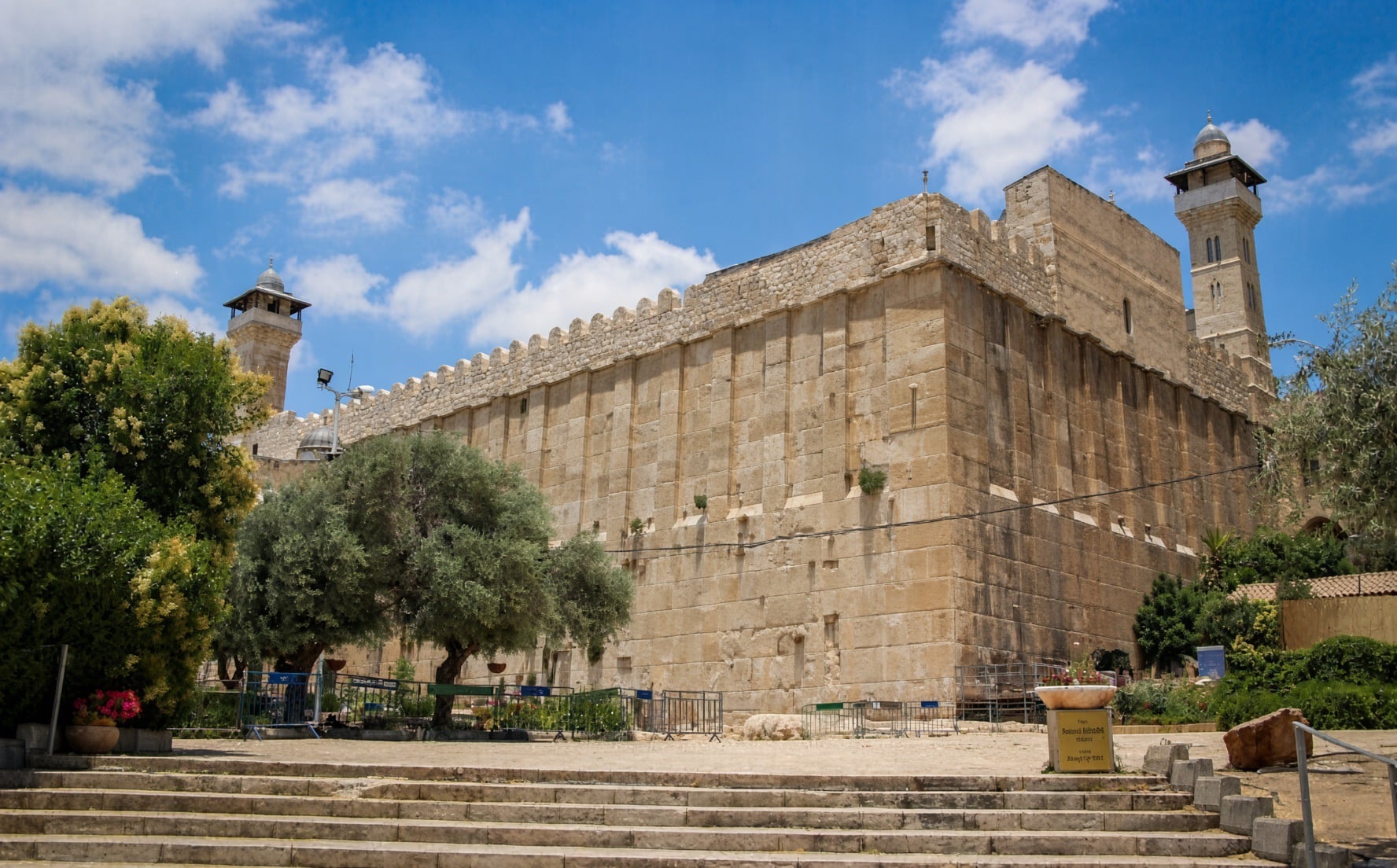
The Tomb of the Patriarchs, in the West Bank town of Hebron, June 22, 2017. (Gershon Elinson/Flash90).
The term “Jew” derives from Yehuda, the biblical kingdom whose heartland comprised the rugged hill country of Judea and Samaria, or as the European globalists love to call it: the West Bank. Throughout these ridges, scripture anchors the foundational milestones of Jewish history: Abraham’s purchase of the ‘Cave of the Patriarchs’ in Hebron, the tabernacle at Shiloh, and the sovereign centers of both the northern and southern kingdoms. Beyond sacred text, the archaeological record confirms a continuous Jewish material culture—evidenced by ancient mikvaot, distinct limestone vessels, and Hebrew inscriptions—spanning more than three millennia. Even Roman historian Cassius Dio documented this dense presence, recording that Rome had to destroy 985 Jewish villages in Judea to quell the Bar Kokhba revolt. Recognizing this deep-seated reality, the main Allied powers at the April 1920 San Remo Conference converted historical connection into binding international law, directing Great Britain to establish the Jewish national home throughout the entire Mandate territory west of the Jordan River.
This legal trajectory was violently interrupted in 1948, when Jordan seized the territory by force and annexed it in 1950. However, because only Britain and Pakistan recognized Amman’s land grab, the annexation remained void under the post-World War I international prohibition on territorial acquisition by conquest. Consequently, when Israel captured the area during the 1967 defensive war, it did not occupy a foreign state; rather, it ended Jordan’s unlawful administration. Any lingering ambiguity was resolved on July 31, 1988, when King Hussein formally renounced all legal and administrative claims to the area, stripping roughly one million residents of Jordanian citizenship and leaving a sovereignty vacuum. Under classic international law, the framework of belligerent occupation strictly requires the displacement of a legitimate prior sovereign. Because Jordan’s title was widely unrecognized, and no alternative sovereign claim existed, the legal criteria for “occupation” do not apply.
When viewed sequentially—moving from Mandate recognition of historical title, through illegal Jordanian annexation, to Israeli defensive recovery and Amman’s explicit renunciation—the territory is properly classified as disputed, not occupied. Maintaining this distinction is a matter of acute regional survival. Geopolitically, the Jordan Valley’s low elevation and the high ground’s command of the coastal plain provide Israel with its only viable strategic depth against eastern armored attack or Iranian-backed infiltration. Therefore, retaining Israeli administrative control does not obstruct peace; instead, it preserves the viability of the Abraham Accords by denying Tehran a contiguous land corridor to the Mediterranean.
To formalize this reality, the international community should establish a San Remo Continuity Tribunal. Staffed by jurists nominated by the successor states of the original Allied powers, this body would apply a Historical Title Density Index—measuring archaeological site frequency, biblical and classical references, and the continuity of ritual practice—as a quantitative test for residual Mandate rights. Concurrently, regional partners should adopt an Abrahamic Residual Zone Protocol. Under this framework, Abraham Accords signatories would declare the territories Mandate residual zones, authorizing permanent Israeli administrative control of the Jordan Valley and strategic ridges. In return, a Geostrategic Equity Swap would trade formal Arab recognition of Jewish historical title for enhanced, joint counter-encirclement capabilities, establishing a demilitarized security buffer verified by all parties.
Ultimately, history and law do not yield to political slogans. The West Bank remains disputed because its only prior administrator abandoned it, and the original Mandate never extinguished the underlying Jewish title. In a volatile Middle East, strategic depth and legal continuity are not negotiable preferences—they are the bedrock conditions under which any durable regional architecture must stand.
Related Topics