
Middle East Analyst
Strategic Implications of Low Public Support for Military Operations in Iran
by author
Public support is not a peripheral variable in U.S. military operations; it is a structural constraint. In democratic systems, the initial level of public approval functions as political capital. That capital must absorb predictable shocks: casualties, economic disruption, operational friction, and media and Congressional scrutiny. When an operation begins with broad bipartisan support, it possesses resilience. When it begins below 30 percent, its margin for error is extremely narrow.
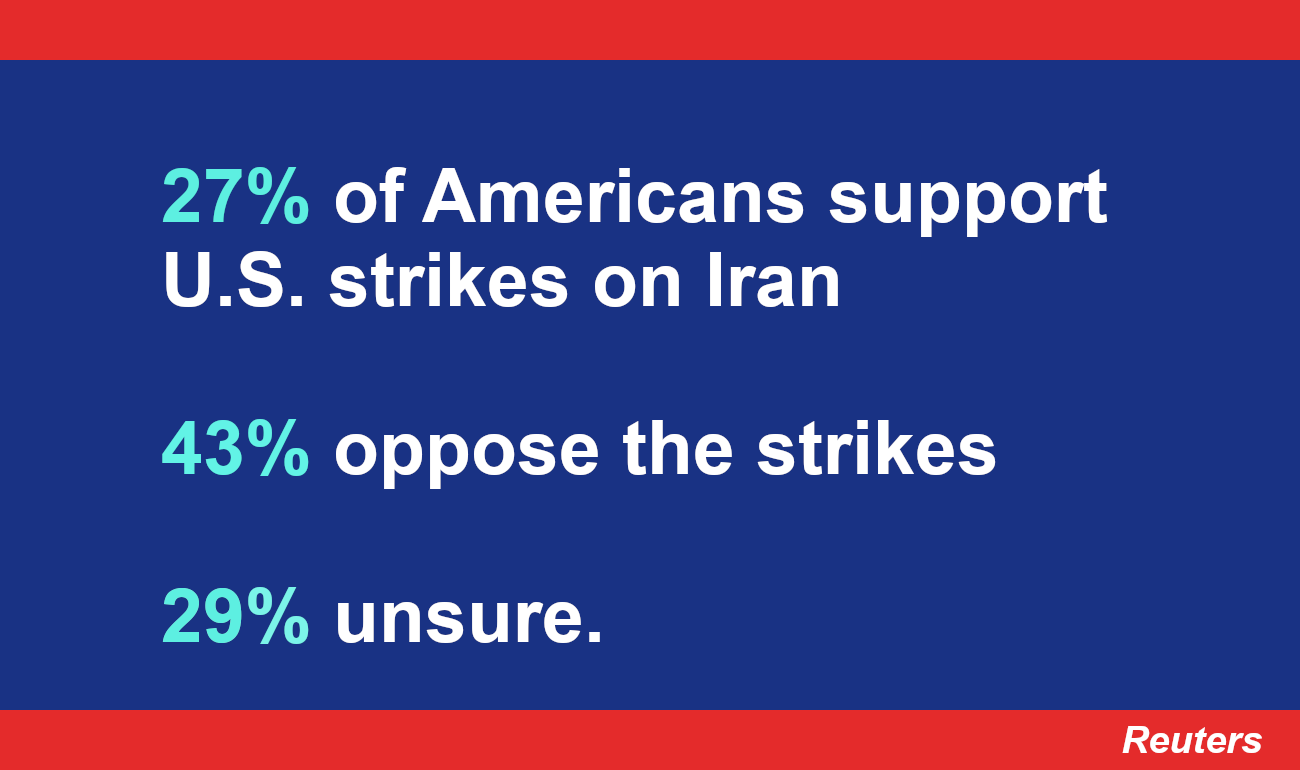
The recent Reuters/Ipsos poll indicating that only 27 percent of Americans support U.S. strikes on Iran establishes an unusually weak starting point. Forty-three percent oppose the strikes and 29 percent remain unsure. The partisan distribution is equally significant: support is concentrated within one party, with minimal cross-party backing. That asymmetry matters. Sustained military operations historically correlate with at least tacit bipartisan consensus. Absent that, political durability becomes uncertain from the outset.
Historical Context and Baseline Comparison
Modern U.S. conflicts illustrate a consistent pattern. Operations that proved politically sustainable—such as the 1991 campaign to expel Iraqi forces from Kuwait and the initial phase of the post-9/11 campaign in Afghanistan—began with public support exceeding 60 percent and strong elite consensus. Even in those cases, support declined over time as costs accumulated.
The 1991 Gulf War is sometimes cited as a counterexample in which support increased during combat. However, that conflict was short in duration, limited in scope, and involved relatively low U.S. casualties during a 100-hour ground campaign. It did not test prolonged casualty tolerance under contested political conditions. It began with high approval and ended before erosion dynamics could meaningfully develop.
There is no modern American case in which a military operation began with sub-30 percent support, incurred casualties, and then experienced a sustained increase in public approval. Temporary rally effects have occurred under extraordinary circumstances—most notably after direct attacks on U.S. territory—but those are driven by external shock and perceived national defense, not by casualties themselves. The historical record suggests that when support begins low, it is difficult to expand once losses occur.
Timing and Political Fragility
The poll’s timing is strategically relevant. It was conducted before the public learned of U.S. fatalities and before any measurable economic consequences materialized. Casualties and economic costs are not hypothetical variables; they are predictable features of conflict involving Iran. The 27 percent figure therefore likely reflects a pre-cost baseline.
Political science literature on casualty sensitivity consistently shows that public tolerance for losses is conditional. Americans are more willing to accept fatalities when three elements are present: perceived necessity of the mission, belief in probable success, and elite consensus across party lines. In the current case, public opinion data suggest that at least one of those pillars—consensus—is weak. Moreover, a majority of respondents indicate that the president uses military force “too much,” which lowers the threshold at which casualties are interpreted as strategic overreach rather than necessary sacrifice.
This does not guarantee a collapse in support. Public opinion is not mechanically deterministic. A decisive and clearly successful strike could temporarily stabilize or even modestly increase approval. A major Iranian escalation against U.S. forces or territory could produce a short-term rally effect. However, absent such dramatic reframing events, historical experience indicates that support tends to erode rather than expand once casualties become salient.
The Economic Variable
Energy markets introduce an additional structural pressure. Iran’s geographic position and role in global oil transit mean that even limited military exchanges can trigger price volatility. Sustained increases in fuel costs feed directly into inflation, consumer sentiment, and electoral calculations.
The 29 percent of respondents categorized as “unsure” represent a volatile bloc. Historically, undecided respondents tend to move toward opposition as costs become tangible and media scrutiny intensifies. If economic disruptions coincide with casualties, political support may compress further. The key point is not that economic effects will necessarily be severe, but that the operation begins without a cushion.
Strategic Constraints
Low public support constrains military planning in practical terms. Operations that require sustained deployments, escalation dominance, or high-intensity retaliation become politically riskier. Decision-makers may face pressure to limit objectives, compress timelines, or avoid actions that risk additional casualties. Political feasibility and operational feasibility become tightly coupled.
Adversaries understand this dynamic. Iran’s leadership is acutely aware of U.S. domestic political cycles and casualty sensitivity. Asymmetric responses—proxy attacks, maritime disruption, cyber operations, or calibrated strikes designed to produce limited but visible U.S. losses—can be used to test American political endurance. When an operation begins with fragile domestic backing, even modest tactical setbacks can have strategic political effects.
Alliance and Credibility Effects
Low domestic support also shapes alliance calculations. Partners assess not only U.S. military capability but also political staying power. If Washington appears constrained by domestic opposition, allies may hedge—either by limiting their visible participation or by accelerating independent action. Coalition cohesion becomes more difficult to maintain when the lead actor’s domestic mandate is contested.
Conclusion
Public support does not determine battlefield outcomes, but it shapes strategic sustainability. Modern American experience demonstrates that support generally declines as casualties and costs accumulate, particularly when initial approval is modest. There is no contemporary precedent for a sustained increase in backing once losses begin when the starting point is below 30 percent.
An operation that begins at 27 percent support is therefore politically fragile. It lacks the buffer that historically allowed prior campaigns to absorb early shocks. That does not make success impossible. It does mean that maintaining public backing will be difficult, and any escalation—whether measured in casualties or economic impact—will occur within a constrained political environment.
In democratic systems, military power is bounded not only by capability but by consent. When consent is thin at the outset, strategic margin narrows accordingly.
Related Topics
Related Posts