
Survival of the Social: Protecting the Mediterranean Countryside
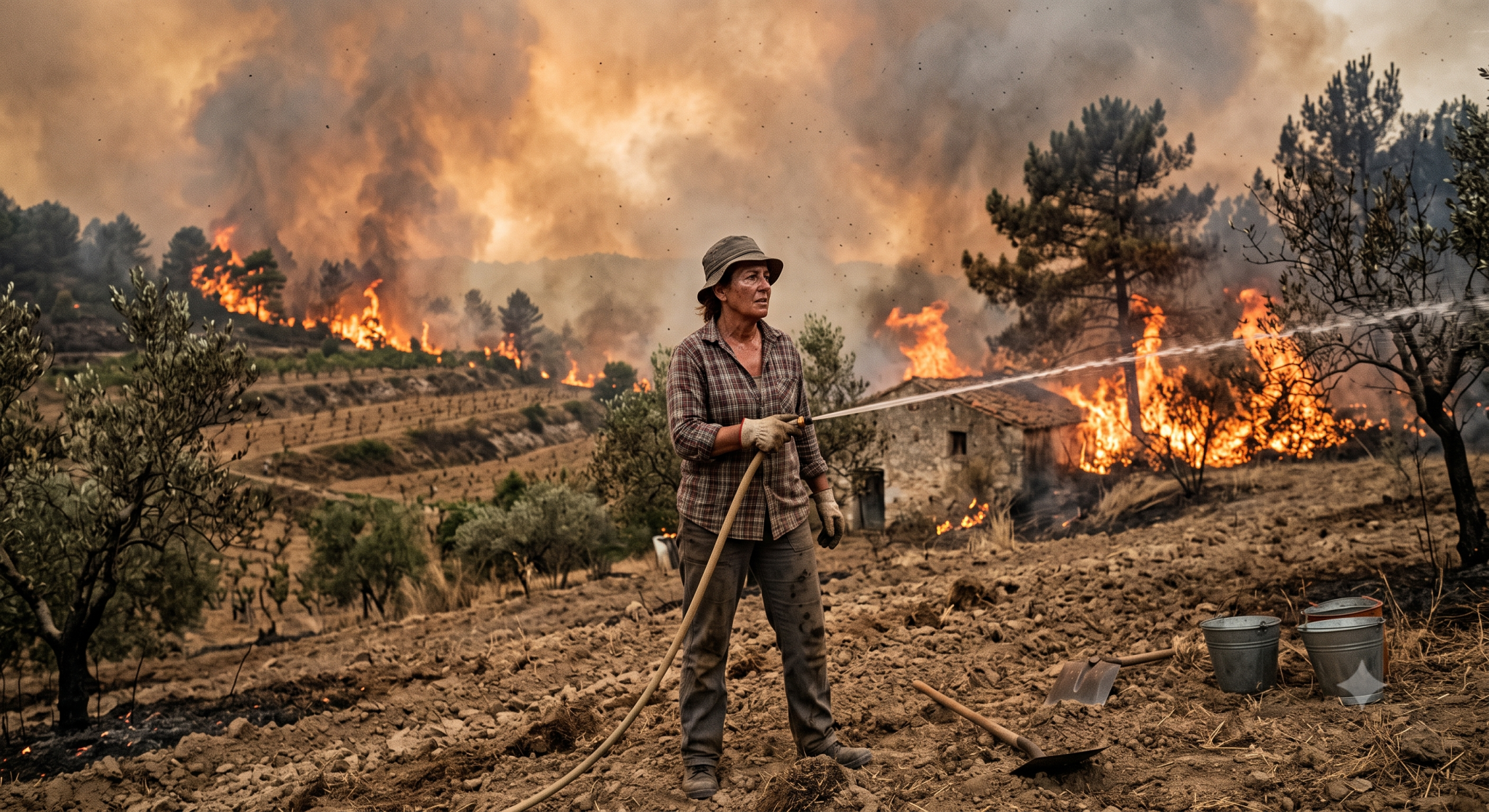
Motto: “Not the strongest survives, but the social.”
A Summer of Recurring Crisis
The summer of 2026 has delivered another harrowing reminder of the Mediterranean’s extreme climate exposure. Wildfires across rural landscapes have broken records, claiming lives—including first responders, firefighters, and aerial firefighting pilots—while devastating agricultural livelihoods, regional tourism, and local ecosystems.
Yet extreme heatwaves and summer fires in the Mediterranean are far from new. What has fundamentally failed to keep pace is our response paradigm: state strategies continue to rely disproportionately on top-down technical interventions, heavy suppression equipment, and centralized emergency mandates. While vital, physical infrastructure alone cannot shield vulnerable populations. Building meaningful resilience requires investing in the social fabric itself.
Demographics and Reality: The Human Face of Rural Vulnerability
Standard emergency response protocols often assume a mobile, agile population capable of immediate evacuation upon receiving digital alerts. In the rural Mediterranean—particularly across Southern Europe—this assumption fails to match reality.
- An Aging Demography: Rural Mediterranean settlements are heavily skewed toward older populations with higher rates of chronic illness and limited physical mobility. Digital broadcast warnings often fail to reach isolated households.
- Attachment to Land and Livestock: Smallholder farmers, vine growers, and livestock owners routinely resist evacuation mandates. Deep economic and emotional ties to their land keep residents on-site attempting to protect homes, livestock, and crops even as fire lines approach their property edges.
- Mobility Obstacles: Limited local transit options and reliance on single-access roads turn mass evacuations into high-risk choke points for vulnerable citizens.
Evacuation models that ignore these human and socio-environmental realities risk worsening casualties. Preparedness plans must be built around the population that actually lives in these regions.
Quantifying the Social Dividend: Data Behind Community-Led Preparedness
Research by the Association for Environmental Justice in Israel (AEJI) presented ahead of the Paris Climate Conference (COP21) demonstrated that top-down emergency management frequently fails when disconnected from local community structures. Empirical data across climate disaster studies strongly confirms the quantitative value of social capital:
High Social Capital (Local Networks): Up to 70% reduction in heatwave-related mortality among isolated elderly populations.
Participatory Risk & Fuel Mitigation: 45% faster evacuation response times during rapid-onset rural wildfires.
Institutionalized Care Checks: Up to 80% decrease in emergency hospitalizations (e.g., French Postal Outreach model) during peak temperature spikes.
A clear operational example is the French national protocol authorizing rural mail carriers to perform structured well-being checks on isolated seniors during extreme thermal alerts. By utilizing trusted, everyday networks, this low-cost social intervention directly prevents medical crises before emergency systems become overwhelmed.
Concrete Policy Recommendations for Tailored Rural Resilience
To align climate adaptation with demographic realities, Mediterranean policymakers should focus on four core initiatives:
- Institutionalize Trusted Rural Care Networks: Expand municipal and public worker duties (postal carriers, social care teams, agricultural extension agents) to conduct door-to-door welfare checks and offer direct assistance to mobility-impaired residents during severe weather alerts.
- Develop Tailored “Stay-or-Safely-Evacuate” Protocols: Recognize agricultural realities by training local farmers in pre-season perimeter defense, creating communal livestock shelters, and establishing neighborhood-level early-support teams to assist elderly neighbors who cannot evacuate unassisted.
- Establish Local Participatory Resilience Hubs: Create community-directed emergency nodes that combine local ecological knowledge with volunteer groups to manage vegetation fuel loads, maintain defensible zones, and run non-digital warning networks (such as phone chains or local sector leaders).
- Prioritize Socio-Environmental Equity in Budgeting: Direct state climate adaptation funding specifically toward socio-economically disadvantaged and elderly rural communities. Reducing socio-environmental gaps directly increases community-wide disaster survival rates.
Conclusion: Rethinking Regional Realities
Relying exclusively on hardware and suppression capacity leaves rural Mediterranean communities exposed to mounting climate risks. True resilience depends on local solidarity, structured care networks, and policy frameworks built around the actual demographic makeup of the countryside. In the face of intensifying climate shocks, it is not the strongest isolated actor that survives, but the connected, cohesive, and socially supported community.