Taking responsibility
When our kids were little, we had three core values that we emphasized as central to our family. One of them was “Do your responsibilities.”
The other two were “Treat people with respect” and “Handle your frustrations.” Together, we felt, these three principles captured so much of what we value and how we hope to carry ourselves as we navigate the complexities of the world.
When the children were young, “Do your responsibilities” referred to things like brushing their teeth, cleaning their rooms, and fulfilling religious obligations such as praying each morning. It was about recognizing what was expected of them, rising to the occasion, and following through.
As they grew older, we began using another phrase alongside it: “Take responsibility.” The distinction matters. Taking responsibility means looking beyond what is immediately expected of you. It means thinking ahead, taking initiative, volunteering, and pitching in. It also means owning your decisions, standing behind them, resisting the temptation to blame others, and acknowledging when you have been wrong or made a mistake.
These values have not lost their relevance as our children have grown. They continue to inform our daily decisions and shape what we admire in others. Do people treat others with respect? Do they handle their frustrations constructively? Do they take responsibility?
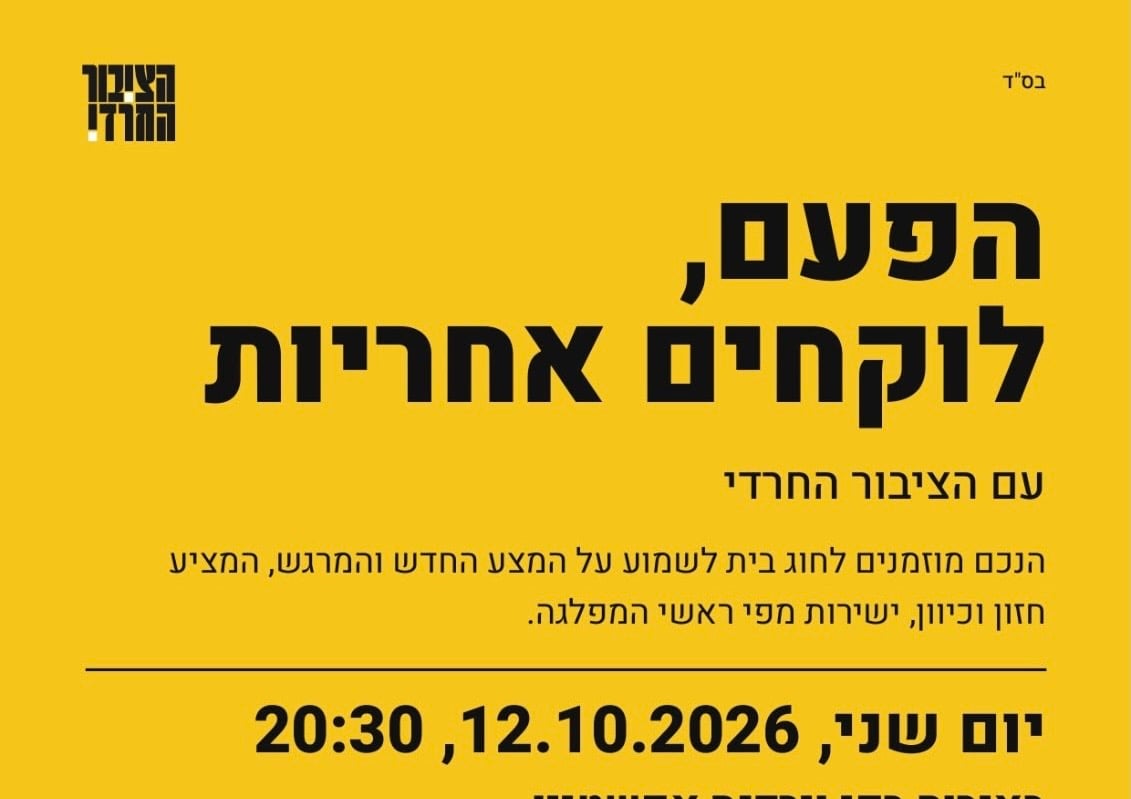
That is why the slogan of a brand-new political party in Israel immediately caught my attention:
הפעם, לוקחים אחריות — “This time, we are taking responsibility.”
The slogan belongs to Hatzibbur HaCharedi (The Charedi Public), for whom taking responsibility means recognizing that it is possible to live a parochial lifestyle while being fully committed citizens of the State of Israel. The two are not contradictory.
The party believes that its constituents should share the burden of Israel’s security. It believes that all children in Israel should receive a solid secular education, including high-level mathematics and English. It believes that adults from all communities should enter the workforce, contribute to society, and support their families with dignity, rather than depend on welfare.
Just hearing about this party gave me hope.
For three years, I have struggled with internal anger toward segments of our society that seem unwilling to view themselves as part of the story of this country. I do not like being angry, especially at people I love and respect. Eventually, my anger gave way to sadness. I began to feel disconnected from ways of life I had once appreciated.
And then, suddenly, here was a vision that filled me with optimism.
I am not Charedi. I live in Gush Etzion, identify as Religious Zionist (demographically, though not necessarily politically), have two sons and a husband in the army, and hold firmly to the Modern Orthodox values in which I was raised—including the value of demonstrating civic responsibility. And here was a voice that was embracing that as its slogan.
A week ago, I had the opportunity to attend a parlor meeting in our neighborhood with Motti Leitner, the head of the Hatzibbur HaCharedi party. I went because I was curious to meet the man behind the vision.
I don’t live life exactly the way Motti Leitner does. I don’t expect him or his party to fully reflect all my values. I know that sometimes he may say things or promote ideas that I don’t agree with and which don’t resonate.
But his voice gave me hope, and kept me curious. He expressed his frustrations in measured, constructive ways and explained how he hoped to make a difference.
This past Saturday night, the party gathered with its supporters for a conference in Jerusalem. I watched parts of the livestream from my bedroom. Toward the end, they introduced Adiel Bar Shalom, head of the party’s Religious Zionist division.
Adiel shared a story from a little over a year ago, when he was serving in Gaza. On Hoshana Rabba, his unit needed to recharge, and so they left Gaza to visit the Nova festival memorial. Afterwards, Adiel was making his way back to his Humvee when he heard a group of people singing with intensity.
He told his friends to wait for him. He needed to find out where the singing was coming from.
Following the sound, he discovered a group of young Charedi yeshiva students singing around lit candles. The soldiers joined them, and together they sang and cried.
When it was time to leave, one of the young men turned to Adiel and asked, “Can I go with you to the Humvee? I want to go into Gaza with you.”
“We would love for you to join us,” Adiel replied.
The two began an emotional conversation. With tears in his eyes, the yeshiva student explained the obstacles still, unfortunately, holding him back from drafting. Then he said something that stayed with Adiel:
“We need a political power that can give us the strength to come and join you there in Gaza.”
Adiel answered, “If a political power gets established, I promise you that I will be there.”
And there he was, standing onstage at the party’s conference, working on its behalf to advance that very vision.
As Adiel explained, this is not about a vision for one specific community in Israel. It is a message of hope for Israeli society, for the State of Israel, and for the Jewish people.
When I first learned about the Hatzibbur HaCharedi, I was thinking about what this party might make possible for the Charedi community. But perhaps it has a message for all of us.
For months, I have been contemplating how to use my vote on Election Day to further the Zionist ideals I believe in. I have been patiently seeking out political voices that want to transcend the “right-left” divide. That believe in unity and approach their missions with humility. That aim to bring people together around Zionist ideals and recognize that a significant portion of the country agrees on far more than we sometimes acknowledge. That want to bring new ideas to old problems, treat people with respect, and handle frustrations constructively.
With Election Day a week away, Hatzibbur HaCharedi has me asking: What would it mean for me to use my vote to most productively move this country forward?
How can I use it most responsibly for the sake of my people and my country?