
Writer covering Israel–Africa, Jewish affairs, and Israel worldwide
The Abnormal Normalization
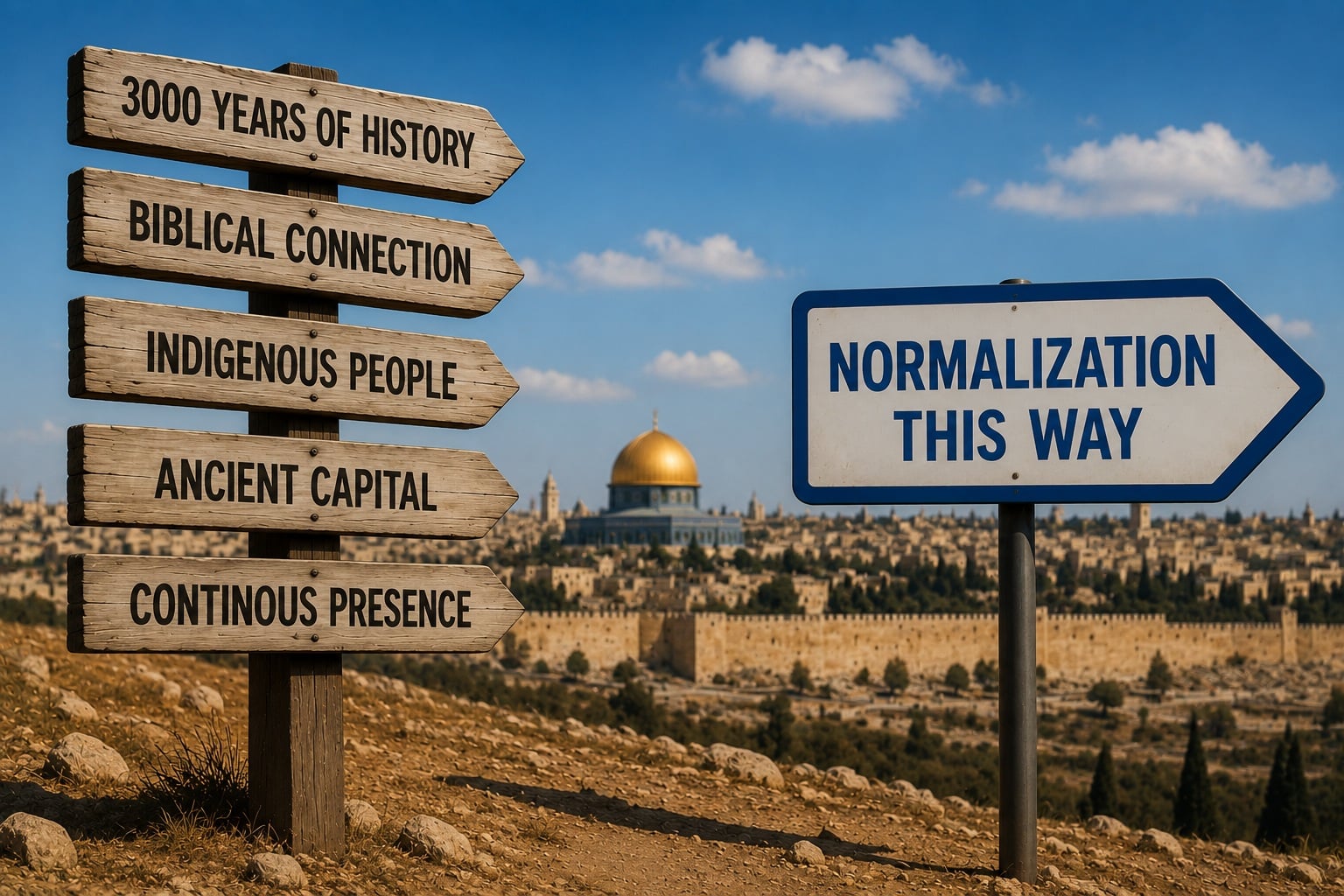
Illustrative. AI image created by the author.
The Middle East has many traditions.
There is the tradition of insisting Israel is the Middle East’s biggest problem.
There is the tradition of condemning Israel on Monday.
There is the tradition of buying Israeli technology on Tuesday.
And then there is perhaps the region’s finest diplomatic custom: pretending Israel still needs permission to live in the Middle East.
This is called “normalization.”
The wording itself is charming. It suggests Israel has been suffering from some unfortunate social condition, like showing up to a black-tie dinner in sandals, and with enough patience and paperwork, might one day become respectable.
Every few months the world’s diplomats gather to ask the same breathless question: “Will Saudi Arabia normalize relations with Israel?”
You can almost picture the scene. Somewhere in Riyadh there must be a large brass key hanging on the palace wall. It is, apparently, the Key to the Middle East. Nobody knows exactly how Saudi Arabia acquired it.
The Jewish people have only lived in the region for roughly three thousand years. Jerusalem was already a capital while much of Europe was still experimenting with forests. Archaeologists keep digging up Jewish history every few months like municipal workers discovering inconvenient plumbing.
But never mind all that. History is one thing. Permission is another. Israel, we are told, must wait politely until someone else decides it belongs. It is a fascinating policy. Imagine asking the Nile for proof that it belongs in Africa. Now imagine asking the Jewish state whether it has finally earned the right to exist in the Middle East.
Normalization, we’re assured, isn’t merely about trade. Trade is sensible. Trade makes money. Normalization is something nobler. It is recognition. Acceptance. Legitimacy.
Which raises an awkward question. Recognition by whom?
Saudi Arabia? An absolute monarchy.
Qatar? Host to Hamas leadership.
Lebanon? Where Hezbollah enjoys more confidence than the government.
Apparently these are the people responsible for deciding when Israel finally becomes part of the region. This is rather like inviting the Houthis to moderate a discussion on freedom of navigation, or inviting the ayatollahs to judge a women’s rights competition.
Yet somehow the arrangement has survived for decades without provoking laughter. Instead, it is discussed with straight faces. Diplomats speak gravely. Analysts nod thoughtfully as though this all makes perfect sense.
Israel, meanwhile, continues with the extraordinary behaviour of functioning as a country. It holds elections. The Supreme Court regularly annoys politicians. The politicians return the favour. Its citizens insult their prime ministers; nobody disappears. It is all terribly democratic.
This, apparently, is the abnormal country. The normal countries are hereditary monarchies. Theocracies. Military regimes. Places where elections are treated as dangerous foreign experiments. One begins to suspect that the region’s definition of “normal” could use professional assistance.
Israel also continued doing something unfashionable.
Building.
Building universities.
Building hospitals.
Building a technology sector worth hundreds of billions of dollars.
Its neighbours built reasons why that state should not exist. The famous Arab League policy of “No peace. No recognition. No negotiations.” was never a moral judgement reached after careful examination of Israel’s conduct. It existed before almost every accusation now routinely levelled against Israel. The verdict came first. The justifications merely changed costumes over the decades.
The Abraham Accords complicated matters. The United Arab Emirates recognized Israel. Nothing exploded. Bahrain normalized relations. The sky remained attached. Morocco survived. Trade increased. Tourists travelled. Life, disappointingly for the professional pessimists, continued. This created an awkward problem. If normalization kept working, somebody might begin asking why it had been delayed for seventy-five years.
So attention shifted to Saudi Arabia.
Saudi became the Final Boss. The last gatekeeper. The diplomatic Holy Grail. The final stamp of approval. The kingdom holding the mystical Certificate of Regional Acceptance.
The truly amusing part is that Israel has never actually needed any of this. Recognition changes diplomatic relations. It does not manufacture history. It cannot relocate archaeology. It cannot erase Hebrew inscriptions. It cannot persuade Jerusalem that it recently wandered into the neighbourhood by mistake. It merely acknowledges facts that existed before the recognition itself.
This is why the conversation has always felt upside down. Israel is treated as though it were applying for membership in the Middle East. The application, unfortunately, has been delayed. There are forms to complete. References to provide. Maybe another archaeological excavation. Someone from the Arab League will be in touch. Eventually. Or perhaps not.
Israel’s Finance Minister Bezalel Smotrich once remarked that if Saudi wished to dictate the terms of Israel’s legitimacy, it could as well continue riding camels in the desert. The wording was predictably condemned. The assumption behind the outrage was more revealing than the remark itself. Everyone debated the “insult.” Almost nobody questioned why Israel was expected to seek approval from the people supposedly being insulted.
That is the true abnormality.
The remarkable thing is not that some governments still refuse to recognize Israel. Countries may choose their diplomatic relationships as they wish. The remarkable thing is that so much of the world still speaks as though those governments possess the authority to decide whether Israel belongs in the Middle East.
They do not. They never did.
So let the Arab League recognize Israel or refuse for another seventy-five years. None of it changes the fact that Israel does not become indigenous when others acknowledge it, nor legitimate when dictators sign papers saying so.
When Saudi Arabia eventually normalizes relations with Israel, and one day it probably will, the headlines will proclaim another great diplomatic breakthrough.
They will have it backwards.
Israel will not have become normal. Reality will simply have caught up with the paperwork.
Related Topics
Related Posts