
The Green Party’s Test of Belonging
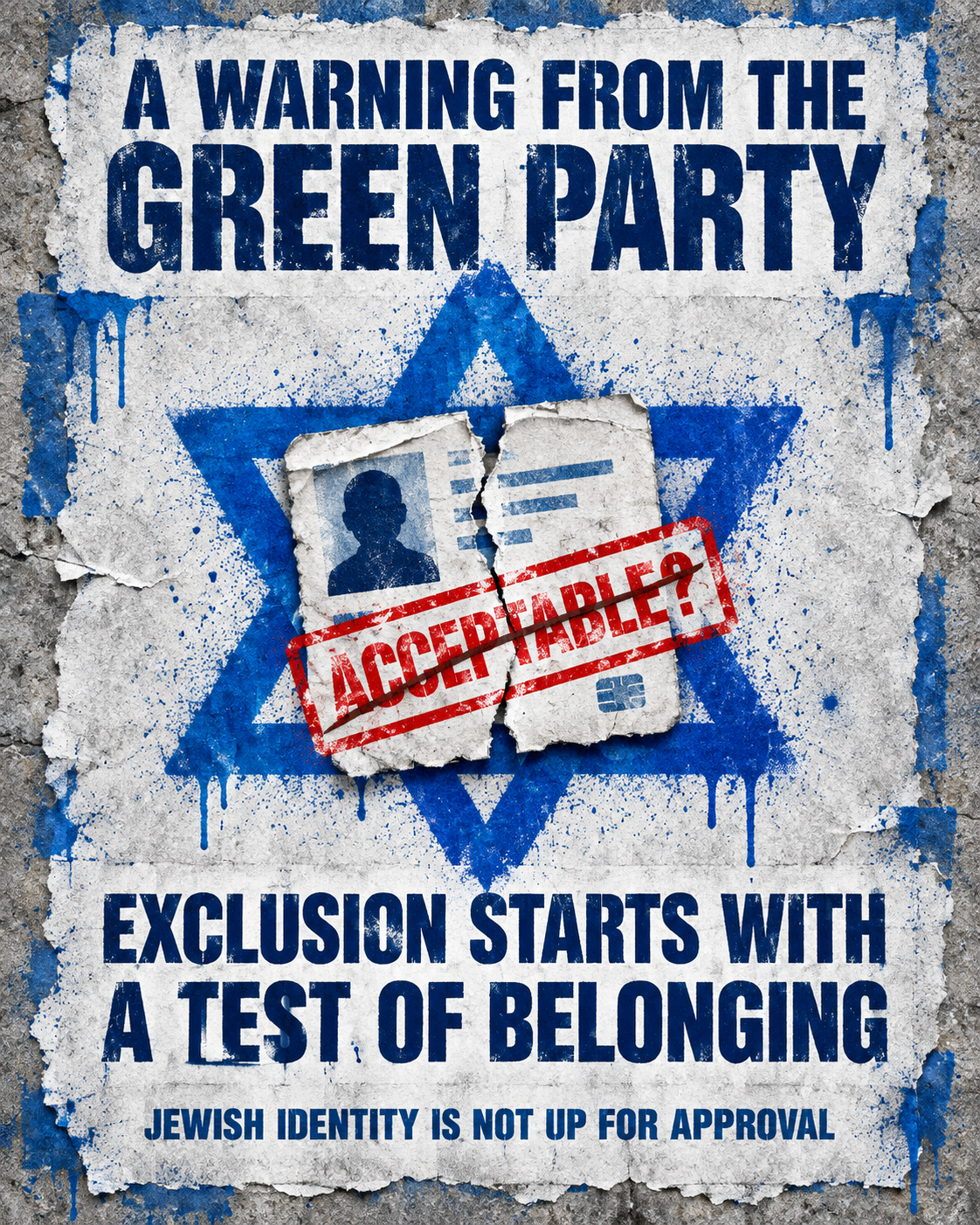
There are political moments when a party reveals itself more clearly than it ever does in a manifesto or a leader’s interview.
The Green Party’s conference in Brighton was one of them.
Its members voted, 1,022 to 813, to declare Zionism a form of racism. They then rejected an amendment intended to protect Jewish members whose synagogues, community groups or affiliations might be labelled Zionist. Afterwards came the familiar assurances: no Jewish member would be targeted; the motion was about an ideology, not a people.
But the vote is the thing. The safeguard was there. Delegates were asked whether Jewish members should be explicitly protected from complaints or disciplinary action because of their links to Zionist communal institutions. They said no.
That is where the danger lies.
Nobody is claiming that the Green Party has begun expelling Jewish members. There is no evidence of that. But exclusion does not usually begin with a letter through the door or a public disciplinary hearing. It begins earlier, and more quietly.
It begins when someone is asked to explain themselves.
Are you a Zionist? Does your synagogue call itself Zionist? Does your family have ties to Israel? Do you volunteer for, donate to or attend an organisation that does? What, exactly, do you mean when you say you support Jewish self-determination?
At first, it may appear as a question asked in a local meeting, a message on a party WhatsApp group, or a complaint filed by someone who has decided that “Zionist” is enough of an accusation. The individual need not be called a racist. The structure has already done the work. Their Jewish identity, or a part of it, has been put on probation.
That is the effect of declaring Zionism itself racist.
The Greens insist that the policy concerns a political idea. But Zionism is not a remote theory to many British Jews. It is tied to relatives in Israel, to Jewish history, to Holocaust memory, to the flight of Jewish families from countries where they once believed they belonged, and to the simple conviction that Jews should not have to rely entirely on the kindness of others for their safety.
A Jewish person can support Palestinian statehood, oppose settlements, criticise Israeli governments and mourn civilian suffering in Gaza. They can do all of that and still believe that Jews have a right to self-determination in their ancestral homeland.
Under this motion, however, that belief is placed under suspicion.
The Greens could have argued for Palestinian rights, a ceasefire, international law, civilian protection or a negotiated future for Palestinians and Israelis. Instead, they chose to declare the national movement of the Jewish people racist at its core.
That is a grave political act. It reaches far beyond criticism of Benjamin Netanyahu or any one Israeli government.
Jewish people know the pattern.
It is never presented at the outset as hatred. There is always a condition attached. Convert. Assimilate. Keep quiet. Be grateful. Prove your loyalty. Make yourself less Jewish, less visible, less troublesome. The language changes with the century; the demand remains.
Now the demand comes dressed as moral progress.
You may be Jewish, of course. You may belong, certainly. But first, explain your relationship with Israel. Make clear that you hold the approved opinion. Put distance between yourself and the synagogue, youth movement, charity or community body that falls on the wrong side of the line.
The distinction between “good” and “bad” Jews has always served those who dislike Jews. The good Jew is the one who disavows. The bad Jew is the one who refuses.
The Greens may say they have no interest in policing Jewish identity. Yet they have set the terms by which others can start doing exactly that.
This is a party that prides itself on understanding institutional prejudice. It knows that discrimination can live in procedures, labels and formal policies. It knows that a rule can harm people even if its authors insist their intentions are good.
Yet when Jewish members raised a precise, practical fear, the party did not meet it.
The amendment was not a demand for special treatment. It was a basic protection. It would have stated that Jewish members should not face party discipline merely because they attended a synagogue or participated in a Jewish organisation that called itself Zionist. The conference rejected it.
There is something bleak about that.
The people who demanded the reassurance were not imaginary. They were Jewish Greens who feared that their ordinary communal lives could become evidence against them. Some were reportedly left shocked and in tears by the result.
The party had been given a chance to show that its commitment to inclusion applied to Jews too. It failed the test.
There may be no expulsions. There may be no formal complaints this week or this month. That is not the point.
A principle has been adopted. Many Jewish members now know that a core belief, and the institutions connected to it, can be treated as suspect within a party that claims to oppose racism.
That knowledge changes how people behave. It changes who speaks in meetings. Who stays quiet. Who stops attending. Who decides that the cost of belonging is too high.
This is how political spaces empty out. Not always through a purge. Sometimes through embarrassment, fatigue and the slow realisation that every appearance comes with an interrogation.
Britain should recognise the warning.
No party has the right to tell Jews that their connection to Israel must be explained away before they can be accepted as decent people. No movement for justice should demand that Jews disavow a piece of their history in order to qualify for compassion.
The Green Party has made Jewish belonging conditional. It should not be allowed to pretend otherwise.