
Russian-American-Israeli Palestinian. Palestine is Israel.
There Is No Such Thing As…
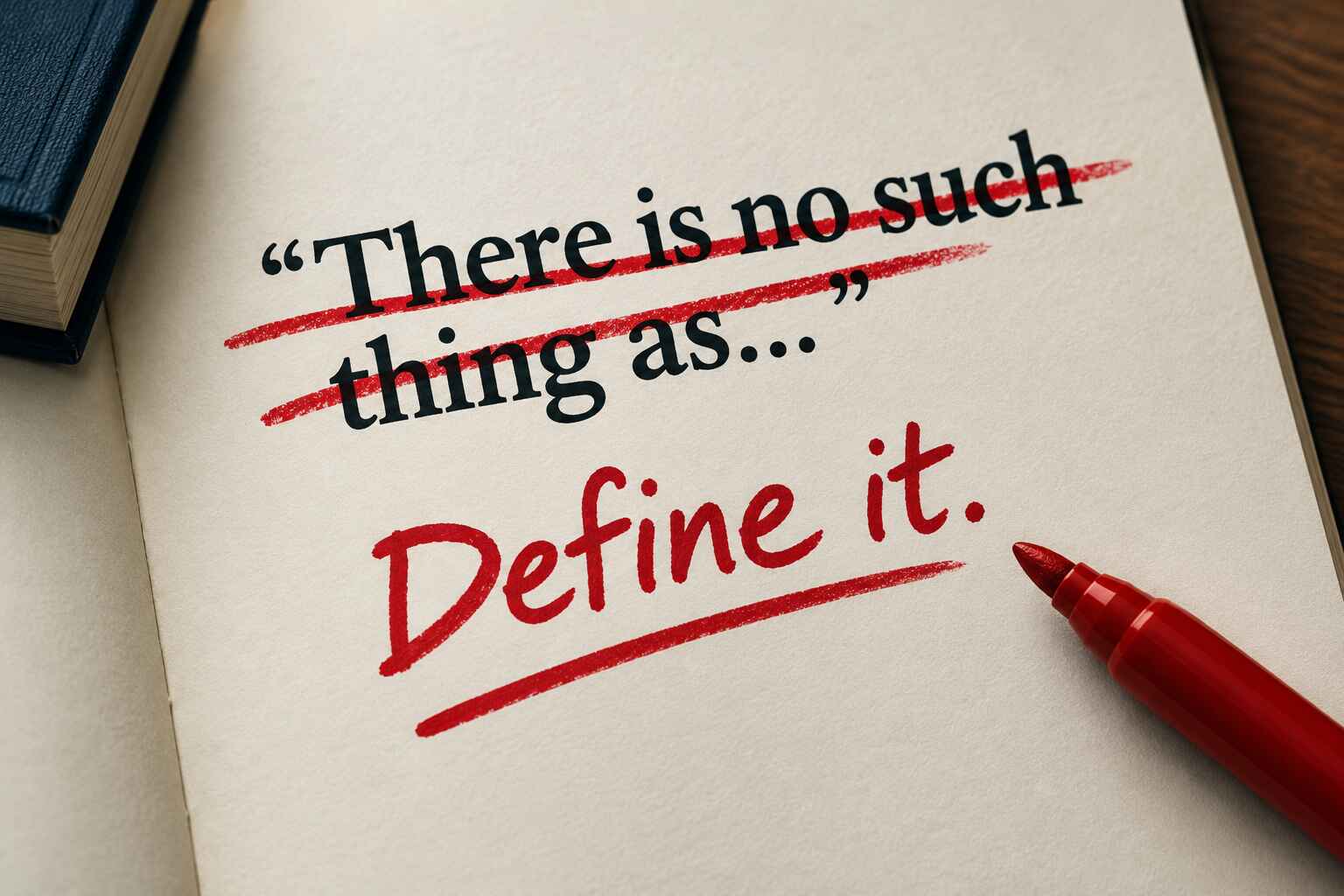
The battle is not over whether the “thing” the word describes exists. The battle is over what the word means. Image © Ivan Bassov, 2026. Licensed under CC BY 4.0.
Why We Should Redefine Words Rather Than Deny Them
“There is no such thing as Islamophobia.”
“There is no such thing as Palestine.”
You hear these statements surprisingly often from pro-Israel advocates. The intention is understandable: to reject concepts that are being used to attack Israel, Zionism, or the Jewish people. But I think this is the wrong strategy.
To see why, consider the mirror image.
Imagine if our enemies said:
“There is no such thing as Zionism.”
“There is no such thing as Israel.”
Would we consider that a convincing argument?
Of course not. We would immediately point out that Zionism exists as a historical and political movement and that Israel obviously exists as a state. We would regard the denial itself as intellectually unserious. We would probably respond by explaining what Zionism actually means and what Israel actually is.
And that is precisely the point.
Why should we use against our enemies a rhetorical strategy that we would immediately recognize as absurd when they use it against us?
The problem with “There is no such thing as…” is not merely that it may be factually questionable. It is that it is strategically passive. If a word already exists, denying the existence of what it might describe does not make the word disappear. People are already using it. The real battle is over what the word means.
Our enemies understand this very well.
They do not generally respond to Zionism by pretending that it does not exist. They accept the word and redefine it. Zionism, they tell us, is racism. Zionism is settler colonialism. They do not deny that Israel exists either; they redefine Israel as a “Zionist entity,” an occupation, a colonial project, or an illegitimate state.
The absurdity of those definitions is not the point here. What matters strategically is that they understand something we should understand as well:
The battle is not over whether the “thing” the word describes exists. The battle is over what the word means.
That is why I would turn the familiar formula around.
Don’t deny the word.
Redefine it.
Islamophobia
Take “Islamophobia.”
There are pro-Israel voices who say, “There is no such thing as Islamophobia.” I understand the impulse behind this statement. The term is often used to conflate criticism of Islam with hatred of Muslims, or to shield particular political ideas and movements from legitimate scrutiny. There are certainly important arguments to be made about how the term is defined and used.
But saying that Islamophobia does not exist is not the strongest way to make those arguments.
The word exists. It has entered the political and cultural vocabulary, and its modern history goes back decades. The Runnymede Trust’s 1997 report, Islamophobia: A Challenge for Us All, played an important role in establishing the term in contemporary public discourse.
So why fight the existence of the “thing,” whatever it might mean?
The more productive question is: What should the word mean?
That is where I would make a different argument. Rather than rejecting the term Islamophobia, we should insist that Islamophobia cannot be understood in isolation from Ziophobia—hatred of Israel and Zionism—and that confronting Islamophobia must also mean confronting Ziophobia.
That is the argument I develop in “Fighting Islamophobia and Ziophobia.”
The point is not to make the word Islamophobia disappear. The point is to challenge the monopoly over its meaning.
Palestine
The same principle applies to the statement, “There is no such thing as Palestine.”
Again, I understand the impulse. The word Palestine is frequently used today as part of a political narrative that denies Jewish history, denies Israel’s legitimacy, or presents the entire Land of Israel as exclusively “Palestinian.” Rejecting that narrative is entirely legitimate.
But denying the existence of “Palestine” is a poor way to reject the narrative.
The word obviously exists. It has a long history of geographical and political usage, and it has accumulated different meanings over different periods. Saying “there is no Palestine” does not erase any of that history. More importantly, it leaves the other side with the advantage of appearing to defend something that we are simply trying to deny.
There is a much more interesting—and much more strategically powerful—alternative.
Instead of denying Palestine, reclaim it.
I do not mean Palestine instead of Israel. I mean Palestine as another name for Israel.
This is the argument I develop in “Hands Off My Palestine,” and more fully in “Palestine, That Is Israel.”
The basic idea is simple: if our enemies have turned the word Palestine into a weapon against Israel, why should we automatically surrender the word to them?
Why not say:
Yes, Palestine exists. Palestine is Israel.
That immediately changes the argument.
“Free Palestine!”
“Of course. Palestine is Israel.”
“Israel occupies Palestine!”
“Of course. Palestine is Israel.”
Now the person using the word Palestine can no longer rely on the word itself to carry an entire political program. The word has been taken out of their exclusive possession.
That is a much stronger position than simply saying, “There is no such thing as Palestine.”
The Mirror Test
This is the simple test I would apply to these arguments.
Whenever we are tempted to say, “There is no such thing as X,” imagine our enemies saying the same thing about something we know exists.
Imagine them saying, “There is no such thing as Zionism.”
Would we accept that?
No. We would say: Zionism exists. Let us discuss what Zionism means.
Imagine them saying, “There is no such thing as Israel.”
Would we accept that?
Obviously not. We would say: Israel exists. Let us discuss what Israel is, how it came into existence, and what its rights and obligations are.
So why should we respond to “Islamophobia” or “Palestine” by saying that they do not exist?
The stronger approach is to apply the same intellectual standard to all of them.
If the word exists, argue about its meaning.
That does not mean accepting the definition attached to it by our enemies. Quite the opposite. It means refusing to let them define the vocabulary of the debate.
Words Are Political Territory
Political battles are fought not only over territory, institutions, and military power. They are also fought over words.
Once a political movement successfully establishes the meaning of a word, it has already won part of the argument. “Occupation,” “colonialism,” “indigenous,” “apartheid,” “Zionism,” “Palestine,” and “Islamophobia” are not merely neutral labels. Each carries a history and a set of assumptions.
This is why our enemies spend so much effort defining words.
And this is why we should spend more effort doing the same.
If someone defines Palestine as opposition to Israel, we should not merely say that there is no such thing as Palestine. We should define Palestine.
And if someone invokes Islamophobia, we should not waste our energy pretending the word does not exist. We should challenge its definition, its application, and the double standards surrounding it.
This is not about accepting hostile definitions.
It is about refusing to surrender the dictionary.
Don’t Deny. Define.
There is a subtle but important difference between denial and redefinition.
Denial says: “That thing does not exist.”
Redefinition says: “The word exists, but your definition of what it describes is wrong.”
The second position is much stronger when the word is already established in public discourse.
We should not be afraid of words simply because our enemies use them. We should not assume that a word belongs permanently to the political camp that popularized it. And we should not make the mistake of believing that the only way to defeat a hostile concept is to deny that the concept exists.
Sometimes the better strategy is to take the word back.
That is what I propose with Palestine.
That is what I propose with Islamophobia.
And that is the broader lesson:
Don’t deny the word or get trapped in debating whether the “thing” it describes exists. Fight for its meaning.
Our enemies understand that words are political territory. We should understand it too.
Let the word exist.
Then take control of what it means.
—
See Also
Related Topics
Related Posts