The Altneu Beginning
The Jews stood on the cusp of the realization of a dream, first envisioned over a quarter of a millennium earlier. Whether as drifting strangers in the Land of Canaan, beaten slaves in Egypt, or weary wanderers in the wilderness, there was always one dream that would orientate their inner compass: one day they would have a home. God would give them the land He had promised Avraham, Yitzhak, and Yaakov. When that dream became reality, upon entering the land they were commanded to perform a specific ceremony. This is detailed in this week’s parasha:
Moshe and the elders of Israel commanded the people, saying: Observe all the instruction that I command you this day. And it shall be on the day you cross the Jordan into the land that The Lord your God is giving you, you shall set up large stones and coat them with plaster. You shall write upon them all the words of this Torah in order that you may enter the Land that The Lord your God is giving you, a land flowing with milk and honey, as The Lord, the God of your ancestors, promised you… You shall write on these stones all the words of the Torah, greatly elucidated. (Devarim 27:13,8).
The Talmud[1] explains that this final phrase “באר היטב – greatly elucidated” is a command to write the parts of the Torah was written on these stones in seventy languages. A painstaking task, whose purpose is a mystery, given that this was a ceremony for the Jewish people alone as they entered their homeland. The Torah continues to describe these events:
Moshe and the Levitical priests spoke to all Israel, saying: Be attentive and listen, Israel! Today you have become a people for The Lord your God… And Moshe commanded the people, saying: The following shall stand to bless the nation on Mount Gerizim when you cross the Jordan: Shimon, Levi, Yehudah, Yissachar, Yoseph, and Binyamin. The following shall stand for (the declaration of) the curse on Mount Eival: Reuven, Gad, Asher, Zevulun, Dan, and Naphtali. (Devarim 27:9-13)
The twelve tribes were split into two groups of six. Representatives of each would go up the two mountains. The Aron HaKodesh, the Kohanim, members of the tribe of Levi, and the rest of the Jewish people would stand in the valley between these mountains, arranged in concentric circles in this order. They would turn to Mount Gerizim and declare a blessing for someone who did something commendable. The people on the mountains would respond “Amen”. They would then turn to Mount Eival and curse someone who did something sinful. The people on the mountains would again respond “Amen”. This pattern would continue back and forth until the whole list of blessings and curses had been completed.
This ceremony sounds vaguely familiar to an earlier event in the Torah. It carries strong echoes of Mount Sinai. Both involved mountains and the writing of the Torah on stone[2]. Both involved a covenant between God and the Jewish people. Before the giving of the Torah at Sinai, God tells the people, “וִהְיִ֨יתֶם לִ֤י סְגֻלָּה֙ מִכָּל־הָ֣עַמִּ֔ים – you shall be treasured to me from all the nations” (Shemot 19:5). Before the introduction of this ceremony Moshe tells the people that God has designated them as “לְעַ֣ם סְגֻלָּ֔ה – a treasured nation” (Devarim 26:18). At Sinai, God says they will be a “ג֣וֹי קָד֑וֹשׁ – a holy nation” (Shemot 19:6). In our parasha, “עַם־קָדֹ֛שׁ – a holy nation” (Devarim 26:19); in English an identical expression, in Hebrew a very similar one. In the ceremony in which the Torah was given, there was an altar set up, sacrifices offered, and twelve pillars of stone representing the twelve tribes[3]. Here too we have an altar, sacrifices, pillars of stone, and tribes. Both events even detail the prohibition against making an altar out of hewn stone[4]. Finally, and crucially, these are both referred to as a “ברית – covenant”. These are the two occasions on which an explicit covenantal agreement is made between God and His people[5]. It seems as if the giving of the Torah on Mount Sinai was to be re-enacted upon entering the Promised Land.
Yet for all these similarities, the differences are clear. In the events of this week’s parasha, there is not one mountain but two. The people do not crowd around them, but their representatives ascend them. In the later ceremony, the people are instructed to write the Torah and announce parts of it. That never happened at Mount Sinai. There God spoke and the people listened.
The differences between these events speak to the evolution of the role of the Jewish people as the desert experience ended and life in the Land of Israel began. They were no longer to be passive observers, listening and accepting the commands of God at the foot of a mountain. The Torah was no longer simply something they received, it was something they were responsible to transmit. They were not simply God’s treasured nation but chosen for a sacred task. They were to be partners with God in creating a better world.
They would have to ascend the mountains, rather than wait at their foot. The Torah would not be written just by God, they would have to write the Torah themselves. It was to be written in the multiple languages of mankind, not just in the holy words of God. Even the role of the stones was different. At Sinai the Torah was written on the Luchot and twelve stones were placed as stationary symbols of the twelve tribes. At the ceremony when they entered Israel, the Torah was to be written on the stones themselves. The people would have to be exhibits of the Torah: it would have to be etched on their hearts, modeled in their actions, and taken with them wherever they went. Crucially, the blessings and curses would be said by them. It was their actions that would decide which of the two paths they would follow.
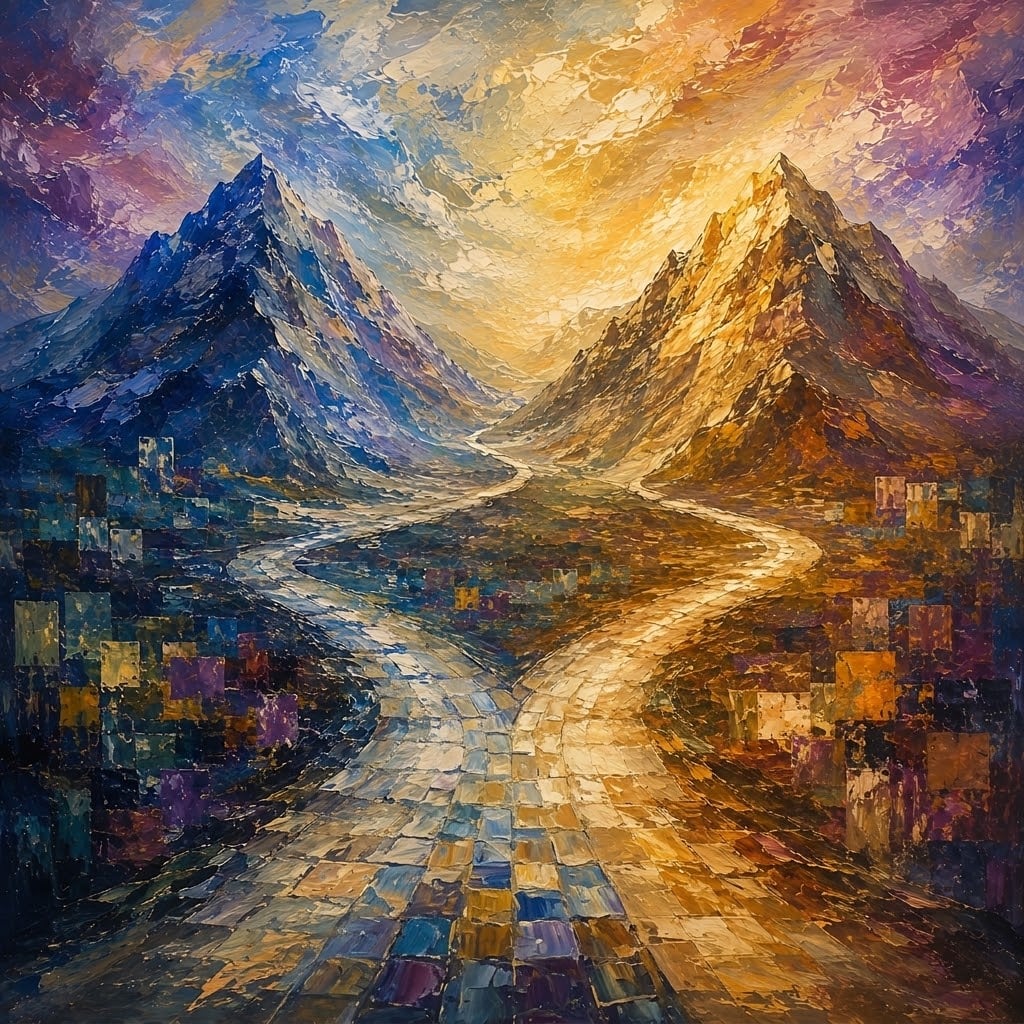
That is why there are two mountains in this week’s parasha. When the Torah is given by God it is presented as one mountain: it is pure, whole, and perfect. However, when that Torah is handed over to man, and he must take responsibility for it, it takes the form of two mountains. He can choose whether to follow its lead or not. There are two options and two paths before him. He can choose life or death, blessing or curse. The most terrifying and beautiful thing is that it is all in his hands.
[1] Sotah 32a
[2] On Sinai Moshe was given tablets of stone (Luchot) with the Ten Commandments engraved on them by God
[3] Shemot 24:4-5
[4] Shemot 20:22 and Devarim 27:6
[5] Shemot 24:7-8 and Devarim 28:69