
99.6% Ashkenazi + .4% Viking = 100% Zionist
The Arab World’s Dirty Little Secret: Palestine!
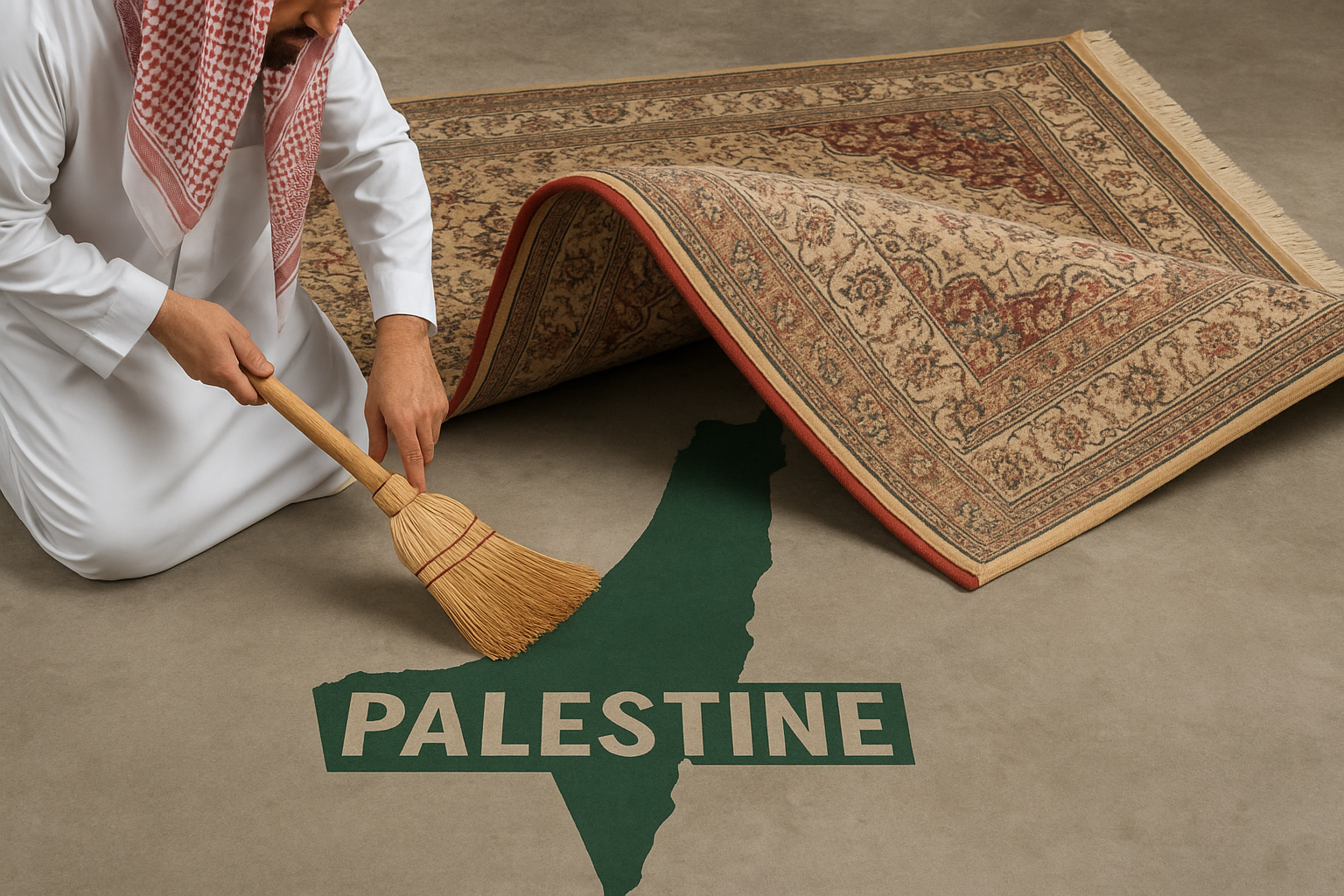
The Arab World's Dirty Little Secret
The two-state solution has long been treated as the holy grail of Middle East peace. The idea is simple enough: divide the land between Israelis and Palestinians, draw up borders, and let each people govern themselves. But for all its surface-level appeal, the two-state solution rests on a flawed assumption—that both parties seek peaceful coexistence. In reality, many Palestinians do not envision a state alongside Israel, but one instead of it.
We’ve all heard the slogan: “From the river to the sea, Palestine will be free.” It is not a call for coexistence. It is a call for elimination. From the Jordan River to the Mediterranean Sea means erasing Israel. So if we’re going to talk seriously about solutions, we need to talk honestly about intentions—and about geography.
Let’s rewind.
In 1947, the United Nations proposed partitioning the British Mandate of Palestine into two states—one for the Jews, one for the Arabs. The Jews said yes. The Arabs said no, choosing war over compromise. When Israel declared independence in 1948, it was immediately invaded by surrounding Arab states. The fledgling nation survived. A second Arab state—Palestine—was never born. Not because of Israel, but because the Arab world refused to allow it.
For the next 19 years, there was no Palestinian state—not even a call for one. Instead, Jordan occupied Judea and Samaria (later rebranded “the West Bank”) and Egypt occupied Gaza. These territories weren’t declared “Palestine.” There was no clamor for sovereignty or independence. The international community didn’t cry out for a Palestinian homeland during this occupation. Only after Israel recaptured these territories in the 1967 Six-Day War—fending off yet another attack—did the idea of a Palestinian state suddenly gain traction.
But let’s be precise: there were no “1967 borders.” There were ceasefire lines—Green Lines—drawn in 1949, not mutually agreed upon international boundaries. Suggesting Israel return to these lines is not a call to restore peace, but a demand to surrender hard-won, legally disputed land Israel liberated in a war of self-defense.
If land is the issue, then let’s look at the land.
- Israel: ~8,630 square miles
- Jordan: ~34,495 square miles
- Syria: ~71,500 square miles
- Lebanon: ~4,000 square miles
- Egypt: ~386,000 square miles
Now add up the Muslim-majority countries in the world—56 nations—spanning millions of square miles.
Now compare that to one: Israel. A sliver on the map. A freckle in the desert. And still, it’s too much to ask for?
Even if Israel were to annex Judea and Samaria (an additional ~2,200 square miles), it would remain smaller than most of its neighbors. And yet, for some, any Jewish sovereignty—anywhere—is too much. That’s not politics. That’s ideology.
So here’s a different idea.
If the world insists on creating a new Arab state called Palestine, then why must it come at Israel’s expense? Why not Jordan, which already occupies nearly four times the landmass of Israel? Jordan, whose population is majority Palestinian? Jordan, which administered the West Bank for nearly two decades and granted its residents citizenship?
Let’s not forget: the people now called Palestinians were, at different moments in history, offered multiple national identities. When Lebanon was established, Arabs in the region could become Lebanese—or leave. When Syria was established, they could become Syrian—or leave. Then came Jordan. Then Israel. In each case, Arab populations made choices. And those caught in the margins—particularly between Israel and Jordan—were absorbed by Jordan, until Jordan no longer wanted them.
When Israel regained Judea and Samaria in 1967, Jordan refused to reabsorb the very people it once claimed. Instead, Arab nations created refugee camps, where generations would languish in poverty and political limbo. Meanwhile, Israel absorbed over 800,000 Jews who were expelled from Muslim countries around the same time—no refugee camps, no international hand-wringing, just a homeland offering shelter to its people.
This contrast isn’t just logistical. It’s cultural. It’s moral.
The Arab World’s Dirty Little Secret: No One Wants the Palestinians
Here’s the part of the story no one tells.
The Arab states shouting loudest for Palestinian statehood are often the same ones that refuse to integrate Palestinians into their societies. Not because of Israeli pressure. Because of experience.
In Jordan, the Hashemite monarchy lives in fear of being overthrown ever since the PLO nearly succeeded in doing so in 1970. That attempted coup triggered the brutal conflict known as Black September, where thousands of Palestinians were killed or expelled.
In Lebanon, armed Palestinian factions helped ignite the Lebanese Civil War in 1975, dragging the nation into 15 years of bloodshed. To this day, Lebanon refuses to grant Palestinians full citizenship or equal rights. They learned their lesson.
In Syria, the Assad regime bombed the Yarmouk Palestinian refugee camp into rubble during the Syrian Civil War. Thousands of Palestinians were killed or displaced—by fellow Arabs.
In Egypt, Palestinians face heavy restrictions on property ownership, work permits, and even travel. Egypt routinely closes the Rafah border with Gaza, preventing escape from Hamas rule or Israeli retaliation alike.
So let’s be honest: the Arab world does not want the Palestinians—not in their countries, not as citizens, and often not even as neighbors. But under the guise of pan-Arab solidarity and human rights, they’ve spent decades trying to offload the problem onto Israel.
It’s a cruel, cynical game. A geopolitical version of Old Maid—except instead of a child’s card game, the stakes are human lives. The unwanted “card” is the Palestinian population, and the goal is to make sure Israel is the one left holding it.
A Real Path Forward
If a Palestinian state is to be born, it shouldn’t be carved from the body of the Jewish state. It should be built with the resources, land, and support of the Arab nations who claim to care so deeply.
Jordan is the logical candidate:
- It shares a border
- It shares a history
- It already governs a Palestinian majority
If the Arab world truly wants to solve the Palestinian issue, it’s time to stop using it as a political weapon and start using their vast territory, wealth, and influence to provide a home—not a hostage situation.
The Final Truth
So let’s stop pretending this is about justice. Let’s stop pretending the Arab world wants peace for Palestinians when their own track record shows the opposite. Let’s stop forcing Israel to bear a burden that far wealthier, larger, and culturally aligned nations refuse to touch.
If a new state of Palestine must be born, let at least a portion of it be in Jordan—or anywhere else in the vast expanse of the Arab world. But stop demanding that the only Jewish state be the dumping ground for a population its own neighbors fear.
Israel has one card. And she’s played it with peace in mind, again and again. It’s time the others stopped rigging the deck.
Related Topics
Related Posts