Russian-American-Israeli Palestinian. Palestine is Israel.
The Arsenal of Linguistic Warfare
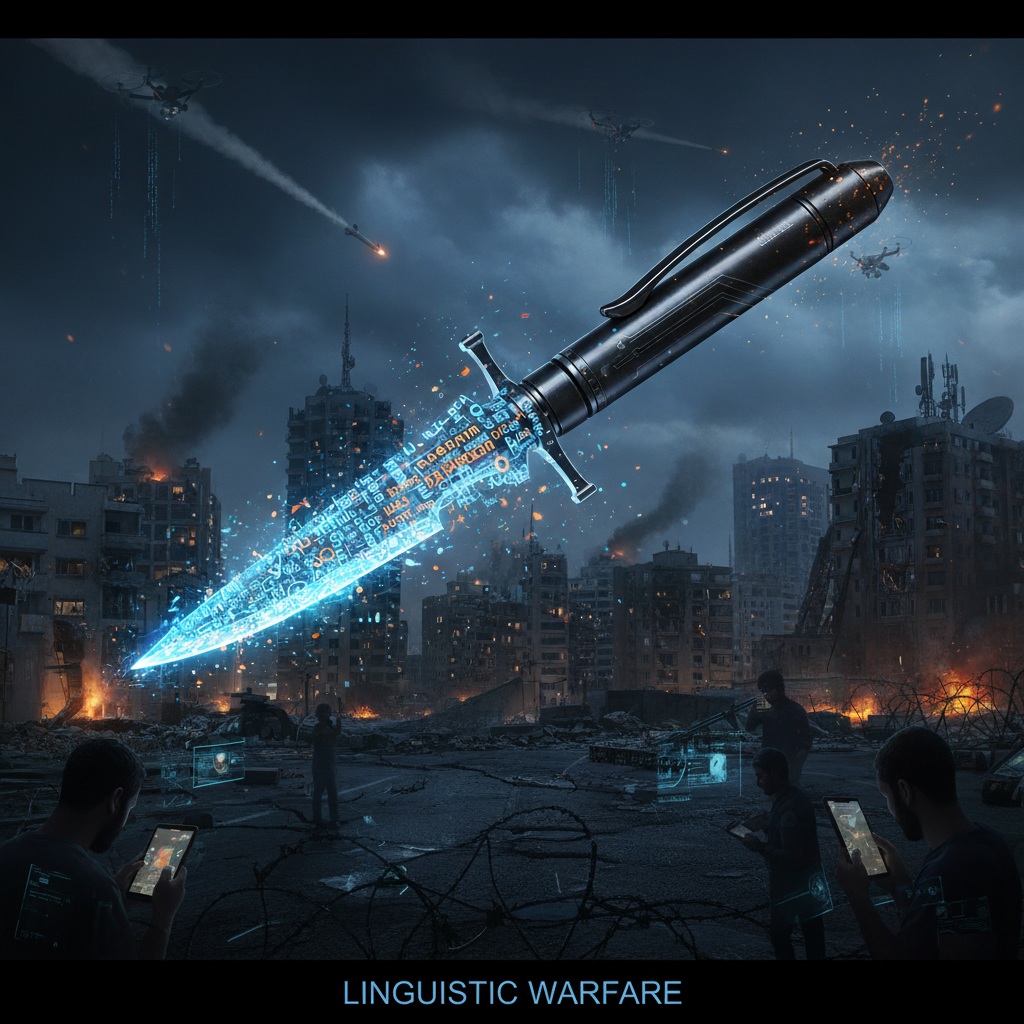
Before the bombs, there are the words. Linguistic warfare lays the groundwork for conflict. Image © Ivan Bassov, 2025. Licensed under CC BY 4.0.
The Language War
Wars have never been fought only on the battlefield. They are fought in language — in definitions, metaphors, and the moral associations attached to words.
Israel’s story, more than any other, has been rewritten through linguistic warfare. Every phrase — “occupied territories,” “apartheid,” “genocide” — has been calibrated not to clarify reality but to reprogram perception. Words no longer describe what is; they dictate what may be believed.
And once language becomes the battlefield, truth itself becomes collateral damage.
While this arsenal is deployed most aggressively against Israel, the same tactics — false equivalence, semantic hijacking, euphemistic displacement, moral inversion, and more — have appeared in other battlefields as well, including coverage of the war in Ukraine and the broader information war against the West.
Here, I have cataloged the various linguistic tactics deployed on this battlefield — from false equivalences and moral inversion to inflation, abstraction, and erasure — so that they may be recognized, named, and effectively countered.
Pairing: The Politics of False Equivalence
One of the most insidious weapons in this arsenal is fraudulent pairing — what can be called moral laundering through juxtaposition.
The formula “antisemitism and Islamophobia” has become a political sedative. It pretends to treat both as parallel threats, yet its true function is to mask Ziophobia — the fear and hatred of Jews as a national people — while projecting balance.
The pattern repeats endlessly:
- “The Holocaust and the Nakba” — equating genocide with displacement, victim with aggressor.
- “Zionism and apartheid” — collapsing national self-determination into racial domination.
- “TZAHAL and HAMAS” — a pairing often stylized in all caps to imply false symmetry, as if a lawful national defense force and a jihadist militia were equally legitimate — or equally illegitimate — actors.
These pairings don’t illuminate; they tranquilize. They dissolve moral clarity under the pretense of fairness.
As I wrote in Fighting Islamophobia and Ziophobia, such rhetorical pairings — like the false pairing of antisemitism and Islamophobia — are not designed to inform but to numb — to neutralize moral judgment and obscure responsibility.
Framing: The Subtle Art of Shaping Perception
Beyond the words themselves, the battle for meaning is fought in how events are framed. Framing dictates what the audience perceives as normal, exceptional, justified, or criminal — often before the facts have even been processed.
A classic example is the phrase “violence on both sides.” On the surface, it sounds neutral, even-handed. In reality, it obscures asymmetry: it implies moral or causal equivalence between Israel, a democratic state defending its citizens, and Hamas, a terrorist organization committed to the destruction of Israel. The framing shifts responsibility away from the aggressor and softens the perception of threat.
Quantitative neutrality is another variation of framing. Presenting numbers without context — “X dead vs. Y dead” — is meant to imply equivalence of guilt. It’s a moral equation without moral math.
Inversion: Turning Accuser into Accused
Another tactic is moral inversion, the deliberate flipping of victim and aggressor. When Jews are called “Nazis,” Israelis are called “colonizers,” and Zionism is called “racism,” we are witnessing not mere exaggeration but rhetorical exorcism — the transfer of guilt.
Those who can’t bear their own moral stain project it onto others. Thus, movements that glorify extermination cry “genocide!” — and are believed. The result is not confusion but moral collapse: when every crime can be inverted, no truth remains absolute.
Moral Inflation: The Cheapening of Moral Language
Words like genocide, apartheid, colonialism, and fascism once carried historical precision. Today, they are thrown about with the recklessness of confetti.
This moral inflation has one purpose: to dilute meaning until it loses all moral gravity.
If every conflict is “genocide,” then none is. If every border is “colonial,” then no nation has legitimacy. When words expand beyond their meaning, they cease to carry moral weight — and memory itself becomes expendable.
As Viktor Pelevin observed,
And what does the word ‘fascist’ mean today? According to one version, it’s someone who keeps a portrait of Trump at home; according to another, it’s someone whose tears don’t appear quickly enough during Greta Thunberg’s speech in Davos. And if we forget about politics altogether, a fascist is simply anyone who prevents you from parking conveniently — both in the physical and in the spiritual sense.
— Viktor Pelevin, The Invincible Sun
Pelevin’s irony captures the essence of linguistic decay: when moral language becomes performative, the gravest accusations turn into casual insults — tools for social convenience rather than ethical judgment.
The same decay now engulfs once-noble words like democracy, liberalism, and human rights, which have been emptied of substance and repurposed as partisan weapons. Even these ideals, born of freedom, are now wielded as slurs — sometimes equated with totalitarianism and fascism by those who have forgotten what these words ever meant.
Abstraction: Turning a Nation into a Noun
Another common tactic is abstraction — stripping Israel of its human and political specificity and recasting it as an abstract, moralized concept.
Instead of discussing a country, its government, or its policies, propagandists speak of “Occupation”, “Evil”, or now “Genocide” as if these abstractions were agents in themselves.
- “Occupation said this, occupation did that.”
- “Genocide struck here, genocide hit there.”
The effect is linguistically absurd but politically powerful: it detaches responsibility from people and institutions, replacing history, context, and agency with moralized caricature. Israel ceases to be a nation and becomes a label for condemnation — a tool to rally indignation while erasing nuance.
Substitution: Rebranding Hatred
When old hatreds become socially unfashionable, new labels are invented. Antisemitism is rebranded as anti-Zionism. Terrorism becomes resistance. Civilians become settlers. Murderers become martyrs. Arabs became “Palestinians.”
This is not linguistic drift but intentional laundering — the rephrasing of evil to make it sound noble.
In Ziophobe Newspeak: A Glossary of Euphemisms for Erasing Israel, I showed how each term in this vocabulary performs the same function: it sanitizes hatred, recasting aggression as justice.
Language here is not a tool of thought — it’s camouflage.
Erasure: The War on Naming
Every culture is anchored in its names — for land, for people, for memory. To rename is to repossess.
Thus, Judea and Samaria become “the West Bank.”
“Palestinian Zionists” vanish from history.
The term “Palestine,” originally tied to Jewish identity, is rebranded as an Arab nationality.
This isn’t linguistic modernization; it’s identity theft.
Notably, members and supporters of Hovevei Zion (Lovers of Zion) — the 19th-century pioneers who laid the foundations of Jewish return — were widely known as “Palestinophiles,” or Lovers of Palestine.
Those who now claim to “liberate Palestine” are, in truth, liberating it from its own meaning.
The Algorithmic Echo
In the digital age, linguistic warfare is turbocharged by algorithms. Social media does not reward accuracy; it rewards emotion. Outrage travels faster than truth.
A lie, repeated a thousand times in fifteen-second clips, becomes reality by repetition.
We no longer face censorship by suppression but censorship by saturation. When the information space is flooded with distortions, truth doesn’t disappear — it drowns.
The Other Tactics
The arsenal of linguistic warfare does not end with those listed above. Other tactics operate subtly but powerfully, hollowing moral language and reshaping perception.
Diversion
Every conversation about antisemitism is redirected toward Islamophobia, “all forms of hate,” or other abstract concerns. Attention is shifted from the real perpetrators to anyone who might appear culpable, diluting moral responsibility.
Projection
Israel is accused of what its enemies openly do — occupation, apartheid, genocide. The act of projecting wrongdoing onto the target obscures the actions of the true aggressor while tarnishing the defender.
Mimicry
Enemy propagandists adopt the language of social justice — “indigenous rights,” “decolonization,” and “oppression narratives” — only to rationalize antisemitism and Ziophobia. By cloaking hostility in familiar moral frameworks, they gain credibility and diffuse scrutiny.
Semantic Hijacking
Key terms are stolen and repurposed. “Resistance,” “justice,” “liberation” are redefined to reward ideological loyalty rather than moral truth. Words are no longer descriptive; they are badges of alignment.
Euphemistic Displacement
Evil is softened and disguised. “Fighters” replace terrorists, “civilian casualties” replace murdered families. Violence becomes “conflict,” terror becomes “tension.” Language is engineered to minimize outrage and moral clarity.
Passive Voice Activism
Agency disappears: “Violence erupted,” “A rocket was launched,” “War broke out.” Grammar camouflages responsibility, leaving events without actors and moral evaluation impossible.
Emotional Transference
Sympathy is redirected through selective adjectives: “traumatized youth,” “desperate militants,” “vengeful civilians.” Emotional engineering masquerades as reporting, shaping audience responses before facts are processed.
Each of these tactics is a linguistic parasite, feeding on the moral language of the West, hollowing it from within. Recognizing them is essential: once we can see the machinery, we can dismantle it, reclaiming truth and restoring ethical clarity.
How to Fight Back
The defense of truth begins with the defense of language.
- Restore precision. Refuse euphemisms; call things by their true names.
- Expose false symmetry. Not every side deserves equal moral weight.
- Reclaim the narrative. Do not react to distortions — redefine the terms.
- Speak repeatedly and clearly. Propaganda thrives on fatigue; truth must thrive on endurance.
The first step to reclaiming meaning is to refuse to share its vocabulary with those who abuse it.
But we cannot play defense only. In any contest, purely defensive tactics exhaust themselves; victory requires disciplined offense. Offense in the war of narratives means using our language, research, institutions, and media proactively — setting the terms, exposing tricks, and saturating the public sphere with truth.
As President Trump put it in the context of Ukraine:
It is very hard, if not impossible, to win a war without attacking an invader’s country. It’s like a great team that has a fantastic defense but is not allowed to play offense — there is no chance of winning.
The point applies to the war of narratives as well.
Conclusion: The Future of Meaning
Every war begins in language — and ends there.
Israel’s struggle for legitimacy is not only political but ontological: it is a fight for the right to define reality truthfully.
When the word “Zionism” is smeared, when “genocide” is trivialized, when “Palestine” is misassigned, the world is not merely confused — it is reprogrammed.
Whoever controls language controls memory. Whoever controls memory controls morality.
That is why the defense of meaning — the insistence on truth in words — is the most sacred form of resistance in our time.
See Also
Related Topics
Related Posts