The Battle for Souls: Chabad, Language, and Mission in Ukraine’s Jews

On a Friday night in Kyiv, the sirens may wail in the distance, but on Instagram the scene is serene. Shabbat candles glow in perfect symmetry, challah rests golden-braided on the table. In the comments, followers offer blessings, emojis, hearts. It looks like Jewish resilience, the survival of a community under siege. But it is not what it appears to be.
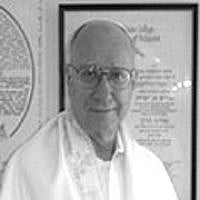
In the turbulent religious landscape of wartime Ukraine, two stories are unfolding at once. One is genuine: Chabad has just completed a Ukrainian translation of T’hilat HaShem, laying the groundwork for an unprecedented Ukrainian Torah edition. For a community that long relied on Russian as its lingua franca, this is more than a linguistic shift. It is a declaration of belonging, a choice for Ukrainian identity—and a refusal to communicate Jewish life in the language of an aggressor. Even the question of who may rightfully be called *Chief Rabbi of Ukraine*—Rabbi Yaakov Bleich with his decades in Kyiv, or Rabbi Moshe Azman with his close political ties—is part of that struggle.
Yet there is another story, one clothed in the same symbols but driven by a very different purpose. Last week, the Federation of Jewish Communities of Ukraine—an umbrella group largely aligned with Chabad—reshared a seemingly innocuous post from the Instagram account kosher_style_. With 34,000 followers, glossy photography, and a feed rich with Yiddish phrases, Hebrew captions, and snapshots of Ukrainian Jewish life, the account reads like the diary of a model Jewish influencer. Torah scrolls, Shabbat rituals, smiling portraits—it is all here, rendered so flawlessly it could be mistaken for a Chabad media campaign.
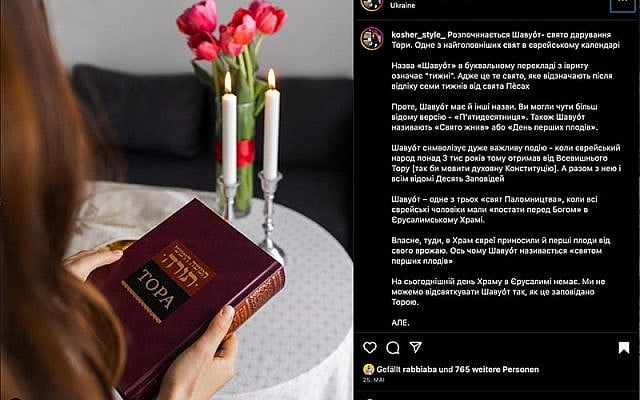
Too flawless. Behind the polished façade is not kiruv, not outreach from within Jewish tradition, but something more disquieting: evangelical outreach. Kosher_style_ is run by a woman named Inna, an employee of Radio M, a media outlet connected to the Far East Broadcasting Company (FEBC). Their mission statement is uncomplicated: to spread “the life-changing message of Jesus Christ.” Inna herself has led prayer circles and broadcast programs centered on missionary activities. The packaging is Jewish; the payload is evangelical.
Dig deeper, and the picture sharpens. Inna declares herself an “ambassador” for jewishculture.kjmc—which sounds innocuous enough, the name of a cultural center. But attached to it is Boris Grisenko, a man who, at first glance, could be mistaken for Slavoj Žižek. He is no philosopher, however, but a self-styled “rabbi” who is in fact a Messianic pastor, leader of the Kyiv Jewish Messianic Congregation (KEMO). In his sermons, Judaism is not preserved but reinterpreted as a waystation to Christianity.
This is no sideshow. Ukraine’s Jews are living through a linguistic and cultural transformation, forced by war to redefine their identity. It is precisely in this moment of searching—between Russian and Ukrainian, exile and homecoming, fragility and renewal—that missionaries step forward. They know that crises open doors. They know that vulnerability invites influence.
A careless double-tap on a photo of Shabbat candles can amplify the very content that endangers Jewish continuity. For followers, it feels communal, affirming, even comforting. But each like, each share, pushes an evangelical agenda deeper into Jewish digital space. The veneer is Jewish; the intent is not.
What is at stake here is not only media literacy. It is the ability of Jews in Ukraine to recognize themselves in their own reflection—without that reflection being hijacked. In a country fighting for its survival, identity is not an abstraction. It is everything. And in the flicker of candlelight online, shadows form easily. Sometimes, those shadows tell a very different story.