The Bible scholar I never met
I came to Eitan Rosenzweig the way you sometimes come to people who have already left — through their work, through other people’s grief, through a document that outlasted them.
It started with a Haaretz article. Then his teacher, Porat Salomon, who spoke about him the way teachers speak about students who have exceeded them. And then his parents — Uzi and Hagit — who came to us at the Bible Lands Museum a few months after their son was killed, carrying a plastic bag.
Inside it was a scroll.
They set it on the table, and something shifted in the room — in them, in the air between us. The way they looked at it was not the way you look at an object. It was the way a congregation follows the Torah around the synagogue — that particular combination of love and reverence and loss that attaches itself to something when it becomes the last vessel for someone who is gone.
My Hebrew was still finding its footing. They were patient with me. They were patient with everything. I didn’t yet know how to be in a room with bereaved parents. I’m not sure anyone does, the first time. They made it easier than it should have been.
Then I stood in front of the scroll.
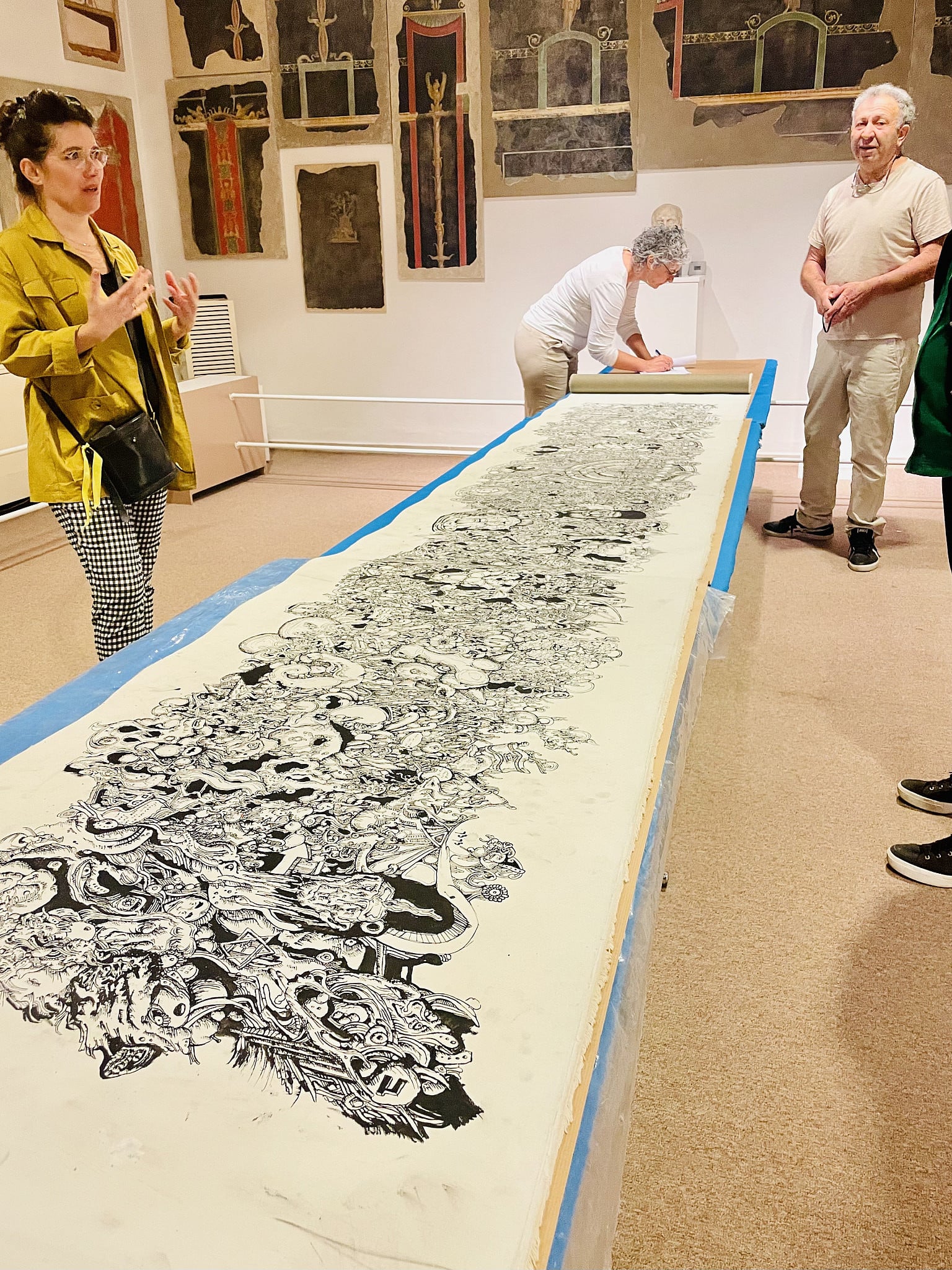
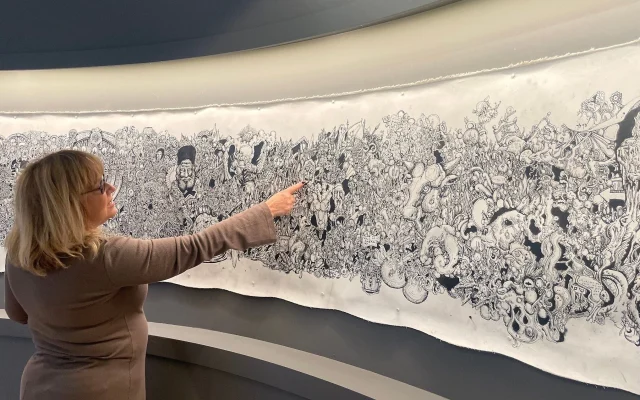
KUMA is 3.6 meters long. Eitan made it during COVID, when he was 18 years old. It is drawn in the technique of a Torah scribe — ink on paper, the same discipline that has copied and recopied the foundational texts of Jewish civilization for millennia — and it weaves together Bible, Talmud, Kabbalah, Joseph Campbell, Buddhist thought, modern Israeli poetry and art. Not as references. As a sustained argument. The kind you make when you have spent serious time with serious sources and found the thread connecting them.
I stood there and thought: I would have sought this person out. Not as a student. As a colleague.
Eitan was 21 years old when he was killed in Jabaliya on November 22, 2023. He had been drafted on October 7th, at the end of his service during his release leave, and was among the first forces to enter Gaza. He was also, at 18, making work of a calibre that most scholars spend a lifetime trying to reach — not the accumulation of sources, but the synthesis. The humanist’s dream. The thing that happens when someone has read enough to stop being impressed by any single tradition and starts asking what they all know together.
I never got to ask him. That is the specific loss I carry from this war, among many specific losses: the conversation that didn’t happen.
Uzi and Hagit stood in front of their son’s scroll at the opening and at the closing and at every significant moment in between — this, only months after burying him — and they did it with a grace I still don’t fully understand. They gave us KUMA to hold. We tried to be worthy of it.
Today I am thinking about the conversation I didn’t get to have. About what it means to encounter a mind entirely through what it left behind. About a young man who looked at three thousand years of human civilization and found it generative rather than overwhelming — who made something original from it at 18, before anyone asked him to.
The scroll is still here. That’s something. It’s not enough. It’s something.