
The Blockade – Part 3: How aid organisations deal with theft
As described in Part 2, aid diversion and other forms of corruption are ubiquitous and some of the biggest challenges facing aid organisations, particularly in conflict regions. However, it is somewhat surprising – given the universal and unambiguous condemnation of Israel’s actions – how these organisations and its donors often deal with it: by suspending aid.
Case Study: Yemen
In 2019 the UN called the emergency in Yemen the “worst humanitarian crisis in the world”. Its scale utterly puts to shame even the worst fears about Gaza. An estimated 24 million people, including more than 12 million children, were in need of humanitarian assistance. 7.4 million people required services to treat or prevent malnutrition including 2 million children under the age of 5 suffering from acute malnutrition – as many as there are people in Gaza. Over 360,000 children under 5 were suffering from severe acute malnutrition – more than there are children under 5 in Gaza. The prevalence of acute malnutrition in children under 5 at the national level was estimated at 12% – in Gaza in July it was 9%.
Yet in June 2019 WFP suspended all food assistance to Sana’a affecting 850,000 people after negotiations with the Houthis about introducing measures to protect against aid theft fell flat. WFP estimated that at least $17.5 million (or 10%) of food aid per month was being diverted in Houthi areas to fund the conflict.
David Beasly, WFP Executive Director at the time, explained: “At this stage, you can clearly say the humanitarian system is funding military and political operations. We are independent, neutral, impartial and if we can’t guarantee that, we shouldn’t be here.”
In Gaza the amount of funding Hamas generated by diverting UN humanitarian aid is estimated in the hundreds of millions of dollars, possibly as high as $1 billion. But since every moral principle is inverted in Gaza, the UN cites these same humanitarian principles of independence, neutrality and impartiality to demonise the (independent) GHF and instead urge a return to the status quo ante with Hamas ruling the humanitarian roost.
Beasly continued: “This is one of, if not the hardest decision I’ve ever had to make in my life. Yemen is the worst humanitarian disaster on Earth today and it’s being exacerbated by food aid diversion.”
WFP eventually resumed aid distribution in August after receiving promises by the Houthis but by March 2020 USAID announced it would halt assistance to all Houthi-controlled regions in northern Yemen as the rebels “failed to demonstrate sufficient progress towards ending unacceptable interference” in aid operations.
This forced WFP to halve its food rations to those regions further exacerbating the dire humanitarian conditions. Aid officials warned US aid cuts could bar access to emergency health services for more than 5 million people amid fears of the spreading COVID pandemic and that millions could go without food.
A US official explained: “Everybody’s ripped up about this. This goes against the grain of people’s emotions. […] While the stakes are very high and we definitely don’t want to cut off lifesaving assistance, the pressure needs to continue until they fall in line.”
Case Study: Ethiopia
In spring 2023 Ethiopia was in the third year of a regional drought and recovering from a two-year civil war in Tigray which had ended only a few months prior in November 2022. In 2022 29.7 million people including 15.8 million children required urgent humanitarian assistance. Over 4.7 million children under 5 were malnourished and 1.2 million were severely malnourished. UNICEF estimated that 800,000 children under 5 required treatment for severe acute malnutrition.
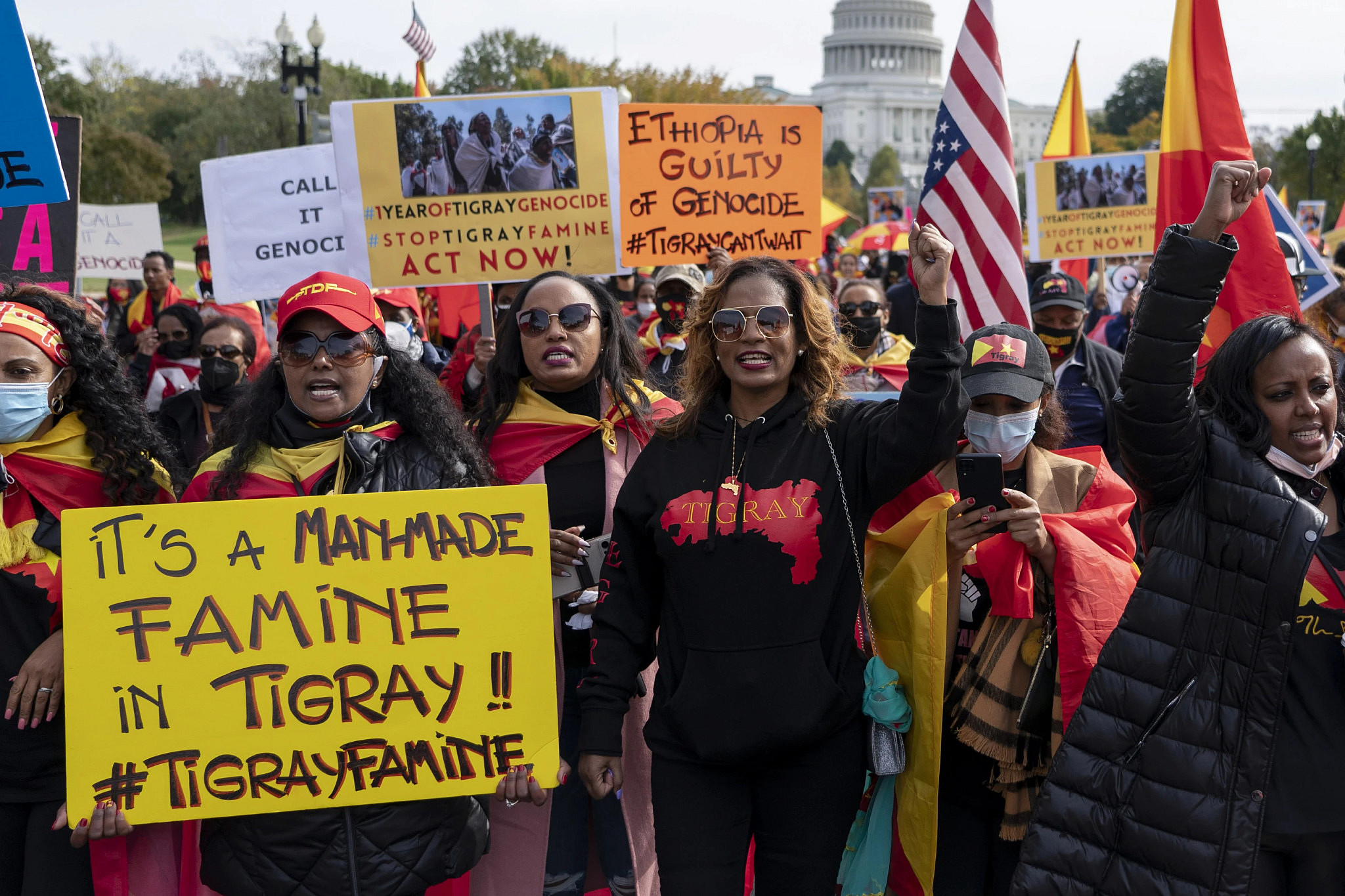
But in May 2023 USAID and WFP suspended food assistance to the Tigray region, where 90% of its 6 million inhabitants relied on aid, after some of its donations were found to be diverted and sold at local markets. By early June the suspension was widened to all of Ethiopia after USAID said it had uncovered widespread theft of food aid including diversion to Ethiopian military units as part of a scheme by federal and regional government entities.
US officials partially justified the suspension by pointing out that Ethiopia marked one of the biggest thefts and diversions of food aid ever documented with one investigation estimating that 7,000 tons of wheat had been stolen. The Shin Bet last year estimated that Hamas diverted some 60% of aid for its own purposes, but with 2 million tons of aid transferred to Gaza since the beginning of the war even just a 1% diversion rate translates to a scale of theft which dwarfs that found in Ethiopia.
At the time McCain said “WFP has zero tolerance for theft or diversion that prevents critical food from reaching the hungry” and later added “we are doing everything we can now to make sure that this never happens again”. But the details sound eerily familiar.
A Reuters investigation last year uncovered that WFP was warned about aid diversion in Ethiopia as early as 2021 and chose to look the other way. In several cases WFP was suspected of direct complicity when its officials instructed truck convoys to drop off shipments in areas where no aid recipients were present. Contradicting the USAID investigation, WFP largely absolved itself as well as the Ethiopian and Tigrayan government of wrongdoing in its internal investigative report saying it “found no indications” that its employees “were implicated in fraudulent activity, corruption, collusion or theft.” Instead it pointed to aid recipients as the main culprits for fraudulently obtaining extra food and reselling some of their rations – what aid agencies in Gaza have artfully termed “self-distribution”.
The impact of aid suspension was predictable. By the end of June local researchers and government officials had recorded 728 hunger-related deaths from 3 of the 7 subregions in Tigray. By August that number had almost doubled to 1,411.
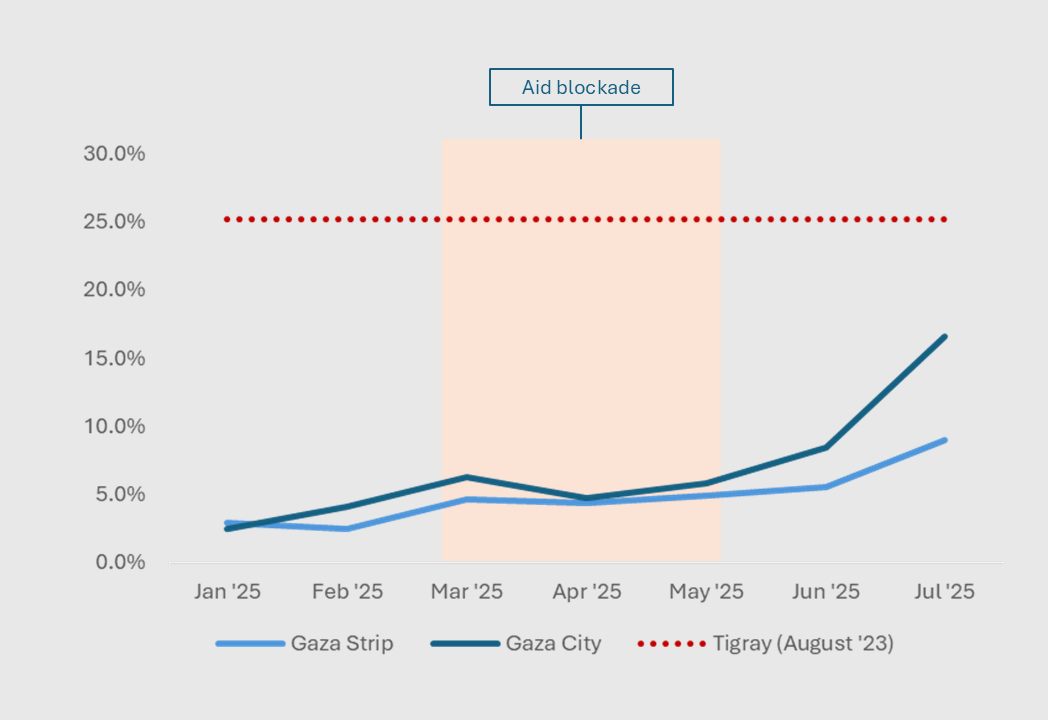
A Nutrition Cluster assessment of the Tigray region from August 2023 found the prevalence of acute malnutrition in children under 5 had reached 25.2% (33.6% in some subregions) when measured by Mid-Upper Arm Circumference (MUAC).
For comparison the same measurement in the Gaza Strip in July was 9% according to the UN and just over 15% in Gaza City, where it was one of the two criteria used to by the IPC to declare “famine with reasonable evidence” for the governorate. Israel implemented the aid blockade when acute malnutrition by MUAC in Gaza was at 2.5% (4.1% in Gaza City) and decided to reverse the policy when it had gone up to 4.9% (5.8% in Gaza City).
USAID and WFP on the other hand continued the aid suspension for another 3 months and only resumed food assistance after a comprehensive overhaul of the distribution model including the implementation of digital registration and identification procedures for aid recipients.
The lessons from Yemen and Ethiopia are too obvious to ignore. First, where bad actors misappropriate humanitarian aid, decision makers are left with only bad options. Second, cessation of food assistance even in the most dire emergencies may sometimes be warranted be it in order to avoid fuelling more violence through corruption or to pressure bad actors into a modicum of compliance. Third, everybody understands who is ultimately to blame for the negative consequences arising from horrifically difficult decisions, and nobody understands this better than aid groups – except in Gaza.
Conclusion
Through aid diversion and human shielding tactics Hamas has deliberately created a trade-off, where Israel is forced to choose between its own security and the well-being of Palestinian civilians. While the IDF has in many ways done more than any modern army to mitigate civilian harm, the argument that the unique extraordinary challenges of Gaza – the tiny piece of land, the densely populated urban battle field, Egypt’s refusal to allow civilians to flee, the local government weaponizing the suffering of its own population – require unique extraordinary precautionary measures to match is not easily dismissed. Despite the unprecedented lengths the IDF goes to, the view that it is still not enough under these difficult circumstances may be defensible. But the contemptuous moral superiority with which Israel has been met by ostensible allies is beyond all sanctimony.
The biggest obstacle to humanitarian assistance today is funding. WFP projects contributions to fall to $6.4 billion in 2025, a 34% decrease compared to 2024 and the lowest budget since 2017, adversely affecting up to 16.7 million people. The shuttering of USAID by the Trump administration may cost as many as 14 million lives by 2030. But EU countries are also cutting their foreign aid budgets by billions with no sign of slowing down anytime soon.
In the trade-off between spending on its own economies and delivering aid to starving foreigners, Western countries chose themselves. Foreign aid is undoubtedly virtuous but rarely considered an unconditional ethical obligation. It is human to prioritise one’s own well-being.
The same holds for Israel. Securing Palestinian well-being as far as possible is undoubtedly virtuous. But it is not an unconditional ethical obligation, especially where it conflicts with Israeli security concerns. Safety is no less of a reason than prosperity to act in one’s own self interest. The ethical obligation begins only where “selfishness” becomes excessive.
Whether this was the case with the aid blockade is a genuinely difficult question. It depends on the one hand on the reasonably expected military advantage – the cited articles by BBC and WSJ both suggest that measures taken since March were largely successful in collapsing Hamas’s finances although the military advantage of this collapse is itself difficult to quantify. On the other hand, it depends on the reasonably expected civilian harm. Clearly, some deterioration was to be expected, but arguably, given the amount of food that was available in March and the sizeable contributions by both Hamas and the UN to the eventual crisis in July nothing like its full extent was foreseeable by Israel when it implemented the blockade.
Even if the answers to both questions were known exactly, reasonable minds might disagree on what constitutes “excessive selfishness”. Is it excessively selfish to cut billions in foreign aid, potentially letting hundreds of thousands of people starve, in order not to have to cut it from pensions or healthcare or education spending? Is it excessively selfish to buy a bigger house, a new car, a better phone when a Nigerian child’s life could be saved for the relatively low price of $3,000?
Since there are no clear guidelines, such proportionality assessments risk becoming a popularity contest which Israel would surely lose. For most of the world, the war in its entirety has been excessive since Octobre 2023. But regardless of where one lands with the blockade, the war itself is much less ambivalent. Those determined to cast Israel’s insistence on destroying Hamas as excessive given the threat would do well to recall the Western response to the threat of ISIS. The US invoked Article 51 of the UN Charter (self-defence) in September 2014, at a time when the total combined death toll from ISIS terror attacks outside Iraq was 4 people shot at the Jewish Museum in Brussels – 2 of them Israelis.
The coalition was supported by half the world including militarily by countries like the Netherlands which have never suffered an ISIS terror attack on its soil. Over 10 years and thousands of civilians killed by coalition airstrikes later the total combined casualty count in Europe and North America with less than 500 killed and 2000 injured is but a fraction of what Hamas has done on October 7 alone.
Like the Europeans and Americans, Israelis will one day have to reckon with the fallout of actions done in the name of their security. Not everything is to be excused, certainly not praised, including quite possibly the aid blockade. But whatever moral failings they reveal are an expression of Israel’s humanity, not its inhumanity.
—
A German version of this article was first published by the Austrian think tank Mena-Watch.