Geopolitical Analyst: Bridging Somaliland & Israel to the world
The Bureaucracy Says Wait. The Strategic Map Says Move.
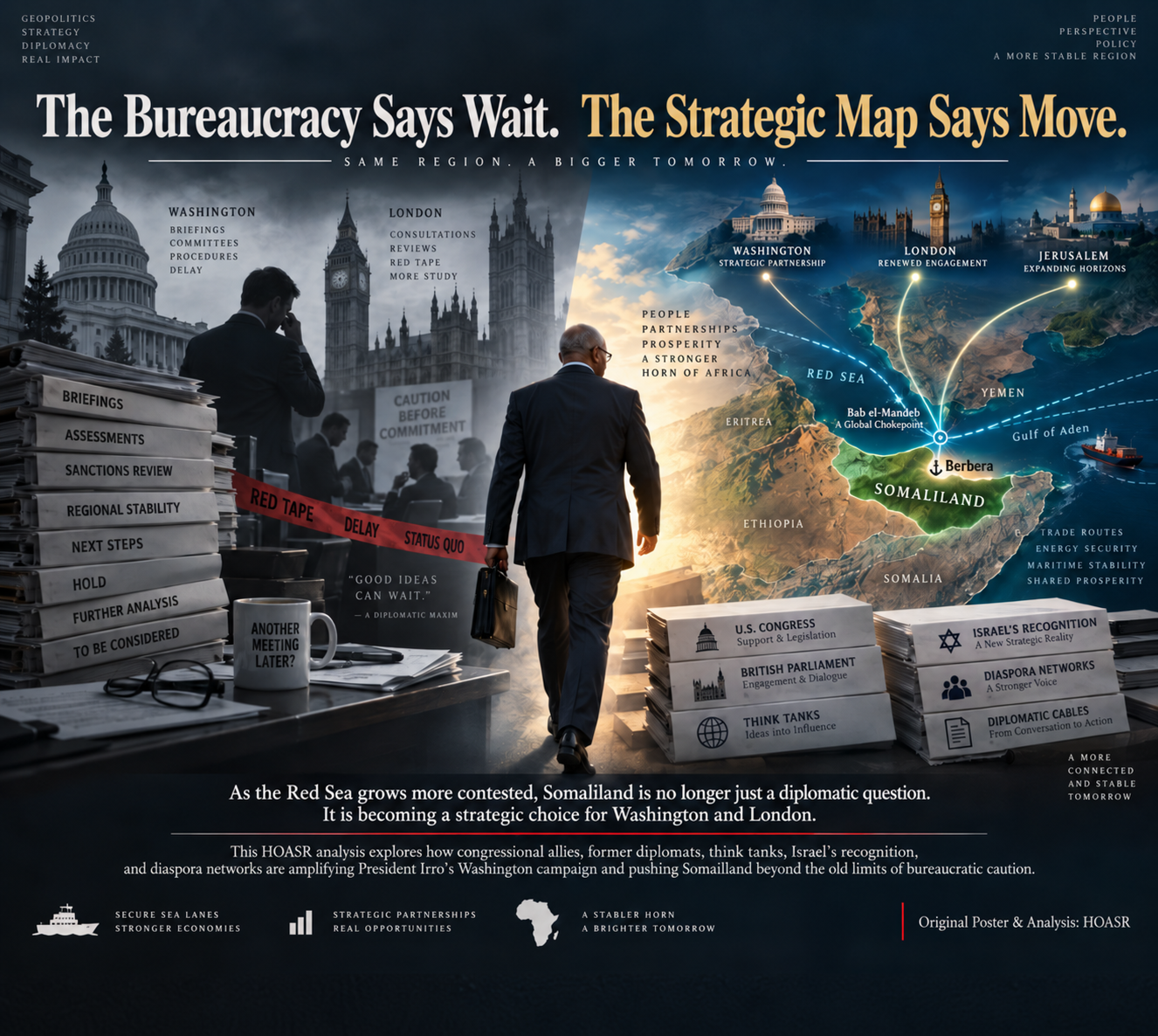
Poster illustrating U.S. and UK bureaucratic caution versus Somaliland’s growing strategic importance around Berbera, the Red Sea and Bab el-Mandeb. HOASR Original Infographic Artwork
How Somaliland’s recognition campaign is outgrowing the foreign-policy establishment in Washington and London
For three decades, U.S. and British diplomacy treated Somaliland as a problem to be managed rather than a strategic choice to be made. That caution once kept diplomatic costs low. Today it is beginning to create costs of its own. Israel, members of Congress, former senior diplomats, think tanks, security analysts and diaspora networks are all pushing Somaliland into a wider Red Sea debate. President Abdirahman Mohamed Abdullahi Irro’s Washington campaign is benefiting from that shift: he is not carrying the recognition case alone anymore.
A policy built to avoid a decision
For years, Washington found a comfortable way to deal with Somaliland. U.S. officials could praise its elections, work with its authorities, fund democratic programs and discuss security without touching the political status question. Recognition remained somewhere else: with the African Union, with Mogadishu and Hargeisa, or with some future negotiation that never quite arrived.
The formula was stated plainly in 2007. The State Department said the United States would continue engaging Somaliland but would allow the African Union to deliberate first on recognition because Washington did not want to get ahead of the continental organization. What began as caution became habit. Later administrations kept the same basic architecture even as the region around Somaliland changed. The original policy is worth reading because so much of today’s language still echoes it: U.S. State Department, “United States Policy on Somaliland” (2007).
By the early 2020s, the standard U.S. formulation was even stronger: Washington recognized Somalia’s sovereignty and territorial integrity within its 1960 borders. When the Ethiopia–Somaliland memorandum caused a regional crisis in January 2024, the State Department again fell back on territorial integrity and dialogue. That response was understandable in the moment. The larger problem is that almost every new Somaliland development has been processed through the same old template. See the continuity in the State Department’s U.S.–Somalia relations framework and its January 2024 press briefing on the Ethiopia–Somaliland MoU.
There are defensible reasons for that caution. The United States has spent heavily on Somalia’s federal institutions and counter-al-Shabaab campaign. A recognition decision would anger Mogadishu, unsettle some African governments and force Washington to revisit legal and diplomatic assumptions embedded in years of policy. Career diplomats are trained to see those costs clearly.
The weakness appears on the other side of the ledger. A bureaucracy can become so practiced at avoiding the immediate cost of a decision that it stops measuring the cost of postponement. That is where the Somaliland file now sits. The Red Sea is more militarized. China is established in Djibouti. The Houthis have made maritime vulnerability impossible to ignore. Taiwan has a political relationship with Hargeisa. Berbera has acquired greater commercial and security value. Israel has recognized Somaliland. Yet much of the diplomatic vocabulary in Washington remains rooted in an earlier strategic landscape.
Former officials are challenging the policy they once inherited. One of the most revealing changes is the number of former senior U.S. Africa officials who now say, in different ways, that the status quo no longer makes sense. These are not outside activists unfamiliar with State Department constraints. They include people who once sat inside the system and understand how recognition decisions are weighed.
Jendayi Frazer, who served as Assistant Secretary of State for African Affairs under President George W. Bush, has said she believed Somaliland deserved recognition. In a retrospective interview, she recalled that South Africa, Kenya, Ethiopia and Nigeria at various points appeared open or sympathetic to Somaliland, while other states resisted. Her account is important because it shows that recognition was not always dismissed as unthinkable; there was a period when a multilateral African opening seemed possible. Frazer’s account is available through the Council on Foreign Relations.
Tibor Nagy, another former Assistant Secretary of State for African Affairs and a former ambassador, has become one of the sharpest critics of bureaucratic hesitation. Herman Cohen, who held the same Africa post decades earlier, has also been a longstanding supporter. J. Peter Pham, a former U.S. special envoy and one of Washington’s best-known Africa policy voices, has repeatedly made the strategic case for closer ties and recognition.
Their influence should not be overstated. Former officials do not sign recognition documents. What they can do is make a once-unconventional policy sound respectable inside elite circles. They know the arguments that will be raised inside the bureaucracy, they have relationships with congressional offices and policy institutes, and they can tell an administration that a shift would not amount to abandoning serious Africa policy. That kind of validation crucial when an issue is moving from the margins toward a presidential decision.
There is also a serious opposing view. Larry André, who served as U.S. ambassador to Somalia and Djibouti, has urged Washington not to rush. His position is not that Somaliland should be ignored. He says the United States should review the consequences carefully, consult African partners and expand practical engagement before crossing the recognition line. His argument captures the strongest case for caution: a strategically attractive option can still carry diplomatic and security costs. André’s more cautious case can be read in his Somaliland status policy review.
That disagreement among former officials is healthy. It also makes the current moment more interesting that the argument is no longer between Somaliland and an uninterested Washington. It is increasingly taking place among Americans who have actually managed U.S. Africa policy.
The think-tank world has moved faster than the bureaucracy
American think tanks were not always this interested in Somaliland. For years the subject belonged mainly to Africa specialists, diaspora advocates and a small number of congressional offices. That has changed. Somaliland now appears in arguments about China, Taiwan, the Red Sea, military access, critical minerals, democratic partners and the Abraham Accords.
The Heritage Foundation was early and unusually direct. Joshua Meservey’s 2021 report argued that the United States should recognize Somaliland and described the existing approach as disconnected from political reality. Heritage later hosted then-President Muse Bihi Abdi during his 2022 U.S. visit, giving Somaliland a platform inside an institution with deep influence in Republican policy circles. See Heritage’s 2021 recognition report and its 2022 Somaliland presidential event.
The policy argument has since spread beyond one conservative institution. Hudson Institute analysts have treated Somaliland as part of the strategic competition in the Horn. The Council on Foreign Relations has published both favorable and cautionary assessments, which is itself a sign of normalization: Somaliland is being debated as a genuine policy option unlike in the past when the argument was rather dismissed before the debate began.
Michelle Gavin’s earlier assessment for the Council on Foreign Relations highlighted Somaliland’s democratic record while stopping short of a simplistic policy prescription.
Think tanks influence foreign policy in less dramatic ways than elected politicians, but their cumulative effect can be powerful. They provide arguments, personnel, briefing papers and language that migrate into hearings, speeches and legislation. They also give policymakers somewhere to stand intellectually. When a senator or president considers a policy taboo, it is easier to move if respected institutions have already spent years explaining why the break might serve American interests.
Congress is creating pressure the State Department cannot ignore
Congress has pushed the debate from commentary toward formal policy. Recognition bills have now been introduced in successive Congresses. The current Republic of Somaliland Independence Act, H.R. 3992, is still Republican-led, so it would be premature to describe recognition itself as a fully bipartisan congressional project. What is broader than the sponsorship list is the growing willingness in Washington to treat Somaliland separately in security, diplomatic and economic discussions. The bill text is available through Congressional bill records for H.R. 3992.
Senator Ted Cruz has become the most consequential congressional advocate because he has gone directly to the executive branch. In August 2025, as chairman of the Senate Foreign Relations Subcommittee on Africa and Global Health Policy, he urged President Donald Trump to recognize Somaliland. His argument was not sentimental. He tied Somaliland to Gulf of Aden security, counterterrorism, Taiwan, China, Israel and the Abraham Accords. Cruz’s letter and argument are published on his Senate website.
This is where the recognition campaign has become more politically effective. Instead of asking Washington to reward Somaliland simply because it has survived and governed itself, advocates are linking recognition to problems Washington already cares about. That does not guarantee a policy change, but it changes the conversation. A president can ignore a moral appeal more easily than a package involving China, maritime access, Israel, terrorism and strategic minerals.
Israel changed the political atmosphere
Israel’s recognition of Somaliland in December 2025 altered the debate in a way that years of lobbying could not. The first-mover barrier was gone. Somaliland was no longer asking the United States or Britain to become the first country willing to absorb the diplomatic shock. Israel had already crossed that line and connected its decision to the language of the Abraham Accords. Heritage’s Abraham Accords tracker records Israel’s December 2025 recognition and Somaliland’s stated interest in the Accords.
The American Jewish organizational dimension has also become more visible. The Conference of Presidents of Major American Jewish Organizations publicly welcomed Israel’s recognition and described Somaliland in the language of maritime security, counterterrorism and U.S. allied interests. Jewish Insider has documented Somaliland’s Washington diplomacy seeking support among Jewish communal leaders. See the Conference of Presidents statement and Jewish Insider’s reporting on Somaliland’s Washington outreach.
There is no need to turn that into a sweeping claim about a single “Israel lobby.” The evidence is more specific and more useful. Somaliland now has access to networks that care deeply about Israel’s security, the Abraham Accords and Red Sea stability. Those networks overlap with Republican foreign-policy circles, evangelical constituencies, donors, think tanks and members of Congress. Their effect is to widen the audience hearing Somaliland’s case and to make an Israel–Somaliland partnership feel less exotic in Washington.
Why Irro’s Washington campaign is stronger because of all this
President Irro arrived in Washington on September 5 with a large delegation and an agenda built around diplomacy, security, investment and Somaliland’s international status. The timing of the visit is consequential. Five or ten years ago, recognition was largely confined to specialist conversations. He is arriving after Israel’s recognition, after congressional recognition bills, after Cruz’s direct appeal to Trump, after years of Heritage and other think-tank work, and with former senior American officials publicly challenging the old policy.
That does not mean the White House has made up its mind. Nor should every meeting, photograph or conference appearance be presented as evidence that recognition is imminent. The more important gain is political access. Irro can now speak to American officials within a conversation that other influential Americans have already prepared for him.
When he raises Berbera, there are analysts and lawmakers who have already written about its value. When he raises Taiwan, there is an established China-policy argument. When he speaks about Israel, he can point to an existing diplomatic relationship rather than a hypothetical one. When he discusses the Houthis and Red Sea security, that subject is already near the top of Washington’s Middle East agenda. The president’s campaign is therefore amplified by a network of arguments, people and institutions operating independently of Hargeisa but increasingly reaching similar conclusions.
Even Mogadishu’s decision to send a senior delegation to Washington at the same time illustrates how much the terrain has shifted. Somalia is no longer responding only to Somaliland lobbying in Africa or Europe; it is responding to the possibility that Washington itself may be reconsidering how it defines its interests in the Horn.
London has its own revolt against the official line
Britain presents a strikingly similar picture. The Foreign, Commonwealth and Development Office remains attached to the traditional formula: Somaliland’s status should be settled through dialogue between Hargeisa and Mogadishu, and Britain does not recognize its independence. That line survived Israel’s recognition almost unchanged. The UK restated the position at the United Nations in December 2025.
Parliament is much less settled. Sir Gavin Williamson, the former defence secretary, has spent years forcing Somaliland onto the Commons agenda. In 2023 he introduced a bill requiring formal recognition. The names supporting that measure came from more than one party, including Labour figures, making Westminster’s parliamentary campaign more visibly cross-party than the current recognition bill in Washington. The full 2023 debate and sponsor list are recorded in Hansard.
Williamson now chairs the All-Party Parliamentary Group on Somaliland, with Labour MP Abtisam Mohamed as vice chair. Baroness Kate Hoey has repeatedly pressed ministers through written questions, including on recognition, the African Union’s 2005 fact-finding mission and Somaliland’s possible contribution to Gulf of Aden security. The government keeps giving essentially the same answer. Parliament keeps asking again.
The current APPG register lists its purpose as promoting understanding of Somaliland’s achievements in building peace, democratic governance and a sovereign state. Baroness Hoey’s questions on recognition and Gulf of Aden security show the pressure being applied from outside the FCDO.
Britain also has a constituency factor the United States does not have in quite the same form. Large, long-established Somaliland-origin communities live in British cities and have produced second- and third-generation citizens with votes, party connections and local political influence. The political influence is more concentrated: constituency meetings, party branches, local campaigns and MPs who know these communities personally.
The real contest is over how fast policy catches up
There is a temptation in Somaliland politics to interpret every favorable article or parliamentary statement as the final breakthrough. That would be a mistake. The State Department and the FCDO still possess enormous institutional power. They control diplomatic machinery, prepare options for ministers and presidents, manage alliances and warn political leaders about second-order consequences. Neither bureaucracy is going to disappear because think tanks or parliamentarians are impatient.
But bureaucratic power is not the same thing as permanent control of the argument. Foreign policy changes when enough pressure accumulates outside the normal channel: Congress writes legislation, former officials challenge inherited assumptions, allies change their own policy, think tanks build an alternative case, media give the issue visibility and political leaders discover that an old position now carries costs.
That is why Irro’s Washington campaign deserves to be judged by more than whether he leaves with immediate recognition. His larger opportunity is to convert a loose collection of sympathetic voices into a durable policy coalition. A meeting with a senator matters if it produces legislative pressure. A think-tank appearance matters if it supplies arguments to administration officials. Israeli support matters if Somaliland enters the U.S.–Israel strategic conversation. Diaspora advocacy matters when it reaches constituencies and lawmakers who can keep the issue alive after the presidential delegation goes home.
Somaliland has spent three decades asking the outside world to look at the record it built at home. The current opening is different. The international environment is beginning to supply its own reasons for looking toward Hargeisa. That is a stronger position, but it still requires disciplined diplomacy. Recognition will not come because the map alone is persuasive. It will come, if it comes, when enough decision-makers conclude that preserving the old policy has become harder to defend than changing it.
For years, the safest answer in Washington and London was to wait. Wait for Mogadishu and Hargeisa. Wait for the African Union. Wait for a regional consensus. Wait for a moment when recognition would somehow become easier than it was before. The waiting had logic, but it also became a substitute for strategy.
The strategic map has changed while the diplomatic language barely moved. Berbera is more important. The Red Sea is more dangerous. China, Taiwan, Israel and the Houthis have all entered the Somaliland equation in ways that were not present when Washington laid down its cautious formula in 2007. At the same time, a coalition of former officials, lawmakers, think tanks, pro-Israel organizations and diaspora networks is widening the political space for a different policy.
The Scoop
President Irro’s task in Washington is to turn that favorable environment into something lasting. The opportunity is real, but it is not automatic. He has to convince American officials that Somaliland is not asking them to take a diplomatic gamble for Hargeisa’s sake. He has to show that the greater gamble may now be continuing to treat a strategically important Red Sea partner through a policy designed decades ago for another era.
Related Topics
Related Posts