
Russian-American-Israeli Palestinian. Palestine is Israel.
The Capitalist Ideal
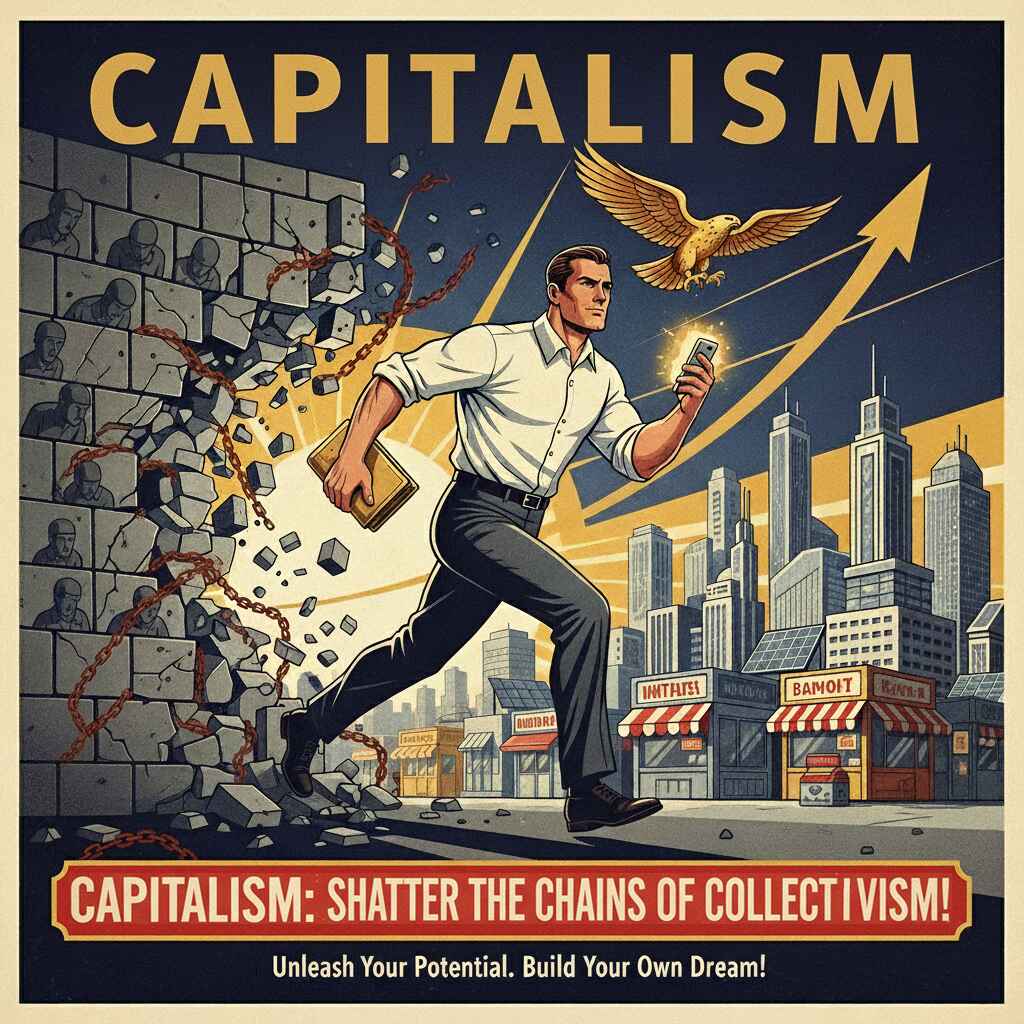
CAPITALISM: Shatter the Chains of Collectivism. Unleash Your Potential. Build Your Own Dream. Image © Ivan Bassov, 2025. Licensed under CC BY 4.0.
From Each According to His Ability, To Each According to His Need
I received numerous critiques of my essay “The Communist Dream That Already Came True,” where I argued that America already fulfills the core of the so-called communist ideal: “From each according to his ability, to each according to his needs.” Most critiques centered on wealth gaps, billionaires, unemployment, and other familiar talking points. Here I address them directly and clarify my vision of capitalism.
I start with the “1% owns 90% of the wealth” critiques.
First, let’s demystify “wealth.” It is not a vault of gold the 1% guards from the masses. Bill Gates does not hoard copies of Windows. Elon Musk doesn’t lock away Teslas. Their “wealth” is equity—digits in a ledger that exist only because millions voluntarily buy what their companies create. If Microsoft vanished tomorrow, Gates’s wealth would vanish with it. Same for Musk and his companies. The 1% do not “own” 90% of anything redistributable; they hold valuation tied to enterprises that function only because the public chooses them. You cannot “allocate” that value without destroying it.
Second—and equally important—the 1% is constantly changing. It’s not the same people or families over long periods; while some maintain wealth across generations, most 1-percenters are replaced within a single generation.
Inequality in a capitalist society is not a moral indictment—it’s a measurement artifact of skill, contribution, creativity, ambition, and—yes—luck. If one person has more digits in their ledger than another, how does that harm anyone? It doesn’t. And if those digits motivate human beings to innovate, produce, and build, why sabotage a system that lifts the baseline for everyone?
Critics hate acknowledging the obvious: wealth is mostly abstraction. But when the “wealthy” spend their wealth on luxuries—private jets, yachts, mansions—they provide income to countless people: architects, engineers, builders, maintainers, repair crews, pilots, captains, and more. Far from being hoarded, wealth is redistributed through salaries, services, insurance, and taxes, accelerating the natural turnover of the 1%.
Critics also complain that billionaires have “too much influence” because they can fund causes they care about. But influence is not coercion—and it is always bounded by law. Billionaires cannot legally use their wealth to fund terrorism, cartels, or anything illegal; they can only spend within the same legal framework everyone else follows. In free societies, people at any wealth level can support the ideas they believe in through donations, activism, research, or politics. Wealth may amplify a voice, but it cannot silence others. The only alternative is a system where the state decides which ideas may be supported at all—and that is far more dangerous than a wealthy person funding their favorite cause.
Meanwhile, the baseline in modern capitalist societies—food, shelter, medicine, education—is real and available. No one starves in America. No one is denied emergency care. No one freezes to death except in rare cases unrelated to “wealth.” Western capitalism quietly delivers what socialism loudly promises—without coercion.
This leads to the central truth: capitalism is the most humane economic system because it relies on voluntary incentives, not force. Socialist systems must compel work because they destroy motivation; “parasitism” was literally a criminal offense in the USSR, and still is in North Korea. In capitalism, work is voluntary. People work because incentives align personal benefit with societal benefit. That is not greed; that is coordination.
Marx’s big “insight”—that labor alone generates value—was his biggest error. Time spent at work has no value by itself. You can dig useless ditches for eight hours and produce nothing. You can write one hour of code that powers a global service. Impact creates value, not hours. Capitalism recognizes this; central planners never can. No committee can micromanage the creative intelligence of millions acting freely.
Some claim AI will perfectly plan and coordinate every worker—or replace nearly all humans, leaving only a few to manage machines. True, AI already automates tasks like translating, editing, and coding. But it cannot replicate the distributed creativity, intuition, and judgment of millions of independent human minds. Value is emergent, context-dependent, and subjective. No algorithm, no matter how advanced, can substitute for the decentralized discovery and voluntary coordination that capitalism unleashes.
Those whose work is automated by AI are not left idle—they are freed to contribute in other ways, learn new skills, innovate, or pursue ventures that AI cannot replicate. Capitalism naturally reallocates talent: some tasks become obsolete, others emerge. People will always find ways to create value where human creativity, judgment, and initiative are needed. Automation shifts work—it doesn’t eliminate the need for human contribution.
Another critique: “companies are centralized, so why can’t countries be run like corporations?” Because the analogy collapses immediately. A corporation is voluntary. You can walk away instantly. A country is not. Emigration requires uprooting your life and obtaining another state’s permission. That is not a “choice” in the corporate sense; it is geopolitical bureaucracy. The citizen-state relationship is inherently non-voluntary—precisely why a country cannot function as one giant centralized firm.
People do migrate, of course—often to exploit geographic arbitrage (earning higher wages in one country while spending in a cheaper one), or to enter the U.S. for higher wages and mobility. People move because capitalism works. That is the beauty of it.
Companies thrive because millions of them compete. That decentralized ecosystem—not corporate hierarchy—is what drives innovation. Turn a nation into a single, centrally managed “company” and you annihilate the competitive mechanism that makes capitalism succeed. Central planning inside a firm is efficient; central planning over a society is tyranny.
This is why capitalism expands freedom and socialism contracts it. In capitalism, you can work or not work. Save or spend. Invest or ignore markets. Move cities, change careers, reinvent yourself. In socialism, none of this is possible. You need permission to move apartments. You cannot stop working. You cannot accumulate wealth. Your future is assigned. And yet I’m told capitalism is the system that “restricts freedom”? Please.
Some commentators love to bring up capitalism strawmen, citing Germany under Hitler, Chile under Pinochet, or Russia under Putin. But these were state-directed economies—nothing resembling free enterprise. The state picked winners, crushed competition, allocated resources politically, and treated private business as an extension of government power. That isn’t capitalism. Capitalism is not just a market economy; it is a socio-politico-economic system fundamentally incompatible with dictatorship.
Similarly, capitalism is fundamentally incompatible with anarchy, such as Russia under Yeltsin. What happened after the Soviet Union fell was not a transition to liberal markets; it was a power vacuum. Courts collapsed, property rights didn’t exist, and criminal groups and ex-party elites privatized the state for themselves. It is undeniable that private property and functioning markets cannot exist without strong state institutions to define and defend them.
The remaining standard critiques disintegrate on contact with reality.
“Capitalism causes unemployment.” Yes—and that is what allows adaptation. It lets people leave dying industries and enter growing ones. Dynamism beats stagnation.
“Capitalism creates billionaires.” Good. They create industries, jobs, technologies—and even when they don’t, their “wealth” is mostly abstraction.
“Capitalism is unstable.” No—it is responsive, which is why capitalist nations outperform rigid ones.
“Capitalism is unfair.” Fairness is not forced equality; fairness is a guaranteed baseline with the freedom to rise above it—or not.
“Capitalism exploits workers.” Workers can quit. Under socialism, they can’t.
“Capitalism destroys the environment.” History shows the opposite: the worst ecological disasters were socialist.
Since Marx’s time, the line between “worker” and “capitalist” has dissolved. Workers now own parts of the economy through pension funds, mutual funds, and stock plans. Anyone who wants more ownership can simply buy shares—and anyone craving the stability of a “guaranteed pension” can purchase one directly through an annuity. Under capitalism, everyone can be a capitalist.
Moreover, under capitalism, anyone can experiment with socialism, communism, or whatever ideology they choose—try that under actual socialism.
Capitalism’s purpose is not ideological purity—it is to make life better for everyone through voluntary cooperation rather than coercion. Yes, it involves cycles: layoffs, bankruptcies, recoveries, growth. Life breathes in cycles. The key is that the baseline remains, and opportunities for personal advancement are far greater than in any centralized system.
So the real debate is not whether to dismantle capitalism. The debate is how to fine-tune it: which services belong in the baseline, and which should remain optional. Everything else—eliminating billionaires, resurrecting Marx, worshipping Lenin—is political theatre.
And this brings us to Israel. Israel began as a romantic socialist project—kibbutzim, collectivism, heavy state control. It built foundations, yes, but by the 1970s and 1980s the economy was crumbling under that model. The miracle happened only when Benjamin Netanyahu pivoted Israel toward U.S.-style capitalism. That shift unleashed the high-tech boom, created prosperity, and funded even more social programs Israelis now enjoy. Capitalism—not socialism—made modern Israel thrive.
Israel today has one of the largest wealth gaps in the developed world, second only to the U.S., and by some measures even exceeding it. And? That gap is mostly numerical illusion, as discussed earlier. Meanwhile Israel consistently ranks among the happiest countries on earth—because strong families, communities, and opportunities matter more than ledger statistics.
Let me restate the conclusion clearly: the communist ideal already exists. It’s called the United States. It’s called Israel. It’s called the modern West.
Everyone’s needs are met. People contribute according to their ability. And—unlike socialist regimes—human beings are free to flourish according to their individuality.
This is not utopia. This is reality. A reality built by capitalism. A reality protected by freedom. A reality worth defending—unapologetically.
See Also
Related Topics
Related Posts