The Case for Restoring the Qajar Monarchy in Iran
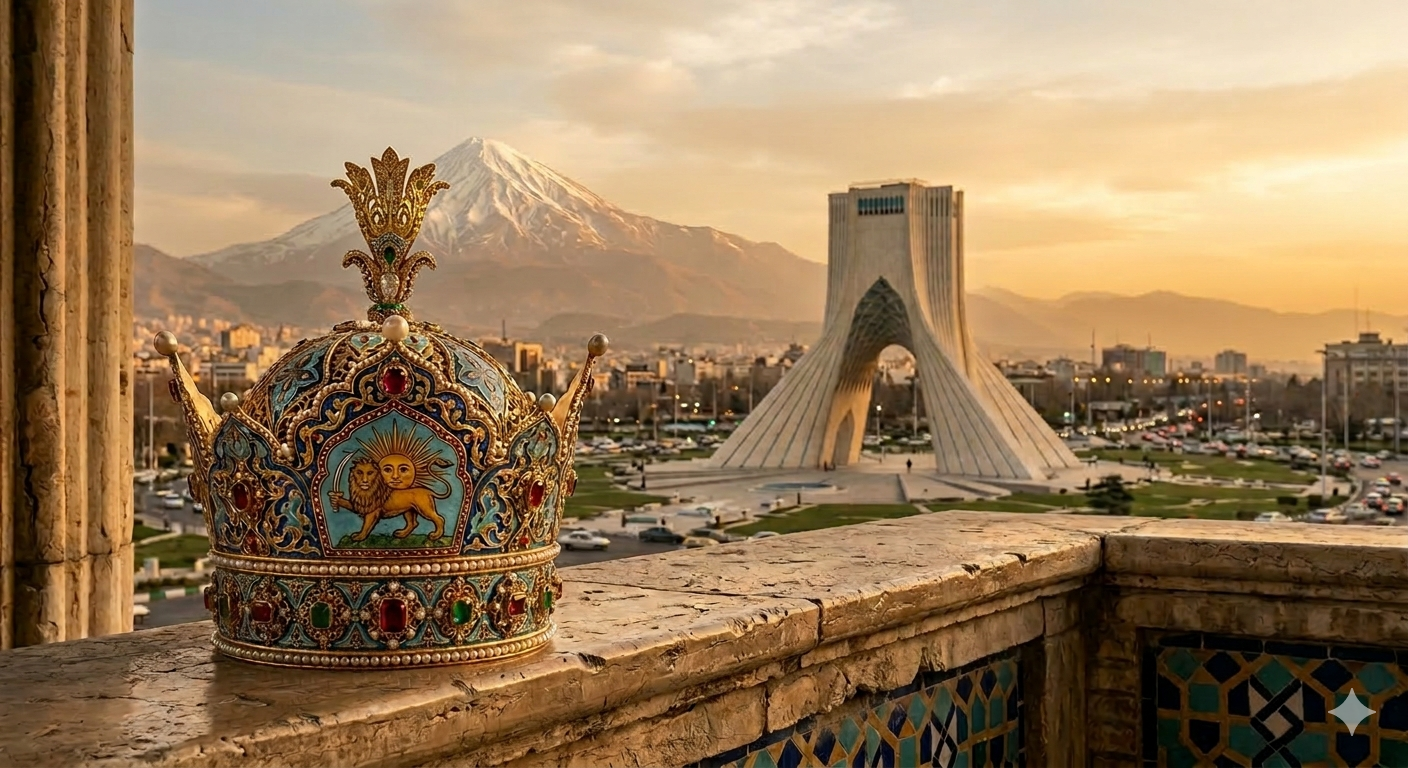
When the bombs stop falling and the smoke clears, the question of who can lead Iran during a transition will become inescapable. Whoever it is will face a Herculean task: reconciling the regime’s remaining, fanatically-religious Shia supporters with the increasingly secular majority of Iranians, while at the same time placating disgruntled ethnic groups who might otherwise rise up to seek self-determination. Just as in Spain’s transition to democracy in the 1970s, a non-partisan constitutional monarch could act as a crucial stabilising force, guiding the process with serenity. Unfortunately, Reza Pahlavi, the son of Iran’s deposed Shah, is far too polarising to step into that role. But Iran’s long-forgotten Qajar royal dynasty, which ruled the country until 1921, may offer a surprisingly viable alternative.
Reza Pahlavi has now become the widely-recognised leader of the Iranian opposition. While support for him was once ridiculed as a diasporic phenomenon, he now reaches millions of tech-savvy young city-dwellers inside Iran with his eloquent social-media monologues. The January mass protests, the largest in recent Iranian history, were the long-term result of the regime’s economic mismanagement. But the specific chain of events leading up to them started with the Mullah regime’s brutal murder of Khosrow Alikordi, a prominent Pahlavi-supporting human rights lawyer in Mashhad, North-Eastern Iran, in December 2025. At the December vigils for Alikordi, and during the January gatherings, protesters risked their lives to chant Pahlavi’s name.
While Reza Pahlavi inspires admiration among his youthful, urban-based supporters, he elicits nothing but hate, anger and rejection from the Mullah regime’s deeply religious, Shia core constituencies. Surveys indicate that these days, as little as 40% of Iranians identify as Muslim, and only a certain fraction of them are diehard supporters of the Shia-Islamist clerical regime – more often those from rural, poor social backgrounds, among them many military veterans of the Iran-Iraq war in the 1980s. For over 40 years, these people have heard an endless cacophony of regime propaganda smearing the Pahlavi dynasty as the arch-enemies of Islam, foreign puppets, and amoral deviants. Even if the regime falls tomorrow, its supporters won’t unlearn decades of lies overnight. Any Pahlavi-led transition has the potential to alienate these people entirely, and could give rise to a debilitating Shia-Islamist insurgency in rural regions. The risk here lies in repeating the fiasco that happened in Iraq in 2003. There, a total exclusion of Baathists from the new American-imposed political system ultimately led many of these former supporters of Saddam’s regime to join up with terror groups such as ISIS. Baathists were a small proportion of Iraqi society, but their ready access to weapons, hideouts and military know-how turned them into devastating adversaries for the new US-backed authorities.
The regime’s remaining supporters are unlikely to embrace a Western-style secular republic or a restored monarchy led by Reza Pahlavi. However, Iran’s Shia believers, even the fanatical ones, were not always enemies of the concept of a monarchy on principle. Iran’s Shia faithful believe we live in an arduous “absence period” (Ghaybah) that precedes the return of the ‘Mahdi’, the saviour who they believe will bring true Islamic order to the world. As such, there is no real onus on the believers to build a theocratic Islamic state before the Mahdi returns. Historically, many eminent Shia clerics kept quiet on matters of politics for this very reason, preferring to leave the business of governing to kings and prime ministers, so long as those were Shia. Ayatollah Khomeini’s attempt to build a theocratic state before the Mahdi’s reappearance required significant theological distortion, namely the ad-hoc invention of the harebrained concept of “velayat-e motlaqaye faqih” (absolute rule of the jurist).
The executed, early 20th century Iranian cleric Fazlullah Nouri was the intellectual godfather of Shia political Islamism, a ‘martyr’ for his cause. Nouri won even Khomeini’s posthumous “unqualified” endorsement. Nouri was deeply disaffected with the Qajar dynasty that ruled Iran at the time, and the westernising direction towards which the Qajars led the country. Consequently, he flirted briefly with revolution against the crown, but was met with a distinct lack of enthusiasm for his dream of clerical rule on the part of fellow revolutionaries. In the end, Nouri changed sides, and “accepted the monarchy to prevent the establishment of idolatry and atheism”.
Today, Shia Islam in Iran is in a much weaker position, popularity-wise, than it was over 100 years ago, in Nouri’s time. If the regime falls, even the most fanatical hardliners will be forced to understand that reality. To prevent the establishment of a fully secular republic, they might now, in desperation, be willing to go far further than Nouri back then, by embracing a restored, nominally-Shia Qajar monarchy, even if this monarchy would serve a largely ceremonial role while day-to-day politics is returned to the secular-democratic realm.
Re-introducing a constitutional monarchy to reconcile religious hardliners with a new political reality may seem paradoxical – but it has been done before in Iranian history. The Qajar Monarchy was overthrown in a British-backed palace coup in 1921. Its overthrow was spearheaded by Reza Khan, a savvy political operator who reportedly started out as a mere horse groom to foreign diplomats, but worked his way up in the military hierarchy until he was able to overthrow the Qajars. Reza Khan never intended to mount the Peacock throne – he fancied himself as a modernist authoritarian strongman, like Kemal Atatürk in Turkey. But in 1926, amidst growing uproar from Shia clerics, Khan decided to have himself proclaimed as a Shah, giving himself the new surname Pahlavi in the process. This political formula worked well to mollify religious backlash until Khomeini started to fundamentally undercut the Muslim credentials of the Pahlavi dynasty with his rabble-rousing lies in the turbulent 1960s. With Khomeini long dead, and his totalitarian political project quite literally in ruins, it is unlikely that the clergy would ever again have the social stature to be able to similarly discredit another royal dynasty.
Restoring the Qajar crown would represent a crucial olive branch not just to former regime supporters, but also to Iran’s disaffected non-Persian ethnic groups. A huge proportion of the Iranian population today is not ethnically Persian. In 2011, a senior regime official estimated that around 40% of the Iranian population speak Turkic languages, such as Azerbaijani, Turkmen or Qashqai. And Turkic groups are not the only non-Persian ethnic groups in Iran today: There are also large Kurdish, Lori, Baloch and other communities. Many of these communities have had their identities and native languages systematically suppressed, both under the Persian-nationalist Pahlavi regimes, and under the Shia-Islamist regimes of Khomeini and Khamenei.
This brutal history of ethnic repression is often ignored or minimised in media coverage of Iran – but the evidence is undeniable. In 2023, academic researcher Prof. Ahmad Mohammadpour published and translated a 1930s archival document from Shah Pahlavi’s Ministry of War that tarred non-Persian Iranians as traitors, stating that the “Turkish, Kurdish, and Assyrian communities living in Iran have not been observed to serve their homeland with honor and dignity”. The letter ordered that “Turkish and Kurdish languages must be abandoned in Iran as soon as possible”. Today’s Reza Pahlavi is the grandson of the Shah whose Ministry of War issued these orders. Of course, there is no suggestion at all that he shares the primordial ethnic prejudices of his grandfather’s regime – in fact, all the evidence suggests that he is a modern, open-minded, liberal politician in his own right. But in the Middle-East, where generational grievances and family feuds have often defined political discourse, a Pahlavi-led transition could nonetheless massively fan the flames of anti-Iranian separatism.
Significantly demilitarised by US-Israeli airstrikes, a transitional Iran would be extremely vulnerable to armed separatist insurrection. However uncertain, there exists a non-zero chance of the well-armed military forces of Ankara and Baku coming to the aid of their long-suffering Turkic cousins in Iran. After all, in 1974, Turkish armed forces unexpectedly invaded the sovereign state of Cyprus under the guise of protecting the local Turkish-Cypriot population from rampant Greek-Cypriot ethnic chauvinism. While Iraqi-Kurdish regional authorities in Erbil have less military leverage, there is also a distinct possibility that they too might provide at least indirect, logistical support to a Kurdish uprising in Iran.
The Qajar royal family is ethnically of non-Persian origin: as historian Manoutchehr Eskandari-Qajar, himself a Qajar descendant, wrote of his family, “they were Turkic peoples”. Nonetheless, as Prof. Eskandari-Qajar notes, “the thought of speaking of themselves and of the land they ruled as anything other than Persia and Iran was completely foreign to them, despite the fact that they were eminently aware of who they were ethnically…” As such, the Qajar crown represented a civilisational ideal that rose above ethnic divisions.
The Qajars officially called their state the “Mamalek-e Mahruse-ye Iran” (Guarded Royal Domains of Iran). According to scholars, the use of the plural noun Mamalek, meaning domains, represented a Qajar attempt at “acknowledging the plurality and diversity of their realm”. Even now, this plural state name is still discussed by members of Iran’s non-Persian ethnic groups as an alternative to Persian ethnic nationalism. Simultaneously, it is also a middle-of-the-road alternative to shrill, Western-origin narratives about ethnic “federalism” in Iran, which provoke immediate backlash from Persian nationalists. Bringing back the Qajars, and reviving their historical state moniker, could thus go a long way towards creating an inclusively-defined national state that all its citizens, ethnically Persian or not, can identify with.
Despite its potential upsides, a restoration of the Qajar monarchy is rarely discussed today, given that the Qajars currently lack a dedicated political support base in Iran. This is in no small part because Qajar descendants, mostly living in the US or France, have chosen to maintain their family’s noble traditions in serene silence, rather than meddling in contemporary Iranian politics or advocating for re-enthronement. It isn’t necessarily a barrier: Monarchies are not popularity contests. The crown, as an abstraction, is a timeless institutional value, its legitimacy is not conditional on opinion polls.
When Spain was rudderless after the death of murderous dictator Francisco Franco in 1975, a constitutional monarchy headed up by the young King Juan Carlos saved the country from disintegration and collapse. Juan Carlos was not put on the throne because he was popular. There was no referendum, no popular clamour for a return to the monarchy. There were other, better-known claimants to the throne, including Juan’s own exiled father, Infante Juan, and Duke Carlos Hugo, a left-wing claimant to the throne who had won public admiration by once working gruelling shifts in a coal mine to better understand his working-class compatriots. Nonetheless, within 48 hours of dictator Franco’s death, Juan Carlos was sworn in as King, in front of Franco’s rubber-stamp parliament, the ‘Cortes Espanolas’. Few expected Juan Carlos to succeed. The New York Times expressed “doubts about the young Prince’s tenure and the survival of the Spanish monarchy itself”.
The young Juan Carlos barely had a political persona of his own: he had been paraded around by Franco, in the final years before the dictator’s death, as a potential successor at numerous carefully-choreographed photo-ops. His few speeches were filled with meaningless platitudes, including the infamous phrase “Espana será lo que todos y cada uno de los espanoles queramos que sea” (‘Spain will be whatever all and each one of the Spanish people would like it to be’). In the eyes of many, this made him weak: Yet precisely this weakness allowed him to be seen as a mediator, not a power-political rival, in the eyes of the many competing forces of the Spanish transition: be it socialists, ex-Francoists or Catalan ethno-linguistic autonomists. So, instead of overthrowing him, they opened a dialogue with him. Eventually, the monarchy became an essential part and parcel of Spain’s transition to democracy.
A restored Qajar monarchy could perhaps fulfil the same role in Iran, if international policymakers embrace outside-the-box thinking to avoid repeating past mistakes. But in the age of social-media-fuelled groupthink, that’s a big if.