
Greek Jewish roots. New York voice. Unfiltered perspective.
The Celebrity Megaphone and the Morning After
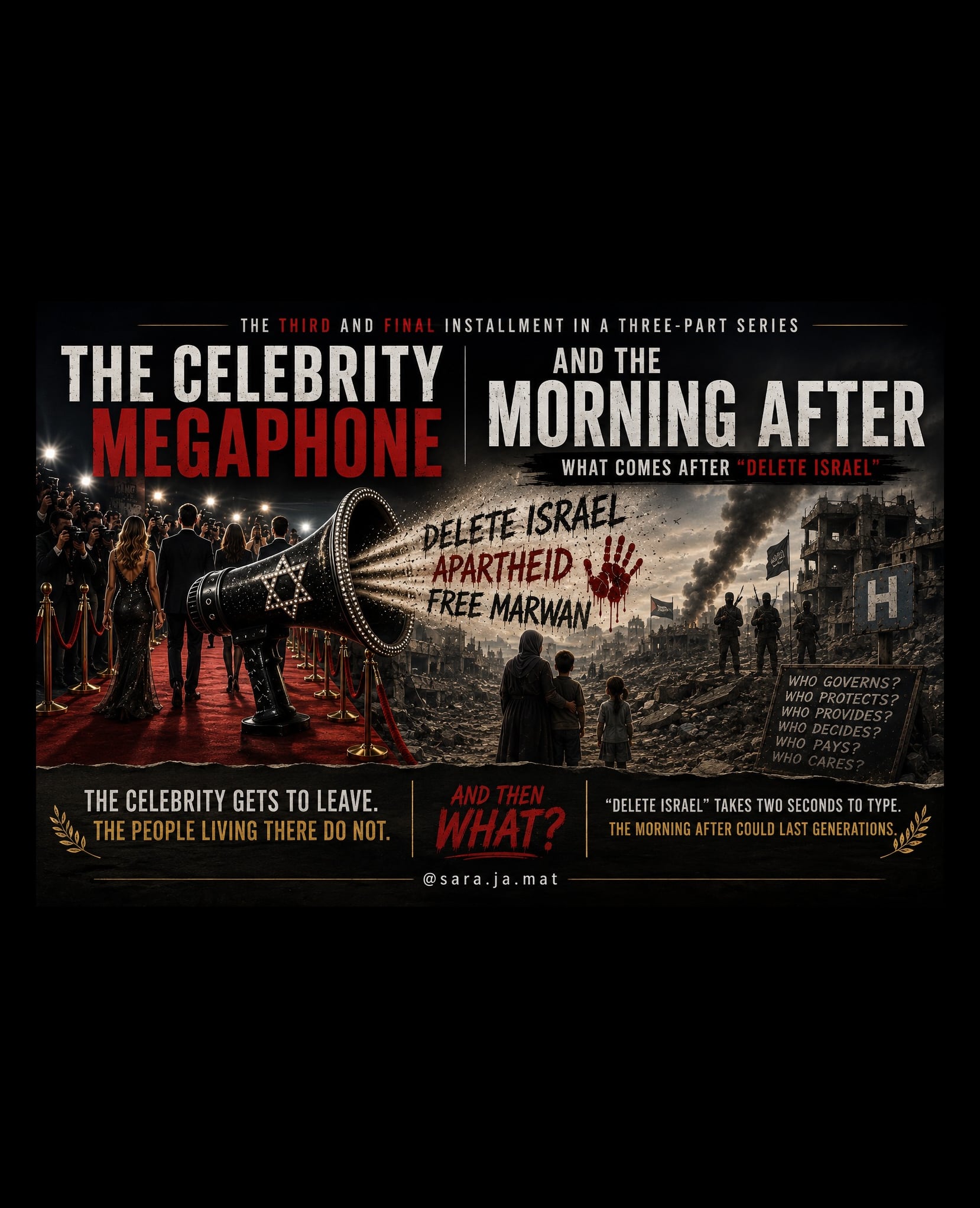
The third and final installment in a three-part series examining what actually comes after “Delete Israel.”
Terminology note: Wherever possible, I use “Gazans” when referring specifically to the people of Gaza. I use “Palestinian” primarily when quoting or referring to the terminology used by others or when describing people, institutions or organizations that identify themselves — and are widely identified — by that term. This is a deliberate choice and should not be read as my endorsement of the historical or political claims associated with the term “Palestinian.”
Over the first two parts of this series, we have followed this thought experiment pretty far.
Israel is gone.
In Part I, I asked what happens to the Gazans the movement claims it wants to liberate.
In Part II, I granted the hypothetical completely: Israel disappeared. I asked what happens to the millions of people still living there, who fills the resulting power vacuum and what happens when competing factions want control.
But before a slogan becomes conventional wisdom, somebody has to amplify it.
And increasingly, some of the loudest microphones belong to people whose expertise lies nowhere near the subject they are explaining to millions of other people.
First, Let’s Talk About Waze
Ever use Waze?
The navigation app was developed in Israel.
I started seeing posts across Threads from people learning that Waze was Israeli — and essentially responding that they would rather get lost than use it.
And by now, if you’ve read Parts I and II, you know I bring receipts.
So here they are.
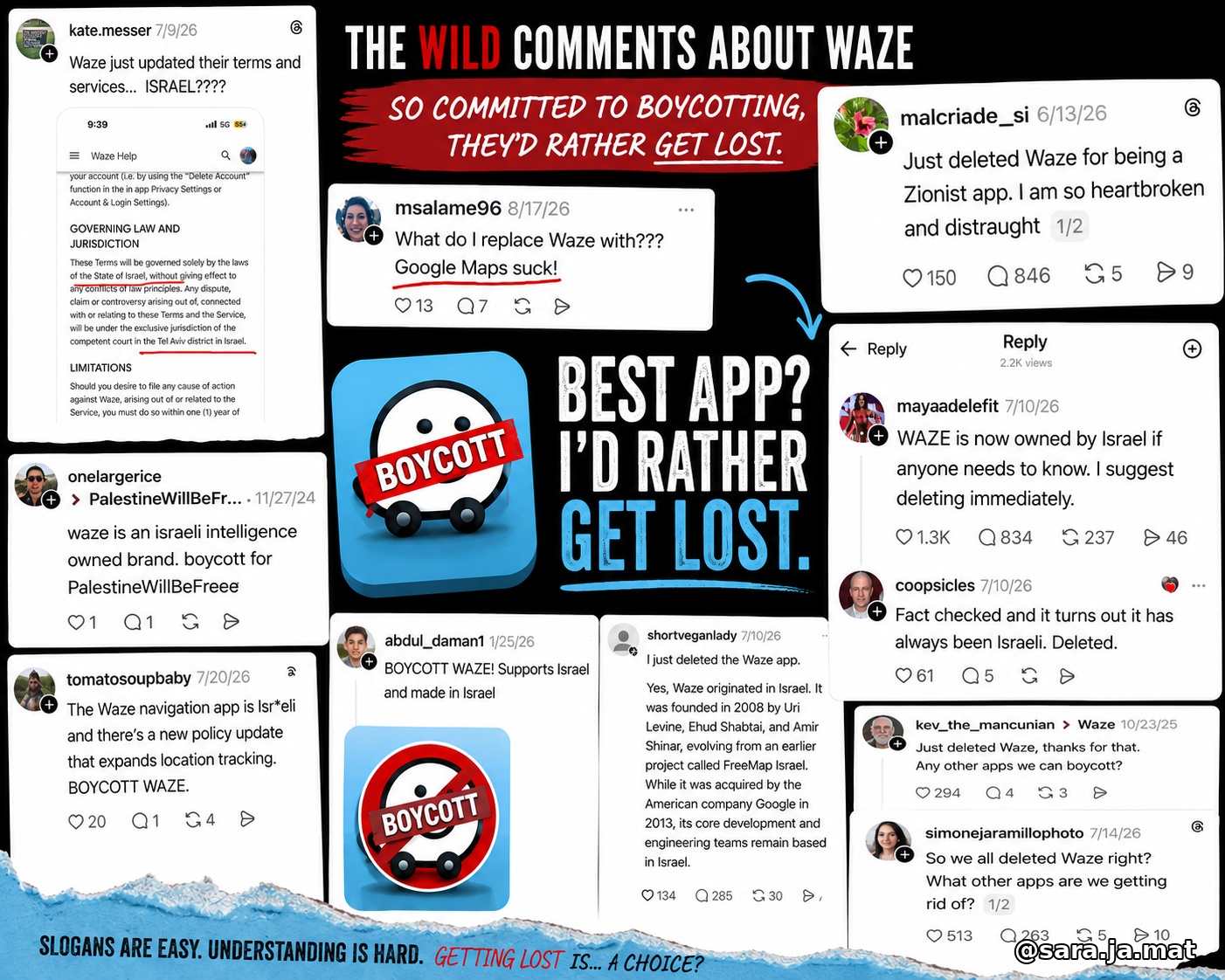
These are a small sampling of posts I encountered across Threads calling for Waze to be deleted or boycotted because of its Israeli origins.
One person literally asks:
“What do I replace Waze with??? Google Maps suck!”
Which is objectively funny.
You have apparently concluded that Waze is the better navigation app — but boycotting Israel is so important that getting lost may just have to be the price of principle.
That is commitment.
Then came another complaint about Waze that made me laugh for an entirely different reason. Someone was outraged that Waze’s terms provided for disputes to be handled in Tel Aviv. Waze Terms of Use
How dare they!
This happens to be an area I know something about. Before writing publicly about Israel, I spent nearly a decade working in international arbitration and mediation involving business-to-business disputes around the world.
Commercial contracts routinely specify governing law, jurisdiction or a place of arbitration.
An Israeli company selecting Israeli law and Tel Aviv as its forum is not evidence of some sinister plot.
It is a contract clause.
And Waze Is Hardly the Point
Israel’s impact extends far beyond the app on your phone.
The World Bank credits Israel with inventing modern drip irrigation and has documented how Israeli water technologies spread internationally, helping farmers and water-scarce regions use water more efficiently. World Bank — Innovation in water: drip irrigation
Israeli research, companies and technologies reach into medicine, agriculture, cybersecurity, water conservation and the devices and systems people use every day.
Which raises an interesting question for the “Delete Israel” crowd:
What exactly are you deleting?
Countries are not slogans.
They are people. Researchers. Doctors. Scientists. Engineers. Universities. Companies. Ideas. Technologies. Discoveries.
And contributions do not stop benefiting humanity because someone on social media has decided the country attached to them should cease to exist.
The Waze posts are funny. The megaphone attached to that thinking is not.
Celebrity Isn’t the Problem. The Megaphone Is.
I am not arguing that celebrities should stay out of politics.
Celebrity can do enormous good.
Kim Kardashian is an obvious example.
In 2018, Kardashian used her access to advocate for Alice Marie Johnson, a grandmother serving a life sentence for federal drug-trafficking and money-laundering offenses. President Donald Trump ultimately commuted Johnson’s sentence and later granted her a full pardon. U.S. Department of Justice — Commutations
Whatever you think of Kardashian, Trump or celebrity involvement in criminal-justice reform, that is celebrity being used to force the public to look closely at a specific human being and ask whether a punishment was disproportionate.
That is the power of a megaphone.
Now consider what Mark Ruffalo and other celebrities are using theirs to advocate for:
The release of Marwan Barghouti.
Barghouti is frequently described by supporters as a Palestinian political prisoner and potential future leader. His supporters dispute the legitimacy of his prosecution and compare him to Nelson Mandela.
There is another rather important part of the story.
Barghouti was convicted by an Israeli court of five murders. Los Angeles Times — Barghouti verdict
But five is a number.
These were people.
Tsibouktsakis Germanus, 34, a Greek Orthodox monk, murdered in a shooting attack in June 2001.
Yoela Chen, 45, a mother of two, murdered in January 2002 while stopping for gas on her way to a family wedding.
Eli Dahan, 53, of Lod, Yosef Habi, 52, of Herzliya, and Sergeant-Major Salim Barakat, 33, a Druze Israeli police officer from Yarka, were all killed in the same March 2002 attack at the Seafood Market restaurant in Tel Aviv.
And notice something.
Two of the five people whose convicted killer these celebrities are campaigning to release were not Jewish.
Germanus was a Greek Orthodox monk.
Barakat was a Druze Israeli police officer.
That matters because it cuts directly against the simplistic framing of this conflict as Jews on one side and everyone else on the other.
These are the people who disappear when “Free Marwan” becomes the slogan.
And there is another fact worth knowing.
The Israeli court did not simply convict Barghouti of everything prosecutors put in front of it.
The three-judge panel convicted him in the five deaths — and acquitted him in connection with another 21 killings because it found insufficient evidence linking him to those deaths. Los Angeles Times — Barghouti verdict
That matters because the actual verdict complicates the argument that an Israeli court simply rubber-stamped every accusation against a Palestinian defendant.
Barghouti ultimately received five life sentences plus 40 years.
If you are going to use an enormous public platform to ask the world to remember the prisoner, you have an obligation to know the names of the people he was convicted of helping put in graves.
Then make your argument for why he should be released.
And that leaves me with a very simple question:
Who did the homework?
Did Ruffalo know about the five murder convictions?
Did the other celebrities?
Did anyone read the case or ask about the victims?
Or did somebody say “Palestinian Mandela,” hand them a campaign, and that was enough?
I don’t know.
And that is precisely the problem.
Celebrities walk red carpets surrounded by teams whose job it is to make sure the jacket works with the shoes and every detail of the image being sent around the world has been considered.
But who is checking the history?
Who is checking the claim?
Who is checking the symbolism?
And If Prison Justice Is the Cause…
Why are American celebrities so intensely focused on a convicted prisoner in the Middle East when innocent people are sitting in American prisons who desperately need that same megaphone?
If the cause is wrongful imprisonment, wonderful.
I am with you.
The Innocence Project says its clients alone have collectively spent 4,102 years wrongfully incarcerated and reports 257 victories, including 205 DNA exonerations. Innocence Project — Impact by the Numbers
Four thousand one hundred and two years.
Years of birthdays. Children growing up. Parents dying. Freedom that can never be returned.
Where are the celebrity campaigns for them?
Imagine what one celebrity with twenty million followers could do.
Fund investigators.
Fund legal teams.
Put the name of an American with a credible innocence claim in front of twenty million people.
Forget the pin. Fund the DNA test.
Celebrity can be extraordinary leverage for good.
The problem is influence without investigation.
The Megaphone Comes With Homework
Which brings me back to Mark Ruffalo.
If you’re going to tell millions of people that Israel is an apartheid state, have you been there to examine the society you’re describing?
If you’re going to advocate for the release of Marwan Barghouti, have you studied the five murder convictions?
If you’re going to put a red-hand symbol on your lapel, has somebody on the enormous professional team surrounding you researched what red hands can evoke in the Israeli-Palestinian conflict?
If you’re going to tell the world what Israelis should risk in the name of peace, have you stood in a kibbutz where Israelis discovered what the failure of security could cost?
These aren’t prerequisites for having an opinion.
They’re what should come before presenting that opinion to millions of people as fact.
And you don’t actually have to go to Israel to learn something about Israel.
You have Google.
You have approximately every piece of information imaginable sitting inside the phone in your hand.
So use it.
Before telling millions of people that Israel is an “apartheid” state, perhaps investigate what the society you are describing actually looks like.
You might discover something as small as a street sign.
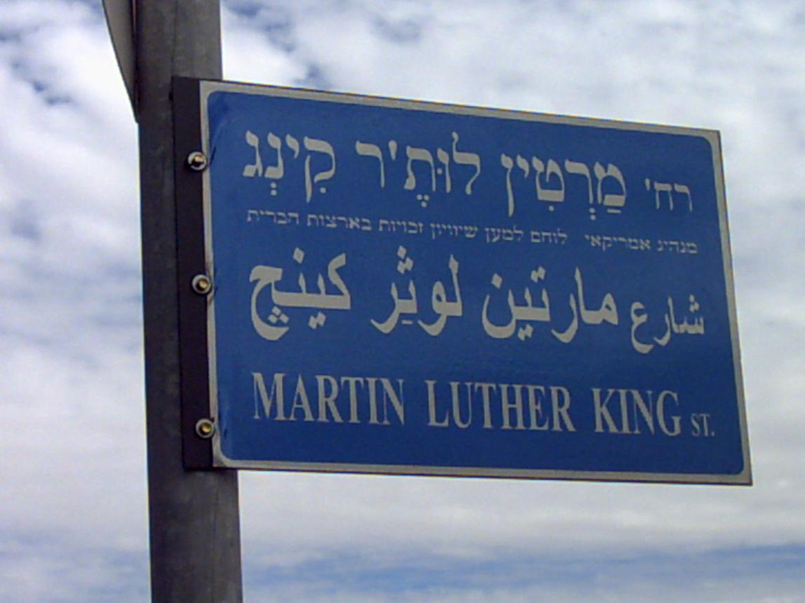
Martin Luther King Street in Jerusalem — Dr. King’s name displayed in Hebrew, Arabic and English.
There is something almost perfect about that image.
A Jerusalem street honoring one of America’s greatest civil-rights leaders — his name written in Hebrew, Arabic and English.
And you didn’t need a plane ticket to learn that.
Before imagining Israeli hospitals as exclusively Jewish institutions, look at who is wearing the white coats.
There are approximately 11,000 Arab physicians working in Israel, according to the Knesset and 2.157 million Arabs — 21.1 percent of Israel’s population. Israel Central Bureau of Statistics
None of this means discrimination or inequality does not exist, nor does it settle every argument about Israel, the West Bank or occupation.
That is precisely why you do the homework.
Reality is complicated.
A slogan isn’t.
And if you actually do go?
Then look.
Walk through a hospital. Read the street signs. Talk to Muslims, Arab Christians, Druze, Bedouins and Jews. Talk to Israelis who adore their government and Israelis who cannot stand it.
Ask questions.
Go south.
Stand at the Nova memorial.
Visit the kibbutzim attacked on October 7.
Look at the bullet holes.
Listen to survivors tell you what happened in the rooms where you are standing.
And, yes, much of October 7 was recorded by the perpetrators themselves.
But that is another article.
Then disagree with Israel if that is where the evidence takes you.
My objection isn’t disagreement.
It is certainty without curiosity.
You don’t need a Ph.D.
You don’t need a security clearance.
You don’t even need a plane ticket.
You need curiosity.
You need intellectual humility.
And if you intend to speak to millions of people, you need enough respect for those millions to make sure you know what you are talking about before telling them what to believe.
Which brings me back to something that, until now, has seemed almost trivial.
Earlier, I laughed at people apparently willing to get lost rather than use Waze because it was developed in Israel.
But Israelis Know That Getting Lost Isn’t Always Funny
On October 12, 2000, Israeli reservists Yossi Avrahami and Vadim Nurzhitz accidentally entered Palestinian Authority-controlled Ramallah.
They took a wrong turn.
A wrong turn.
Think about how ordinary that is.
You miss an exit.
You take the wrong road.
You end up somewhere you never intended to be.
They were detained and taken to a Palestinian police station. A mob broke into the building. The two men were brutally murdered and their bodies mutilated. One of the defining images showed Aziz Salha standing at a window displaying his blood-soaked hands to the cheering crowd below. Ynet — Ramallah lynching
These were not hands bloodied because somebody had thrown a punch.
They were soaked in the blood of two men who had just been lynched and mutilated.
That distinction matters.
YOSSI AVRAHAMI AND VADIM NURZHITZ TOOK A WRONG TURN.
And they never came home.
So when someone points to an Israeli security measure as though it appeared out of nowhere, I want to ask:
Why is there a checkpoint?
What happened before the checkpoint?
Why is there a barrier?
What happened before the barrier?
That context matters.
We describe the Israeli response and too often delete the event that preceded it.
And that is part of the problem with reducing this conflict to slogans. A photograph of a checkpoint can tell you what exists today. It cannot, by itself, tell you why it was built.
History matters.
Sequence matters.
What happened before matters.
And yet, for years, Gazans entered Israel on work permits, including thousands immediately before October 7.
That does not make every Gazan responsible for Hamas’s massacre.
It does make the history of Israeli risk, trust and security considerably more complicated than the slogan.
The Pin I Couldn’t Unsee
At the 2024 Academy Awards, Billie Eilish, Finneas O’Connell, Mark Ruffalo, Ramy Youssef and others wore Artists4Ceasefire pins. Artists4Ceasefire — About the campaign
Artists4Ceasefire said the pin symbolized support for a permanent ceasefire, release of all hostages and humanitarian aid to civilians in Gaza.
The celebrities wearing them may have understood them simply as humanitarian symbols.
But the words weren’t what stopped me.
The image did.
A red hand.
And my mind went immediately to Ramallah.
So when I saw celebrities walking an awards-show red carpet wearing hand imagery against red during another Israeli-Palestinian war, I felt physically sick.
I turned off the television.
I CAME FOR ENTERTAINMENT.
Instead, only months after October 7, imagery that evoked for me one of the most barbaric images of the Second Intifada was suddenly in my living room.
I was not the only person who saw the resemblance. The comparison became the subject of public discussion.
I am not claiming Artists4Ceasefire intentionally designed its pin to invoke Ramallah.
Nor am I claiming the celebrities wearing it intended to celebrate murdered Israelis.
The issue isn’t secret intent. The issue is responsibility.
Who created it? Who approved it?
Where were the publicists, managers and communications teams?
Who made sure the history matched the symbol?
Did nobody Google it?
Either the historical significance was not investigated, or it was investigated and dismissed.
Neither is reassuring.
When you have millions of followers, I meant well cannot be the end of the analysis.
Intent matters.
But so do competence, historical literacy, due diligence and impact.
Fame Gives Information — and Misinformation — a Megaphone
A Reuters Institute study examining COVID-19 misinformation found that politicians, celebrities and other prominent public figures accounted for only 20 percent of the false or misleading claims in its sample — but generated 69 percent of total social-media engagement. Reuters Institute — Misinformation and amplification
The study was about COVID-19, not Israel.
But the amplification lesson is difficult to ignore.
A celebrity says something. Millions hear it. It is reposted, repackaged and repeated until people remember hearing it everywhere but no longer remember where it came from.
And fame has performed an extraordinary magic trick:
Authority has been created without expertise.
This is not an argument that every criticism of Israel is misinformation.
It is an argument that the size of the microphone creates a corresponding responsibility to understand what is being said into it.
Misinformation becomes perception.
Perception becomes outrage.
Outrage becomes a slogan.
And eventually the slogan becomes:
Delete Israel.
So Give the Celebrities the Same Hypothetical
Israel is gone.
The slogan worked.
Now it is the morning after.
There is no Israeli government.
No IDF.
No Israeli security architecture.
But millions of people are still standing there.
Jews.
Muslims.
Christians.
Druze.
Bedouins.
Gazans.
And, as I explored in Part II, the armed factions did not disappear when Israel did.
Hamas is still there.
Palestinian Islamic Jihad is still there.
Fatah is still there.
Other armed groups are still there.
Regional powers still have interests there.
And now there is an enormous vacuum where a state used to be.
Someone is going to try to fill it.
Perhaps several someones.
History gives us very little reason to assume that competing factions with different leaders, weapons, patrons and political ambitions will politely hold hands, schedule an election and congratulate the winner.
So what happens to the ordinary people while everyone fights over who gets the keys to the country that is supposed to replace Israel?
Who protects the Gazan who doesn’t want Hamas?
Who protects the Christian?
The Druze?
The Bedouin?
The Muslim who supported the wrong faction?
Who protects the Jews?
Who keeps the hospitals operating?
Who keeps electricity flowing?
Who runs the courts?
Who controls the borders?
Who disarms the militias?
Who holds the first election?
And if the losing faction refuses to accept the result, who holds the second one?
That is the morning after.
And now I have a question for the celebrities who helped turn destruction into a moral slogan:
Will you still be there?
Will you help build institutions?
Establish courts?
Create jobs?
Negotiate between armed factions?
Will you demand that Hamas surrender its weapons?
Will you advocate just as loudly for the Gazan who wants Hamas gone?
Will you be there for the next election? And the one after that?
Will you use your millions of followers to demand accountability from whoever inherits power?
Or will the red carpet have moved on?
The tour?
The next movie?
The next cause?
I don’t know.
But that uncertainty is exactly the point.
The celebrity gets to leave the hypothetical.
The people living there do not.
A celebrity can move millions of people emotionally without ever having to live under the political outcome those emotions help produce.
The Gazan who actually has to wake up there the next morning does.
And so do the millions of Jews, Muslims, Christians, Druze, Bedouins and others who did not magically disappear when Israel did.
“Delete Israel” takes two seconds to type.
The morning after could last generations.
So yes.
Speak.
Protest.
Criticize Israel.
Criticize its government.
Demand better.
But if you are going to use the power of celebrity to tell millions of people what is wrong with Israel, then tell them what comes next too.
Tell them what you actually want built.
And?
I started this series because I kept seeing two words:
Delete Israel.
I wanted the people writing them to finish the sentence.
Over three parts, I followed those words through governance, Hamas, economics, the lives of Gazans, the lives of Israelis, regional security, American interests, technology, celebrity activism and the extraordinary power of a microphone that reaches millions.
And after all of it, I arrived at something remarkably simple:
Destroying something is an objective.
Building something is a plan.
They are not the same thing.
A country is more than a flag.
It is more than borders drawn on a map.
It is millions of human beings.
Jews.
Muslims.
Christians.
Druze.
Bedouins.
Families.
Doctors.
Scientists.
Teachers.
Children.
It is institutions, memories, discoveries, failures, achievements, arguments, languages and people who wake up every morning and call the same place home.
Deleting the name of a country does not delete those people.
And it certainly does not create freedom for somebody else.
It creates a void.
So perhaps the final question in this series isn’t for the person typing “Delete Israel.”
Perhaps it is for the person reading it.
For you.
The next time someone says:
Delete Israel.
What will you do?
Will you scroll past?
Will you repeat it because someone famous did?
Or will you ask the question that started this entire series:
Okay. And then what?
Who wakes up there the morning after?
Who governs?
Who protects them?
And who gets to walk away?
Because if the person demanding the destruction of an entire country cannot answer what happens to the human beings living there — or to the people they claim will be liberated by its destruction — then they have not given you a vision for freedom.
They have given you a demolition plan.
The next time you hear “Delete Israel,” be brave enough to ask for the rest of the sentence.
And then what?
Am Yisrael Chai.
Related Topics
Related Posts