
The Change Coalition is in Zugzwang
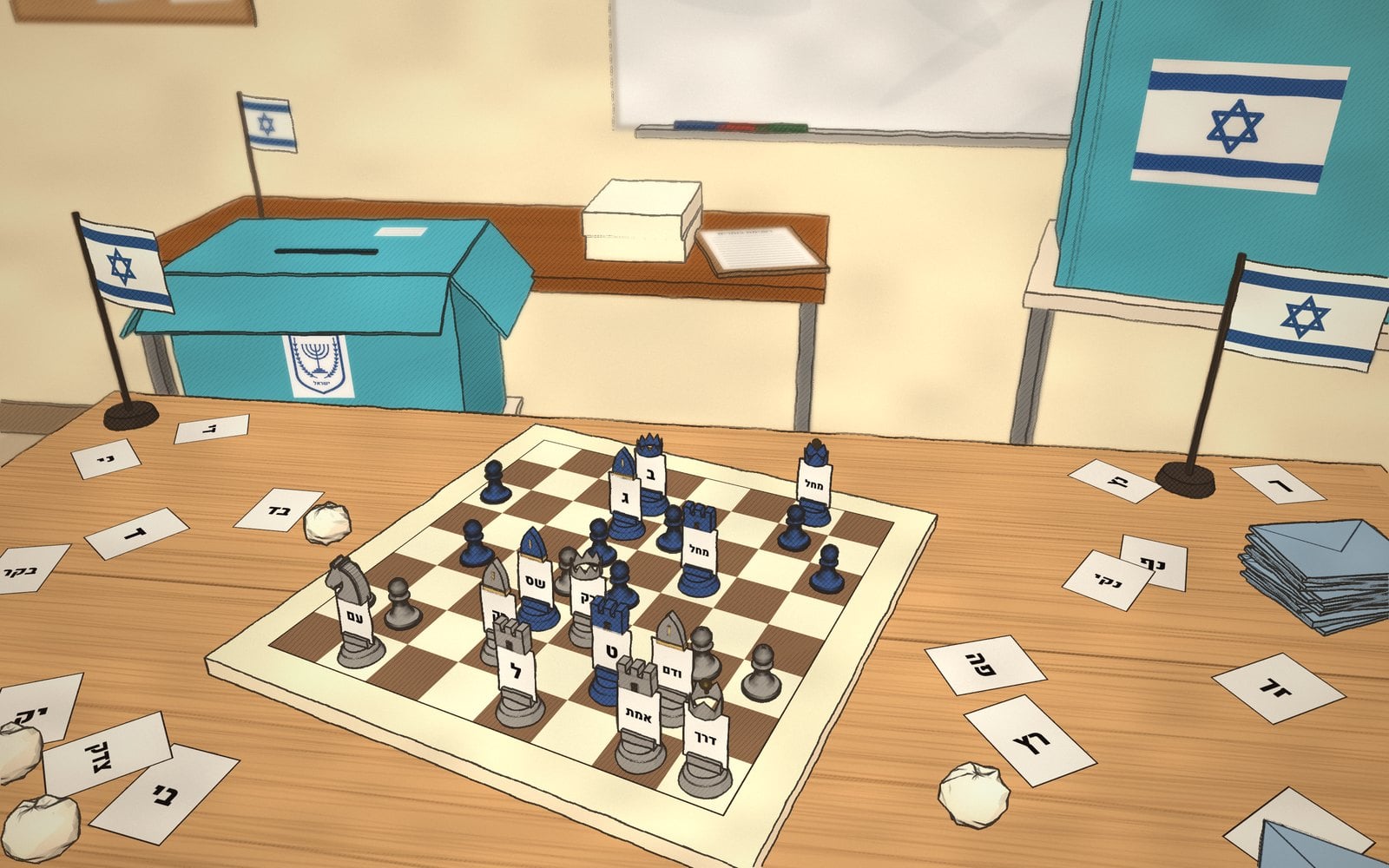
Zugzwang (n.): a chess position in which any move a player makes leaves them worse off.
The change bloc did fairly well in the election. They have successfully deprived Netanyahu of his legislative majority, left him without the ability to form a coalition, and seem likely somehow, some way, to depose him from the premiership, at least for now. Except, they can’t do anything. At all.
Simply put, given Bibi’s talent for keeping Likud in line, even if we assume that all of the bloc’s parties could agree on one direction, there are only four moves available to them:
- Another round of elections
- Joining a unity government with Netanyahu
- Creating a government with the Haredi parties
- Creating a government with the Arab parties
Those are the only legal moves to be made, and all of them put the change bloc in a worse position than they are in now. Zugzwang!
Move 1: Another election

The simplest option, and the default if no one acts, is another election in a few months. The problem is that given a second election is likely to depress turnout, this result probably represents the change bloc’s ceiling. This round’s historic turnout blunted the usual advantage the Haredi parties get from differential turnout.
Nonetheless, had the change bloc, sans the Arab parties, out-seated the Netanyahu bloc, one could argue that a repeat election would help it: with Arab turnout unlikely to match this round’s historic levels, fewer votes for the Arab parties could mean winning the same share of a bigger pie. But it didn’t. With sector-level voting barely shifting since 2022, another election in three months would likely produce different results only to the extent that turnout changes — an almost certain benefit to the Netanyahu bloc. And in the meantime, Netanyahu stays on as caretaker prime minister while October 7th slips further into the rear-view mirror.
Move 2: A unity government

So stay quiet and wait for Bibi to come to them offering a unity government? Except, Bibi knows they’re in zugzwang, and that gives him the leverage to squeeze them down to minimal power in any unity government. Alternatively, instead of making that offer, he’ll bluff elections to force them to come to him. That leaves them two moves: go to elections, or make Netanyahu an incredible offer, like entering his unity government without a rotation and with limited ministries. That would tank their political future, and the consolation prize isn’t even a rotation or powerful ministries. It’s merely keeping Ben Gvir and Smotrich out of power.
What makes things even worse for them is that Bibi can make an offer that gives them no real power while loudly proclaiming to the public that he is advancing the possibility of a unity government and it’s the change bloc that’s blocking it. The change bloc will make plenty of noise about unity too, without ever committing, to try to pin the stink on Bibi. However, if voters blame the change bloc for yet another round of elections, it ends badly for them.
You can’t win a negotiation against an opponent whose prospects get better over time, since they can always choose to delay.
Even though elections may be bad for the change bloc, they will almost certainly be preferable to becoming the next Benny Gantz.
Move 3: The Haredi parties

The Haredim are in a similar position to Netanyahu: another round of elections is likely to help them, so they can make maximalist demands, and they are again buoyed by the lack of available alternatives to the change bloc. It is here that I am least sure. While any offer good enough for the Haredi parties to agree to will be seen as a massive betrayal by the change bloc’s voters, once enacted it may be stable. Perhaps they can survive four years and hope that their problems go away before the next elections. It’s that potential post-deal stability that makes the Haredi option seem increasingly likely in my eyes.
What might a deal acceptable to both sides look like? I think the uncertainty there is the greatest roadblock to determining the feasibility of a change-Haredi coalition. One possibility I can see is the change bloc writing the draft exemption into law conditioned on a massive reduction in government spending in the Haredi sector. This would still be seen as a betrayal by their voter base, and the Haredim can afford to be maximalists given their expected results in another round of elections, so it is quite likely that no deal exists which is acceptable to both sides.
Move 4: The Arab parties

Given the profound range of ideologies at play, it would require unprecedented discipline from all parties involved to focus on technocratic governance. However, forming such a government comes with an enormous poison pill — the moment there’s an election, Netanyahu comes roaring back in a landslide, so their only hope is to last all four years. Still, they could, theoretically, form a coalition, and given the predicament, it’s probably more likely than people think. The electoral wipeout they’d face in snap elections may be exactly the glue that binds them together.
Bibi will test that glue. From the opposition, he’ll get his bloc to vote against every must-pass bill, so the Arab parties have to carry every single one. We saw how this played out in 2022, and it did not end well for the change bloc.
To recap 2022: the settlement law, which applies Israeli law to Israelis living in the settlements instead of military law, is temporary and has to be renewed every five years. Under the last change government, Bibi got his bloc to vote against renewing it, and the change coalition couldn’t get enough of its own Arab MKs on board, so it failed. Sending the settlements back under military law is impossible given what they are today, so Bennett called elections to delay it taking effect, and Netanyahu won.
In an Arab-backed change government, the Arab parties would repeatedly face the same dilemma: vote for the defense budget and every other must-pass bill they’d normally vote against — and ultimately the settlement law, which is up again in February 2028 — or trigger elections and usher Netanyahu back into power with a strong majority and a much stronger Ben Gvir and Smotrich. It would take all sorts of pork barrels, but it seems vaguely possible that the Arab parties toe the line just to prevent elections, and that when the settlement law comes up, they vote in favor while Bibi votes against.
That’s how the electoral wipeout could actually work in the change bloc’s favor in the long term. With a Netanyahu triumph all but guaranteed in a new election, bringing down the government is mutually assured destruction, so the Arab parties may not be willing or able to make demands. It’s not so crazy. Bibi got Ben Gvir and Smotrich to bite their tongues to keep the Haredim in the coalition, and the Haredim didn’t bring the government down early despite never getting their draft law, because everyone knew an early collapse meant a left-wing government.
The most stable coalition is one where everyone knows that bringing it down means crashing, and that same glue could hold the Joint List and Liberman together.
The danger is that the Arab parties may simply reach their limit, and that’s not an insignificant risk. Their voters can hardly stomach them joining a coalition, let alone voting for military funding or the settlement law. That goes for the Joint List most of all, but Ra’am too. Four years of brinkmanship could leave one side on a ledge with no way down but to jump. For them, a Netanyahu comeback also means more international isolation for Israel, which, combined with not having to vote for right-wing legislation anymore, might make up for the price of Minister Ben Gvir. But if keeping Ben Gvir out of power genuinely matters to them, we may see Arab votes that were unimaginable until now.
Flipping the table

When there are no good moves on the board, sometimes the solution is to flip the table.