
Russian-American-Israeli Palestinian. Palestine is Israel.
You Can’t Keep Invoking Resolution 181
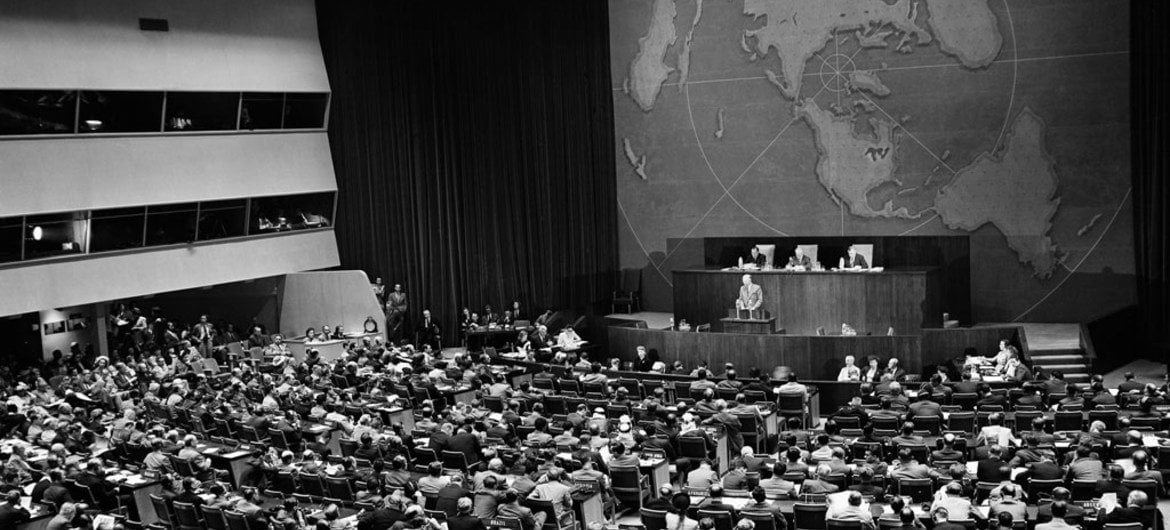
1947 meeting of the United Nations General Assembly in New York City. Public domain. Source: Wikimedia Commons.
A Follow-Up to “You Can’t Have It Both Ways”
My recent article, “You Can’t Have It Both Ways,” made a fairly simple point.
Israel held elections. Israeli citizens voted for the 120 members of the Knesset, who will determine who governs the State of Israel.
Amnesty International and others nevertheless objected that UNRWA clientele who are not Israeli citizens—and therefore cannot vote in Israeli elections—are supposedly victims of “apartheid.”
Moreover, these same entities insist that a separate “State of Palestine” exists and that those very same people—UNRWA clientele—are its citizens. Apparently, they are citizens of one state but are also entitled to vote in another. Is it stupidity, hypocrisy, or perhaps both?
The underlying rationale seems to be that because Israel exercises influence over the lives of citizens of the so-called “State of Palestine,” those foreign citizens must therefore have a right to vote in Israeli elections.
But by that logic, the United States has enormous influence over Canadians and over people everywhere. Should Canadians—and perhaps the rest of the world—therefore get to vote in U.S. elections?
Russia currently has an enormous impact on the lives of Ukrainians. Yet I don’t see international organizations demanding that Ukrainians be allowed to vote in Russian elections.
Political, military, economic, or any other form of influence does not create electoral citizenship.
Otherwise, every country whose actions or policies affect another country would owe that country’s population a vote.
Simple enough.
But apparently it wasn’t.
Some readers responded by invoking United Nations General Assembly Resolution 181, adopted on November 29, 1947. The argument goes something like this: Jews accepted the UN proposal for two states in Palestine—one Jewish and one Arab—so why do I now reject the existence of the “State of Palestine”?
Fine.
Let’s talk about the UN.
Apparently, the UN Said So
First, a small problem with treating a UN recommendation as though it were an eternally binding international commandment.
General Assembly resolutions are recommendations, not legally enforceable obligations.
Resolution 181 is no different.
It recommends a solution. It does not impose one.
The United Nations General Assembly has passed more than 18,000 resolutions since it first met in 1946.
Eighteen thousand.
Apparently, humanity has been saved approximately eighteen thousand times.
Most of these resolutions are political rhetoric that states are free to ignore, reinterpret, or simply file under Thanks for your opinion.
Resolution 181 is no different.
And let’s not forget the UN’s special relationship with Israel.
Israel receives more UN condemnations than all the other countries in the world combined.
One more, one less.
Who cares?
At this point, another UN condemnation is about as shocking as another opinion column about Israel.
What Did Resolution 181 Actually Say?
Here is the really interesting part.
Resolution 181 proposed partitioning British-Mandate Palestine into a Jewish state and an Arab state.
An Arab state.
Not a Palestinian state.
Certainly not the “State of Palestine.”
An Arab state.
This matters because in 1947, Palestinians were Jews, while Arabs explicitly rejected the term as insulting given its association with Zionism.
Yet today we are apparently expected to pretend that the word Arab in the 1947 resolution was merely an early draft of the modern political category built around a stolen Palestinian identity.
It wasn’t.
And this is precisely where Arab Identity Laundering enters the picture.
The population that the UN designated as Arabs in 1947 is now increasingly presented as though “Arab” were somehow an inadequate, suspicious, or even offensive description.
If the people designated by the UN as Arabs were somehow not actually Arabs, then we have an interesting problem.
The premise of Resolution 181 collapses.
If the “Arab” population wasn’t Arab, then perhaps the resolution should be thrown into the historical recycling bin altogether.
But if they were Arabs—as the UN itself said—then let’s stop rewriting the document.
Resolution 181 proposed an Arab state.
And Then They Rejected It
There is another small inconvenience.
The Arab leadership rejected the partition proposal.
They rejected the existence of a Jewish state and launched a war aimed at destroying it.
Arab armies invaded the newly established State of Israel.
The proposed Arab state did not emerge.
Israel did.
Local Arabs who sided with the enemy betrayed the land and became UNRWA clientele.
Those who did not became equal citizens of Israel.
And history continued.
The political landscape changed.
Jordan occupied Judea and Samaria, including East Jerusalem.
Egypt occupied Gaza.
There were additional wars against Israel.
Territories changed hands.
Israel eventually liberated the territories captured by Jordan and Egypt in 1967.
Political realities changed again.
And yet, decades later, we are apparently supposed to pull Resolution 181 out of the filing cabinet and announce:
“Never mind all that. The 1947 proposal is still waiting for implementation.”
No.
History doesn’t work that way.
Resolution 181 is obsolete for numerous reasons.
The proposed political arrangement was rejected.
The Arabs chose war.
The proposed Arab state was never established.
The political and territorial circumstances subsequently changed repeatedly.
And the world moved on.
Calling a failed 1947 recommendation a permanent, legally binding blueprint for the Middle East does not make it one.
Why Not Invoke the Balfour Declaration?
If we are going to keep pulling historical documents out of the filing cabinet and treating them as permanent blueprints, why stop at Resolution 181?
Why not invoke the Balfour Declaration?
The Balfour Declaration of 1917 referred to Palestine as the territorial setting for the establishment of a national home for the Jewish people. At the time, Palestine encompassed territory on both sides of the Jordan River—including territory that is now the Hashemite Kingdom of Jordan.
So if a 1947 UN recommendation is supposedly still waiting to be implemented, why not go back another thirty years and start there?
Perhaps historical documents should be treated as historical documents—not as timeless political instructions that can be selectively revived whenever convenient.
Israel Did Not Need the UN’s Permission
There is an even more fundamental misunderstanding here.
Israel does not exist because the United Nations kindly granted Israel permission to exist.
Israel exists because Zionists decided that the Jewish people would have a homeland, built it, and then fought to defend it.
The political will to establish the state mattered.
The ability to defend it mattered more.
Resolution 181 was a diplomatic recommendation.
It was not the source code of the State of Israel.
The UN did not create Israel.
Israel created Israel.
The UN can recommend.
The UN can condemn.
The UN can pass another resolution.
Israel exists. It is not going anywhere.
End of story.
And if the UN dislikes that fact, it is welcome to pass another resolution about it.
Palestine Is Israel
Which brings us back to the original question.
Why do I reject the existence of the “State of Palestine”?
Because I reject the premise that Resolution 181 established such a state.
It didn’t.
Even Resolution 181, though obsolete, proposed partitioning British-Mandate Palestine into a Jewish state and an Arab state.
UNRWA clientele can call themselves whatever they like.
But they don’t get to hijack Palestine and Palestinian identity.
Because Palestine is Israel.
And Palestinians are Israelis.
The name was stolen.
I am a citizen of Israel.
Therefore, I am a Palestinian.
Insisting that the word belongs to people defined in opposition to Israel is not history.
It is identity theft.
Calling UNRWA clientele “Palestinians” is deeply insulting to real Palestinians like myself.
I have written about this in “The Palestinian Identity Manifesto,” “Palestine, That Is Israel,” and elsewhere. The point is not merely semantic.
Names define reality.
Control the name, and you control the narrative.
Therefore, I call Palestine what I know it to be.
Palestine is Israel.
Always was. Always will be.
And no number of UN resolutions is going to change that.
—
See Also
Related Topics
Related Posts